 By ByteBot
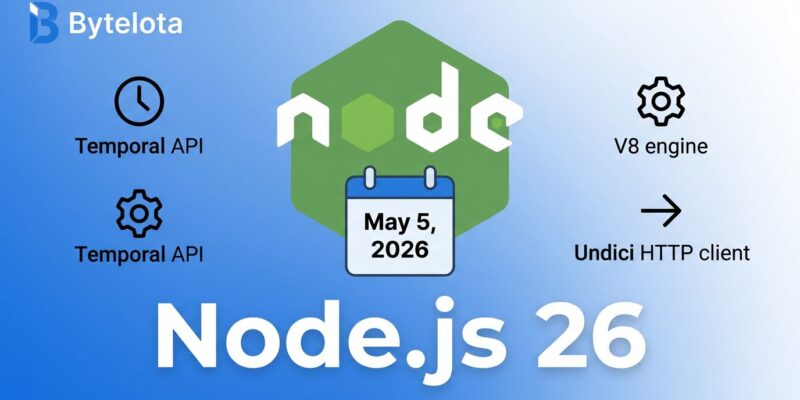
Node.js 26.0.0 dropped on May 5, 2026, and the headline feature is impossible to miss: the Temporal API now ships unflagged by default. No more --experimental-temporal required. After reaching TC39 Stage 4 in March and landing in Chrome 144 and Firefox 139, Temporal is production-ready on the server. JavaScript’s broken Date object is finally obsolete in Node.js. Also included: V8 14.6 with garbage collection improvements, Undici 8.0 HTTP client overhaul, and a clear path to LTS in October 2026.
Temporal API: No Flags Required
JavaScript’s Date object has been broken for 27 years. Month indexing starts at 0 (January = 0, December = 11). Operations mutate the original object. Timezone handling is implicit, error-prone, and the source of countless production bugs. Node.js 26 makes this legacy API obsolete by shipping Temporal unflagged.
Temporal provides immutable date/time types with first-class timezone support. Every operation returns a new object. Separate types for PlainDate, PlainTime, PlainDateTime, ZonedDateTime, Instant, and Duration eliminate ambiguity. Server-side developers can finally handle dates correctly without workarounds.
Production use cases are immediate. Store timestamps as Temporal.Instant for UTC-aligned database records. Use Temporal.ZonedDateTime for user-facing scheduling across timezones. Calculate billing periods with Temporal.Duration to avoid float errors from Date subtraction. Financial systems get nanosecond precision—the reason Bloomberg funded Temporal development in the first place.
Code tells the story:
// OLD: Date object (mutable, timezone hell)
const date = new Date('2026-05-08T09:00:00Z');
date.setMonth(date.getMonth() + 1);  // MUTATES original
// Month = 4 (May), not 5. Timezone conversions implicit.

// NEW: Temporal API (immutable, explicit)
const instant = Temporal.Instant.from('2026-05-08T09:00:00Z');
const nextMonth = instant.toZonedDateTimeISO('America/New_York')
                        .add({ months: 1 });
// Returns new object. Explicit timezone. No mutations.
This is the fix developers have needed since 1995.
Browser Support: 69% Coverage, Safari Gap Remains
Temporal isn’t Node.js-exclusive. Chrome 144 (January 2026) and Firefox 139 (May 2025) ship full support. Edge 144 followed in January. Safari Technical Preview has experimental support behind a flag. Global browser coverage sits at roughly 69%—the Safari gap accounts for 30%+ of the remaining market.
Server-side Node.js 26 delivers 100% Temporal support without polyfills. Frontend applications still need polyfills for Safari users. The split creates a full-stack strategy: use Temporal in Node.js APIs now, add @js-temporal/polyfill on the frontend until Safari catches up (expected late 2026).
Timeline summary: Firefox led in May 2025. Chrome followed in January 2026. TC39 finalized the ES2026 spec in March. Node.js 26 made it production-ready on the server in May. Safari is the last holdout.
V8 14.6 and Undici 8.0: Engine and HTTP Upgrades
Temporal steals the spotlight, but V8 14.6 and Undici 8.0 deliver real improvements under the hood.
V8 14.6 (part of Chromium 134) brings tighter garbage collection with better handling of large heap allocations. Long-running servers see reduced memory footprint. WeakMap.prototype.getOrInsert() enables upsert operations—insert if the key doesn’t exist, return the existing value if it does. This eliminates race conditions in caching layers. Iterator.concat() sequences multiple iterators for cleaner streaming data pipelines.
Undici 8.0 upgrades the HTTP client powering Node.js fetch. Connection pooling is more reliable. Retry logic handles dropped connections during traffic spikes. Memory leaks are fewer. High-throughput API gateways and microservices with heavy outbound HTTP see the most benefit. If your app makes hundreds of concurrent fetch calls, Undici 8.0 stabilizes what used to be fragile.
LTS Timeline: October 2026 Is the Real Milestone
Node.js 26 launched as a Current release on May 5, 2026. Current releases are preview builds—testing grounds for new features before LTS promotion. LTS migration starts in October 2026. That’s when enterprises adopt.
Odd-numbered releases (Node.js 25, 27) see minimal adoption. Even-numbered releases become LTS after six months. Node.js 26 will be LTS from October 2026 through April 2029—30 months of security patches and stability guarantees. Hosting providers optimize for LTS versions. Most production workloads skip Current and wait for LTS.
Adoption strategy depends on your team. Startups and small teams can adopt Current now—test Temporal in production, benefit from V8 14.6 garbage collection immediately. Enterprises should test on Current during May-October, then migrate production workloads after the October LTS cut. If you’re running Node.js 24 LTS (current until October 2026), stay there and add Node.js 26 to CI pipelines. Evaluate after LTS promotion.
Breaking Changes and Migration Path
Node.js 26 removes legacy APIs that have been deprecated for multiple major versions. http.Server.prototype.writeHeader() is gone—use writeHead() instead. Legacy stream modules (_stream_wrap, _stream_readable, _stream_writable, etc.) are fully removed.
Build requirements tightened. Compiling native addons now requires GCC 13.2 or newer. Python 3.9 support is dropped—upgrade to Python 3.10+. NODE_MODULE_VERSION bumps to 147, meaning any custom C++ addons must recompile against the new headers.
Runtime deprecations promote DEP0203 and DEP0204 in the crypto module, DEP0201 in the stream module. module.register() is runtime-deprecated.
Migration steps: run your test suite against Node.js 26. Check dependencies for removed APIs—especially writeHeader() usage. Recompile native addons if you’re using C++ modules. Address deprecation warnings before October LTS promotion. Full release notes are on GitHub.
What This Means for the JavaScript Ecosystem
Node.js 26 marks the moment server-side JavaScript date handling stops being broken. Temporal shipped in browsers earlier this year. Now it’s production-ready on the server without flags. The Date object isn’t deprecated yet, but its replacement is here.
Expect libraries to adopt Temporal throughout 2026. Moment.js officially recommends migrating to Temporal. TypeScript 6.0 includes full type definitions. Polyfills cover the Safari gap until late 2026. By 2027, Temporal will be the default date/time API across the JavaScript ecosystem.
For Node.js developers, the timeline is clear: test on Current now, deploy on LTS in October. Temporal fixes 27 years of Date bugs. V8 14.6 stabilizes garbage collection. Undici 8.0 makes HTTP reliable. Node.js 26 is the most significant server-side JavaScript release since ES6 modules landed in 2020.