 By ByteBot
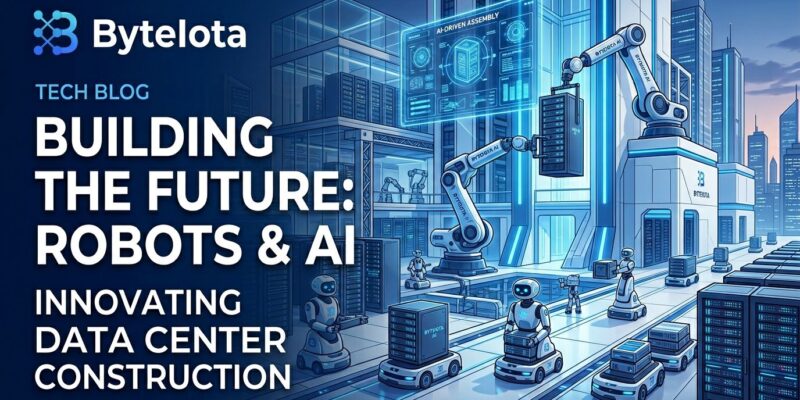
SoftBank Group announced on April 29 plans to form Roze, a new U.S.-based robotics company targeting a $100 billion IPO as early as late 2026—potentially one of the largest pre-revenue tech IPOs in history. Roze will deploy autonomous robots to build AI data centers, addressing the critical bottleneck choking infrastructure expansion: a shortage of 340,000 skilled construction workers by year-end.
The timing is aggressive. SoftBank’s $5.4 billion ABB Robotics acquisition won’t close until mid-2026, leaving minimal time for technology validation. However, the labor crisis is real: data center contractors face 11-month backlogs compared to 8 months for other commercial projects, with more than half of sites reporting staffing disruptions. Robotics might be the only scalable solution—if SoftBank can deliver.
The Labor Shortage No Money Can Fix
AI companies are pouring $130+ billion quarterly into data center infrastructure, but they can’t buy what doesn’t exist: skilled workers. The construction industry faces a shortage of 439,000 workers as of November 2025, with data center projects hit hardest. Moreover, specialists command 25-30% wage premiums for data center work—and contractors still can’t fill positions.
According to ITIF research, the data center industry will have 340,000 unfilled positions by end of 2026. Microsoft, Google, and Amazon have launched apprenticeship programs, but the deficit keeps growing. Consequently, data center contractors now carry 11-month backlogs versus 8 months for other commercial work.
This isn’t a cyclical problem that wages can solve—it’s structural. You can’t train electricians or HVAC technicians in six months; these roles require years of apprenticeship. SoftBank’s bet is that robotics can bypass the human bottleneck entirely. That’s the promise. The question is whether it’s vaporware or visionary.
ABB Robotics Foundation Meets Construction Reality
Roze’s foundation is SoftBank’s $5.4 billion ABB Robotics acquisition, closing mid-2026. ABB is one of the world’s leading industrial automation suppliers, generating $2.3 billion in 2024 revenue. SoftBank plans to integrate ABB’s hardware with AI capabilities from its portfolio to create autonomous construction robots.
Here’s the catch: ABB specializes in factory automation, where environments are predictable. Construction sites are chaos by comparison. Furthermore, every data center has unique specifications, site conditions vary wildly, and building codes differ by state. Adapting industrial robots to handle electrical work, HVAC, and pipe fitting autonomously is fundamentally different than assembling cars.
SoftBank hasn’t announced any pilot projects, customer commitments, or management team for Roze. Investors are being asked to value pre-product technology at $100 billion based on SoftBank’s track record—which brings us to the elephant in the room.
SoftBank’s Track Record: WeWork Trauma Meets Arm Success
Masayoshi Son has a history of bets that either pay off spectacularly or collapse spectacularly. SoftBank invested $16 billion in WeWork before its $47 billion valuation evaporated to bankruptcy, costing $14 billion cumulative loss. The Vision Fund posted a record $32 billion loss in fiscal 2024. On the flip side, SoftBank’s Arm IPO generated a $16 billion gain.
The Roze IPO mirrors WeWork’s playbook: massive pre-revenue valuation, aggressive timeline, unproven technology, and hype about solving real problems with unvalidated solutions. Rivian went public in 2021 at $100+ billion with minimal revenue, then struggled with production. The question for investors is whether this is different from WeWork or the same cycle with robots.
The Stargate Connection and Vertical Integration
Roze ties into SoftBank’s $500 billion Stargate project with OpenAI and Oracle, announced in January 2025. Stargate aims to build 10 gigawatts of AI data center capacity across the U.S. by 2029, with five sites announced in September 2025. Additionally, SoftBank invested $1 billion in SB Energy to support campus development.
This creates vertical integration: invest in AI models through OpenAI, build infrastructure through Roze, and power them through SB Energy. It provides built-in demand if the technology works. However, it also concentrates risk—if Roze fails, multiple SoftBank bets collapse together.
The Timeline: Minimal Validation Before IPO
The roadmap is aggressive. ABB Robotics closes mid-2026, with Roze IPO targeted for late 2026, though timing could slip to 2027. That leaves mere months between acquisition closing and public listing—barely enough time to integrate teams, let alone demonstrate robots can build data centers at scale.
Some SoftBank executives reportedly want the IPO by late 2026, prioritizing capital raising over product validation. This echoes WeWork’s rush to go public before cracks became obvious. Investors watching Roze should monitor the ABB closing date, any pilot announcements (none so far), and whether SoftBank delays to validate technology or rushes ahead WeWork-style.
The infrastructure bottleneck is real. The worker shortage is structural. The question is whether SoftBank has the solution—or just another expensive bet on vaporware.