 By ByteBot
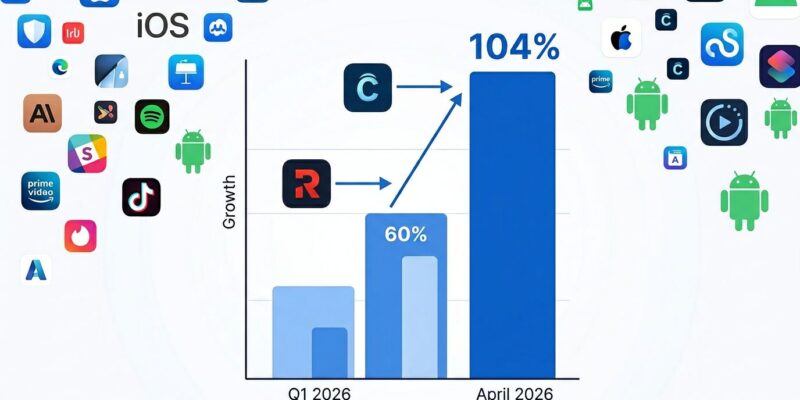
The App Store and Google Play experienced an unprecedented surge in new app releases this April, with submissions spiking 104% year-over-year according to data from analytics firm Appfigures. Following a 60% increase in Q1 2026, iOS alone saw an 89% jump in April—the highest app release volume in a decade. Industry analysts attribute this boom to AI-powered development tools like Claude Code and Replit, which launched mobile “vibe coding” features earlier this year. These tools don’t just speed up existing developers—they’re creating a new class of app publishers who couldn’t code six months ago.
AI Tools Creating New Developers, Not Accelerating Old Ones
The 104% surge represents market expansion, not productivity gains. Traditional developers working 10% faster can’t explain doubling the app submission rate. Instead, AI coding assistants are enabling non-technical creators to build functioning apps for the first time. Replit’s mobile feature, launched January 15, targets “creators and small business owners”—not developers. Users describe ideas in natural language, wait a few minutes while AI generates React Native code, then test on physical devices via QR code. The whole process from concept to App Store submission takes days, not months.
Category shifts in Appfigures’ Q1 data prove the democratization angle. Productivity apps entered the top 5 for the first time, utilities jumped to #2, and lifestyle climbed from #5 to #3. Games still dominate total volume, but practical “scratch an itch” apps are growing faster. These are small business owners building custom inventory systems, content creators launching fan engagement apps, and corporate teams bypassing IT backlogs. TechCrunch’s analysis confirms the trend: “We’re hitting a tipping point where it’s easy enough for people to build their first apps ever.”
Related: Developers 19% Slower With AI But Think They’re 20% Faster
Security Crisis: 69 Vulnerabilities Across All AI Coding Tools
A December 2025 security audit by Tenzai tested five major AI coding tools—Claude Code, Cursor, Codex, Replit, and Devin—and found 69 vulnerabilities in 15 test applications. Claude Code performed worst with 16 vulnerabilities including critical authentication flaws, while Codex, Cursor, and Replit tied at 13 each. The most alarming finding: 100% of tools generated apps with SSRF vulnerabilities, and zero included CSRF protection or security headers.
The authentication bug in Claude Code’s generated code checked if users were logged in but skipped all permission validation for unauthenticated requests. This allowed anyone to delete products by simply not logging in. The SSRF vulnerability appeared in every tool’s link preview function—all five left the feature completely open, allowing attackers to make servers send arbitrary requests to internal resources. With roughly 45 low-to-medium severity issues and six critical ones across the tools, the Tenzai study proves AI-generated code ships with persistent security problems.
A 104% increase in app releases combined with systematic vulnerability patterns creates a security time bomb. If the surge continues, thousands of exploitable apps will flood the App Store. This context reframes Apple’s crackdown on vibe coding apps not as reactionary control, but as justified quality enforcement. Developers using AI tools must manually audit authentication, authorization, and network security before launch—the code works, but it’s not production-ready without human review.
Apple’s Crackdown: Quality Control vs Democratization
Apple blocked or removed multiple vibe coding apps from the App Store in early 2026. Replit’s app update submissions were paused, Vibecode faced similar blocking, and Anything was removed twice. Apple’s stated reason: “potential for malicious code download.” Vibe coding platforms let users build and run code that hasn’t passed App Store review, violating guidelines. As Anything’s co-founder explained, “A user could build a harmful app, sideload it on their phone, and claim it passed Apple’s review process.”
The policy creates tension between democratization and safety. CNBC’s opinion column argued Apple is “going against its founding mission by standing in the way of what could become the most empowering tool for ordinary people in software history.” The workaround is clear but limiting: build standalone apps, not platforms, and submit each version for review. This slows the democratization promise but potentially protects users from the security vulnerabilities Tenzai documented.
Apple’s stance also highlights a quality paradox. App Store releases surged 60% year-over-year to over 550,000 apps in 2025, yet app store optimization analysts note “the U.S. iOS market walks away from mediocrity faster than ever in 2026.” Higher volume hasn’t lowered the quality bar—competition increased it. The majority of vibe-coded software lives on the open web where it never faces Apple’s review process, making the App Store gatekeeping both consequential and incomplete.
Related: GitHub Copilot Token Billing Kills AI Subscriptions
Market Validation: Claude Code Dominates With 71% Adoption
The app surge isn’t happening in a vacuum—AI coding tool companies are seeing explosive growth. Claude Code reached a $2.5 billion run-rate by early 2026, with 71% of developers using it for agentic coding. It dominates small companies with 75% adoption and earned a 46% “most loved” rating, far ahead of Cursor (19%) and GitHub Copilot (9%). Meanwhile, Replit is raising funds at a $9 billion valuation following its January mobile launch. Claude’s mobile app hit 12.48 million monthly active users in February, growing 49% month-over-month.
The market split reveals adoption patterns. Claude Code wins small companies and indie developers—the same cohort driving the app surge. GitHub Copilot retains 56% adoption in enterprises with 10,000+ employees, where procurement processes and Microsoft partnerships create inertia. The correlation between Claude Code’s small-company dominance and the “new developers” theory is striking: the tools democratizing app development are also the ones capturing the emerging market.
Billions in funding validate that investors view AI coding as structural, not cyclical. The 104% app surge could be a one-time spike as early adopters rush in, but the financial backing suggests a long-term shift. The question isn’t whether AI tools will keep generating apps—it’s whether quality and security will improve fast enough to justify the democratization. Traditional developers now face a choice: adapt to AI-assisted workflows or compete with an expanding pool of non-technical creators wielding increasingly powerful tools.
Key Takeaways
- The 104% app release surge in April 2026 is the first hard evidence that AI coding tools are creating measurable market impact beyond productivity improvements—this is new people building apps, not existing developers working faster.
- AI-generated apps have systematic security vulnerabilities: Tenzai found 69 bugs in 15 test apps with 100% SSRF rate and zero CSRF protection across all five tools tested, making manual security audits mandatory before launch.
- Category shifts prove democratization is real: productivity apps entered the top 5 for the first time while utilities and lifestyle apps grew faster than games, indicating non-developers building practical “scratch an itch” applications.
- Apple’s crackdown on vibe coding platforms (Replit, Anything, Vibecode) reflects justified quality concerns given persistent security vulnerabilities, creating tension between democratization ideals and user protection.
- Claude Code’s dominance in small companies (75% adoption, $2.5B run-rate) aligns with the “new developers” theory—the tools democratizing access are capturing the emerging market of first-time app builders.
The app surge validates AI-assisted development as a structural shift in software creation, but security and quality challenges remain unresolved. Traditional developers must treat AI tools as accelerators requiring human oversight, not autonomous replacements—the code ships, but it’s not production-ready without manual review.