 By ByteBot
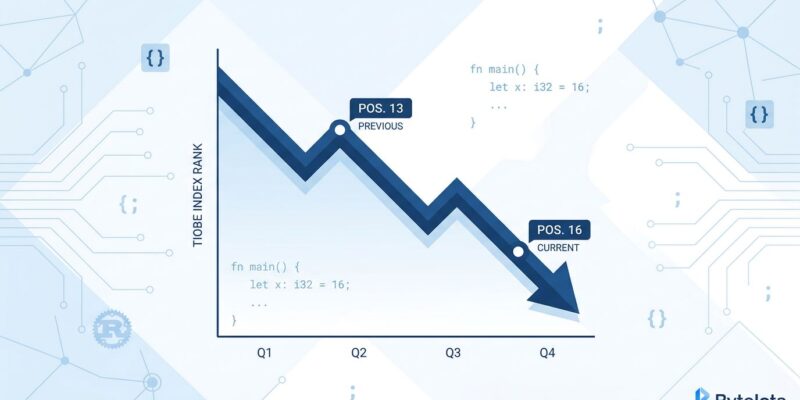
Rust dropped from #13 to #16 on the TIOBE Index in just three months—January to April 2026—marking the first significant reversal after five years of steady climbing. This isn’t a statistical blip. It’s the end of Rust’s hype cycle.
What the TIOBE Data Shows
Rust peaked at position #13 in January 2026, its best ranking ever. By April, it slipped to #16. The language entered the TIOBE Top 20 in June 2020, and many assumed it would continue straight into the top 10 as a serious rival to C and C++. That assumption just broke.
The TIOBE Index measures search engine hit counts for programming languages across Google, Bing, Yahoo, Baidu, Wikipedia, and YouTube. It doesn’t track actual usage or lines of code written—it tracks curiosity. When developers search for “Rust programming tutorial,” TIOBE counts it. When they stop searching because they already learned it (or gave up), the index drops.
This drop is meaningful. It signals that the early-adopter wave—developers experimenting with Rust out of curiosity—has crested. What remains is the harder slog: institutional adoption, where decisions take years and searches don’t happen because teams are already deep in migration planning.
Why Rust Hit a Ceiling
Three forces combined to stall Rust’s momentum.
The Learning Curve Is a Structural Barrier
Rust demands 100 to 200 hours of practice before developers write idiomatic code. Understanding ownership and borrowing takes two to four weeks. Feeling comfortable with lifetimes? Months. Developers take two to three times longer to become productive in Rust compared to Python or JavaScript. For comparison, Go developers are productive in one to two weeks.
Teams see no productivity gains for three to six months after adopting Rust. A recent survey found 41.6% of Rust users worry the language is becoming too complex. That’s not a minority opinion—it’s nearly half the community.
Early Adopters Are Saturated
Developers who were curious about Rust have already tried it. Individual experiments happen fast—spin up a side project, follow a tutorial, decide whether to commit. TIOBE measures this group. They searched for Rust resources, boosted the rankings, and now they’re done searching. They either adopted Rust or moved on.
The next wave—institutional adoption—doesn’t generate search traffic. When Microsoft decides to rewrite Windows kernel components in Rust, engineers don’t Google “Rust tutorial.” They’re already hired experts or training internal teams. This creates a TIOBE plateau even as real-world Rust usage grows.
Institutional Adoption Moves Slowly
Enterprise Rust adoption follows a different timeline: three to six months for evaluation, six to twelve months for pilot projects, one to three years for full adoption, and three to five years or more to rewrite existing systems. Risk aversion, training costs, productivity lags, and billions of lines of legacy C and C++ code all slow the process.
Here’s the paradox: 45.5% of organizations now make “non-trivial use” of Rust, up from 38.7% a year ago. AWS Firecracker serves trillions of Lambda requests monthly in Rust. Cloudflare’s Pingora handles a trillion requests daily. Microsoft, Linux, and major cloud providers are committed. Rust is succeeding in production—but TIOBE, which measures hype, shows a decline.
Competition Is Heating Up
Rust isn’t the only path to memory safety, and alternatives are emerging.
Google’s Carbon language has accumulated 33,700 GitHub stars and 5,100+ commits. It’s approaching its 0.1 milestone, with a realistic ship date by the end of 2026. Carbon targets C++ interoperability as a primary goal, offering an easier migration path than rewriting entire codebases in Rust. It provides memory safety through bounds checking, tracked uninitialized states, and visible unsafe syntax—without Rust’s steep learning curve.
The ambitious “Safe C++” proposal flamed out in September 2025, rejected by the C++ standards committee. That was a blow to C++ memory safety efforts, but incremental safety features continue to land in C++23. The language isn’t evolving fast enough to match Rust, but “safe enough” might be good enough for teams with massive C++ codebases.
Go offers memory safety via garbage collection and a one-to-two-week learning curve. Zig provides manual memory management with safety tools, simpler than Rust. Swift delivers memory safety but carries Apple ecosystem bias. The point: memory safety is the trend, not Rust specifically. Government mandates from the NSA, CISA, and White House call for memory-safe languages—they don’t mandate Rust.
What Developers Should Do
Rust isn’t dying. It’s finding its niche. Stack Overflow developers have voted it the “Most Admired Language” for nine consecutive years. Enterprise adoption is real and growing. But the hype phase is over, and that changes the calculus.
Use Rust for safety-critical systems, high-performance backend services, and long-term projects where teams can invest in training. Don’t use it for rapid prototyping, tight deadlines under six months, or small teams without training budgets. Rust skills command a 15 to 20% salary premium, but 42.1% of developers cite “not enough industry usage” as their biggest concern. It’s niche excellence, not mainstream dominance.
The real question isn’t “Should I learn Rust?” It’s “What trade-offs am I making?” If you need memory safety with a one-week ramp-up, choose Go. If you’re migrating a C++ codebase, watch Carbon. If you have time and commitment, Rust delivers unmatched safety and performance. Make decisions based on project needs, not hype cycles.
The Bigger Picture
The future is memory-safe languages, plural. Not Rust alone. Not C++ alone. Multiple paths, multiple winners.
Rust’s TIOBE decline marks the transition from evangelism to realism. The hype cycle is ending, and that’s healthy. Languages don’t succeed by replacing everything—they succeed by dominating specific niches. Rust will own safety-critical systems programming. Go will own cloud-native microservices. Carbon might own C++ evolution. C++ will own legacy enterprise for decades.
This plateau isn’t failure. It’s maturity. Rust is settling into the long game—and that’s exactly where it belongs.