 By ByteBot
A developer just paid $30k for the Friendster domain and trademarks, then rebuilt it as an iOS app that requires you to physically tap phones together to add friends. No algorithms. No feeds. No data monetization. Just Bluetooth proximity and a bet that people are tired of engagement-optimized social media. The project is trending on Hacker News with 405 points, but here’s the problem: iOS-only kills network effects, phone-tapping novelty will wear off, and ethical social platforms have a 100% failure rate. This is a fascinating experiment in nostalgia-driven product design—and a cautionary tale about why anti-algorithm platforms keep failing.
What He Built
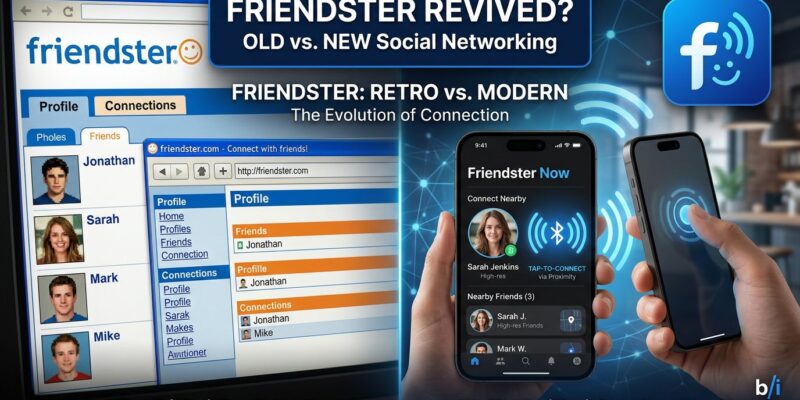
Mike Carson purchased the Friendster domain and trademarks in April 2026 for $30k—$20k in Bitcoin plus a domain generating about $9k annually in ad revenue. He rebuilt it as an iOS app with a radical design: you can only add friends by physically tapping your phones together using Bluetooth proximity detection. No email. No password. No algorithmic feeds. Just your name, Bluetooth permission, and the requirement that you meet people in real life.
The app includes “fading connections”—friendships decay if you don’t meet in person for a full year. It’s a deliberate rejection of modern social media’s engagement-maximizing playbook. No infinite scroll. No data mining. No targeted ads. Carson explicitly designed Friendster as an anti-algorithm manifesto.
The Fatal Flaw: iOS-Only
Here’s the strategic mistake that will kill this project: it’s iOS-only. That means roughly half of potential users—anyone on Android—can’t join. Network effects are winner-take-all. Social platforms need critical mass to survive, and Friendster just excluded 50% of the market before launch.
Hacker News commenters flagged this immediately as the most glaring problem. Your Android friends can’t connect with you. College students on budget phones can’t participate. International users in Android-heavy markets are locked out. Carson likely chose iOS for technical simplicity—better Bluetooth stack, controlled ecosystem—but it’s a fatal trade-off. You can’t build a social network by fragmenting your potential user base.
Compare to Mastodon (10 million users, cross-platform) or Bluesky (rapid growth in 2026, cross-platform). Both are anti-algorithm platforms gaining traction, and both prioritized accessibility over platform purity. Friendster chose purity and will pay for it.
History Repeats: Ethical Platforms Always Fail
Developers want ethical social platforms to succeed. But wanting something doesn’t make it viable. Friendster joins a long graveyard of noble failures—platforms that prioritized users over growth and died quietly as a result.
Ello (2014) raised $5.5 million on an ad-free promise. Dead. Diaspora (2010) built decentralized, privacy-focused social networking with $200k in Kickstarter funding. Barely alive. Peach (2016) launched to hype, died within months. Path (2010-2018) limited connections to 50 friends for intimacy. Shut down. Vero (2015) promised chronological feeds and no ads. Irrelevant.
The original Friendster had 115 million users in 2011, rejected a $30 million acquisition offer from Google in 2003, and still failed. Site load times hit 40 seconds. MySpace and Facebook outcompeted them. By 2018, Friendster was completely dead—domain parked, company dissolved.
What makes Carson think his version will succeed where 115 million users couldn’t save the original?
Phone-Tapping: Charming or Tedious?
The Bluetooth proximity feature sounds charming initially. Tap phones together at concerts, conferences, parties—it’s physical verification, reduces catfishing, feels authentic. Real-world connections matter.
But novelty wears off. Tapping phones is cute for your first 5 connections. By connection 50, it’s annoying. By connection 100, you’re wondering why this isn’t just a QR code or username. Compare to Bump, an app from 2009-2014 that used physical proximity to share contacts and photos. Trendy initially, then tedious. Shut down because it couldn’t monetize and users abandoned it.
And what about long-distance friendships? Remote work relationships? Global developer communities? The “fading connections” feature penalizes anyone who can’t meet in person annually. That’s not ethical design—that’s enforcing a narrow definition of valid friendship.
What This Says About Social Media in 2026
Friendster’s revival proves developer dissatisfaction with algorithmic social media is real. 405 points on Hacker News, trending as the #1 story—that’s not random. Developers are tired of Meta’s engagement-maximizing, ad-driven platforms. They want alternatives. They want chronological feeds, data privacy, and platforms that don’t manipulate behavior for profit.
But here’s the uncomfortable truth: users say they hate algorithms, then spend hours on Instagram. We complain about data mining, then hand over our information for convenience. Ethical platforms fail because we (users) prefer engagement optimization over principles. Algorithmic feeds are easier to consume. Infinite scroll is addictive by design. We know it’s bad for us, and we keep using it anyway.
Mastodon has 10 million users—impressive for an ethical platform, but a rounding error compared to Facebook’s billions. Bluesky is growing rapidly, but it’s still a Twitter alternative for developers and journalists, not a mass-market platform. Network effects favor incumbents, and no ethical platform has cracked that problem yet.
Friendster Is Another Noble Failure
Friendster’s revival is an experiment, not a revolution. Carson deserves credit for trying. The developer community wants this to work. But iOS-only limits growth, phone-tapping is a gimmick that won’t scale, there’s no announced business model, and ethical platforms have a 100% failure rate.
Until someone solves the network effects problem AND finds a sustainable business model without ads or data monetization, anti-algorithm platforms will keep failing. Friendster is just the latest addition to the social media graveyard—a noble experiment that proves developers are desperate for alternatives, even when those alternatives have no path to viability.
The $30k domain purchase makes for a great Hacker News story. But buying a name doesn’t resurrect a platform. Friendster died in 2018 for a reason, and tapping phones together won’t bring it back.