 By ByteBot
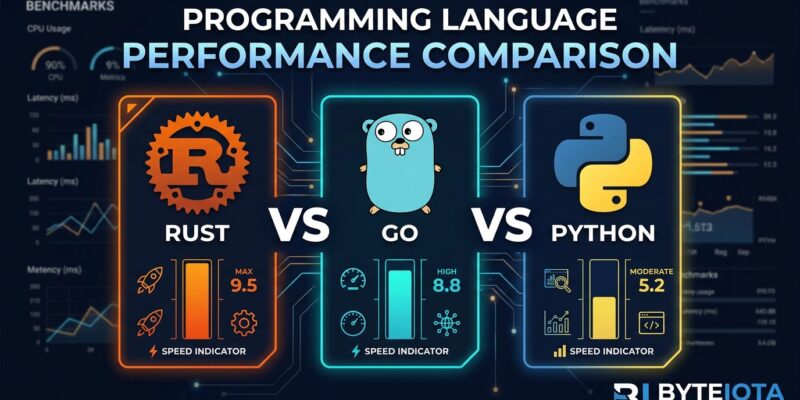
Programming language benchmarks in 2026 reveal Rust is 25-100x faster than Python for CPU-bound workloads and 2-12x faster than Go, but these raw numbers miss critical context. Go compiles 10-60x faster than Rust, making development cycles dramatically quicker. Python maintains an impenetrable AI/ML moat with 530,000+ packages versus Rust’s 155,000. The question isn’t “which language is fastest” but “which language for which layer of the stack.”
Language selection is one of the highest-stakes technical decisions in software development, affecting performance, team productivity, and system scalability. Developers need data-driven decision criteria, not marketing hype or benchmark numbers without context.
Benchmark Reality: 100x Speed Gaps Aren’t Hype
Rust delivers 25-100x performance advantages over Python in CPU-bound workloads based on Computer Language Benchmarks Game 2026 data. For web services, Rust’s Actix Web achieves 7.1 million requests/second versus Python’s FastAPI at 24,800 req/s—a 286x throughput gap. Go sits in the middle with 200K req/s. These aren’t theoretical benchmarks—they represent actual architectural implications.
The N-body simulation benchmark shows the range: Rust completes in 3.2 seconds, Go in 9.8 seconds, Python in 312.4 seconds. That’s a 97x gap between Rust and Python. Moreover, binary trees reveal Rust running 12x faster than Go and 25x faster than Python. Memory efficiency follows the same pattern—Rust uses 512MB for the binary trees benchmark while Go consumes 1.2GB and Python 2.1GB.
Discord’s Rust migration demonstrates real-world impact. The company reduced memory consumption from 1GB to 128MB (8x reduction) and eliminated garbage collection latency spikes that plagued Python services during peak usage. AWS Firecracker boots microVMs in under 125 milliseconds, enabling thousands of isolated functions per server. However, performance gaps this large have architectural consequences: lower infrastructure costs, faster response times, better user experience.
But these gains only matter if you’re actually hitting performance limits. Most web apps are I/O-bound where network latency dominates, making language speed differences negligible. The 286x web throughput advantage means nothing if your database is the bottleneck.
Rust’s Hidden Cost: 60x Slower Compilation
Rust’s performance advantage comes with a steep compilation penalty: 30-120 seconds for medium projects versus Go’s 2-10 seconds—a 10-60x speed gap. Large Rust projects with complex dependency trees take 5-10 minutes for clean builds. Furthermore, this affects every stage of development: testing, CI/CD pipelines, and iteration speed. Go’s fast compilation is a competitive advantage often ignored in raw performance comparisons.
Developer productivity metrics tell the story. Go teams reach production-ready code in 2-4 weeks; Rust teams take 3-6 months. Additionally, team onboarding runs 6-12x faster with Go than Rust. The “write-compile-test” cycle is fundamental to productivity—waiting minutes instead of seconds compounds across hundreds of daily iterations.
Consequently, development velocity often trumps runtime performance. Fast compilation enables rapid iteration, quick CI/CD cycles, and faster debugging. Rust’s slow builds can bottleneck teams, especially in fast-moving startups where shipping quickly matters more than maximum performance. In fact, most production services never exceed 1,000 requests per second sustained—Go’s 15,000 TPS is already overkill.
Python’s 530K Package Moat Beats Rust’s Speed
Python dominates AI/ML with 530,000+ PyPI packages versus Rust’s 155,000 crates. PyTorch, TensorFlow, Hugging Face, NumPy, and Pandas are industry standards with no viable Rust alternatives. Moreover, the job market reflects this reality: 215,000 Python positions versus 18,000 Rust positions (12:1 ratio). Despite being 25-100x slower, Python’s ecosystem makes it irreplaceable for machine learning development.
Stack Overflow’s 2025 Developer Survey shows Python adoption increased 7% year-over-year, accelerating significantly due to AI/ML dominance. Rust grew 42% annually but from a much smaller base (18,000 jobs versus Python’s 215,000). Furthermore, Python senior developers earn $165,000 on average; Rust senior developers earn $195,000—but the Python job market is 12x larger.
Ecosystem depth matters more than raw speed for most development work. Python’s AI/ML libraries represent decades of research, thousands of contributors, and battle-tested production deployments. Consequently, switching to Rust for 100x performance gains is pointless if you spend weeks reimplementing basic ML utilities. The ecosystem moat is why Python’s dominance continues despite performance limitations.
Pragmatic Pluralism: Python Interface, Rust Engine
Production systems increasingly adopt “Python interface, Rust engine” architectures. Pydantic V2 rewrote its validation engine in Rust, achieving 5-50x performance gains while maintaining Python’s developer-friendly API. Similarly, Hugging Face tokenizers, Ruff linter, and other tools follow the same pattern—Rust powers performance-critical components while Python handles user interfaces and workflows.
Ruff linter checks Python codebases 10-100x faster than Pylint by implementing the linter in Rust. Pydantic V2’s Rust-powered validation engine delivers 5-50x speedups without changing Python APIs. Moreover, Hugging Face tokenizers use Rust internally with Python bindings, combining ecosystem compatibility with raw performance.
This pattern allows leveraging both languages’ strengths: Python’s 530,000-package ecosystem plus Rust’s performance. Developers don’t need to choose one language—they need to know when to deploy each strategically. The “language war” narrative is obsolete. In fact, modern architecture uses the right tool for each layer: Python for data science and interfaces, Rust for computational kernels, Go for cloud infrastructure.
When to Choose Each Language
Benchmarks are useless without context. Choose Rust for high-performance services exceeding 10,000 sustained requests per second, sub-millisecond latency requirements, systems programming, and safety-critical applications. However, Discord eliminated GC spikes, AWS Firecracker boots in under 125ms, high-throughput APIs leverage Actix Web’s 7.1M req/s capability.
Choose Go for cloud-native microservices, rapid development cycles, and “good enough” performance. Kubernetes, Docker, Terraform, and Prometheus all use Go. Furthermore, a typical e-commerce platform using Go reduced latency 40% and increased throughput 300%. JetBrains’ 2025 Developer Ecosystem survey shows Go has steady cloud-native adoption with highest perceived growth potential alongside TypeScript and Rust. Most importantly, Go’s 15,000 TPS exceeds most real-world needs—Rust’s 30,000 TPS is unnecessary optimization for most services.
Choose Python for AI/ML, rapid prototyping, data analysis, and automation where ecosystem depth matters more than runtime speed. PyTorch and TensorFlow are industry standards. Healthcare providers using Apache Airflow and Pandas improved data pipeline efficiency 60%. Additionally, PyInfra reduced configuration management overhead 70% versus YAML approaches.
As Bitfield Consulting notes: “Use Go for 80% of your projects where simplicity and velocity matter most, and reach for Rust for the 20% where performance and safety are non-negotiable.” Consequently, start with Python or Go for rapid validation, profile in production, migrate bottlenecks to Rust only when you hit actual performance limits. Premature optimization wastes resources.
Key Takeaways
- Rust is 25-100x faster than Python and 2-12x faster than Go in CPU-bound benchmarks (N-body: 97x gap, web throughput: 286x gap), but these advantages only matter when you’re actually hitting performance limits—most web apps are I/O-bound where network latency dominates
- Rust compiles 10-60x slower than Go (30-120 seconds vs 2-10 seconds), creating a development velocity tradeoff that favors Go for rapid iteration, testing, and CI/CD workflows—fast compilation matters more than peak performance for most projects
- Python’s 530,000-package ecosystem versus Rust’s 155,000 crates creates an impenetrable moat in AI/ML (PyTorch, TensorFlow, Hugging Face have no Rust alternatives), reflected in job markets: 215,000 Python positions versus 18,000 Rust positions
- Hybrid “Python interface, Rust engine” architectures deliver best-of-both-worlds: Pydantic V2 (5-50x faster validation), Ruff (10-100x faster linting), and Hugging Face tokenizers leverage Rust performance while maintaining Python ecosystem compatibility
- Use case determines winner: Rust for high-performance services (>10K sustained req/s, sub-millisecond latency), Go for cloud-native microservices (rapid development, “good enough” 15K TPS), Python for AI/ML and prototyping (ecosystem depth beats runtime speed)
The question “Rust vs Go vs Python” is wrong. The right question is “which language for which layer of the stack.” Modern systems use pragmatic pluralism: Python for data science interfaces, Rust for computational kernels, Go for cloud infrastructure. Developers should learn multiple languages strategically, not commit religiously to one.