 By ByteBot
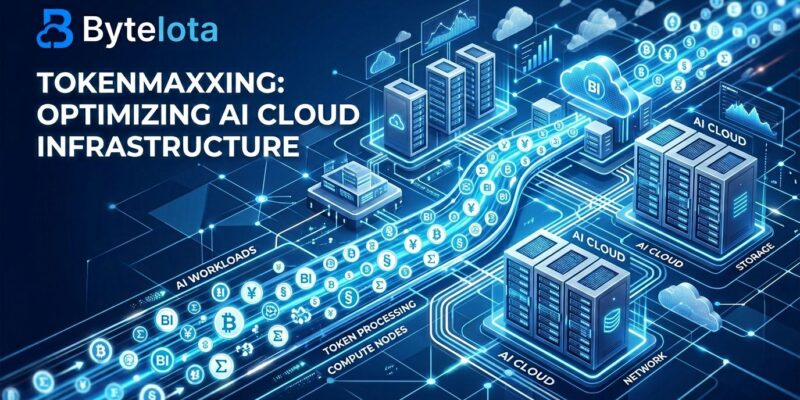
Parasail, a startup founded by former Groq executive Mike Henry, just raised $32 million to bet on “tokenmaxxing”—a new approach to AI infrastructure that challenges how developers pay for compute. Instead of billing for GPU hours like AWS or GCP, Parasail charges only for the tokens your AI models generate. The company is processing 500 billion tokens daily, and investors believe this inference-only, pay-per-token model could disrupt the $100+ billion cloud AI market.
What Is Tokenmaxxing?
So what exactly is “tokenmaxxing,” and why are investors betting $32 million on it?
Traditional clouds like AWS, GCP, and Azure bill you for GPU hours—the time your compute is running, whether it’s generating tokens or sitting idle. Parasail flips this model. You pay only for the tokens your AI models actually produce. No reserved capacity. No long-term contracts. No paying for idle GPUs while you wait for traffic spikes.
This pricing shift matters because AI workloads aren’t like traditional web apps. An AI agent might sit quiet for hours, then burst into action when a user triggers it. With traditional cloud billing, you’re either over-provisioning (wasting money on idle GPUs) or under-provisioning (facing slowdowns when demand spikes). Pay-per-token billing aligns costs with actual usage.
Parasail’s bet is that developers want to optimize for token throughput, not GPU utilization. The company aggregates GPU supply across 40 data centers globally and routes your workloads to optimize for tokens generated per dollar. Deploy in five lines of code, and you’re in production within minutes. The proof is in the numbers: 30% month-over-month revenue growth and customers like Elicit, mem0, and Gravity already processing billions of tokens.
The Inference Inflection
The timing matters. AI’s compute demands just shifted dramatically.
For the first two years of generative AI (2022-2024), most cloud spending went to model training. Training GPT-4 or Llama required massive clusters running for months. But in 2025-2026, inference became the dominant workload. Reasoning models like o3 think before they respond, burning 10,000x more compute per session than simple chatbots. AI agents run continuously in the background, generating tokens nonstop. Every action requires tokens, every token requires inference, and every inference requires compute, memory, bandwidth, and power.
The AI inference market hit $106 billion in 2025 and is projected to reach $255 billion by 2030. Analysts estimate the developer-controlled AI market alone will exceed $100 billion. This isn’t hype—it’s companies deploying ChatGPT-style interfaces, GitHub Copilot workflows, and autonomous agents that burn through tokens at unprecedented rates.
“These agents will require massive amounts of tokens,” says Steve Jang, managing partner at Kindred Ventures, one of Parasail’s Series A co-leads. “Parasail offers the first agent-focused inference.”
Who’s Behind Parasail
Parasail’s founder saw this shift coming because he helped build the inference infrastructure powering it.
Mike Henry founded AI hardware company Mythic in 2012 (which raised $165 million) and served as interim chief product officer at Groq in 2023. At Groq, he worked directly with datacenter operators running AI inference at scale. He watched them struggle with traditional cloud billing models that weren’t built for token-based workloads. So he left to build Parasail with co-founder Tim Harris in late 2023, launched in April 2025, and is now processing 500 billion tokens daily just one year later.
“AI builders shouldn’t have to become infrastructure experts to ship great products,” Henry says. That’s the pitch: Parasail handles the infrastructure complexity so developers can focus on building AI products, not managing GPU clusters.
How Parasail Compares to AWS, GCP, and Azure
Henry’s bet is that inference-only beats general-purpose clouds—at least for AI workloads.
AWS, GCP, and Azure offer everything: training, inference, storage, databases, networking. They’re optimized for broad workloads, which means they’re not optimized specifically for inference. They bill for compute time, require reserved capacity for cost savings, and lock you into their ecosystems with proprietary tools.
Parasail does one thing: inference. No training allowed. You bring your own open-source models (Llama, Mistral, etc.), deploy them with a few lines of code, and pay only for the tokens generated. No contracts. No vendor lock-in. If you need to scale down or switch providers, you can do it instantly.
“AI infrastructure is moving beyond single-cloud models,” says Samir Kumar, general partner at Touring Capital, Parasail’s other Series A co-lead. “Parasail has built the control layer.”
The market seems to agree. Parasail’s $32 million Series A, co-led by Touring Capital and Kindred Ventures with participation from Samsung NEXT, Flume Ventures, and Banyan Ventures, signals investor confidence that specialized inference clouds can carve out market share from the hyperscalers.
What Developers Should Watch
For developers, this funding signals a broader market shift.
First, “tokenmaxxing” is likely to become industry jargon. Optimizing infrastructure for token output—not just GPU uptime—is the new performance metric. Nvidia is already pushing “cost per token” as the defining metric for AI data centers.
Second, if you’re deploying AI agents, chatbots, or code generation tools with high token volumes and variable traffic, do the math on pay-per-token versus pay-per-compute. Below 20 million tokens per month, managed APIs usually win. Above 100 million tokens per month, specialized inference providers may save significant money over traditional clouds.
Third, the inference-only model could follow the “API-only” pattern from the 2010s. Remember when Stripe and Twilio proved that specialized API providers could beat general-purpose platforms? Parasail is betting the same dynamic applies to AI inference—specialized beats general-purpose when the market gets big enough.
The inference inflection is here. Cloud pricing models are catching up.