 By ByteBot
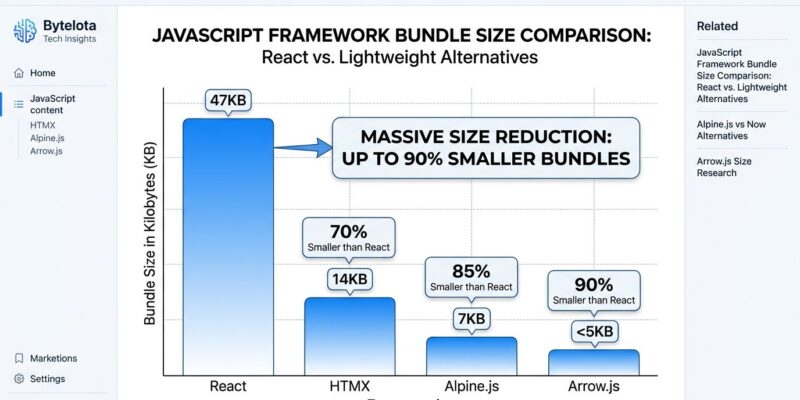
The JavaScript ecosystem is experiencing a lightweight framework renaissance in 2026. Developers are abandoning React’s 47KB base bundle for sub-10KB alternatives like Arrow.js (under 5KB), Alpine.js (7KB), and framework-agnostic utilities like TanStack. This April, Standard Agents launched Arrow.js as “the first UI framework for the agentic era”—designed specifically for AI code generation with no build step and simple rules. This isn’t just about bundle size. It’s a fundamental rethinking of how web applications should be built when AI agents author significant portions of frontend code and every kilobyte affects Core Web Vitals.
AI Coding Demands Simpler Frameworks
Frameworks with fewer implicit rules produce more reliable AI-generated code. React’s hooks ordering requirements, useEffect dependency arrays, and the distinction between controlled and uncontrolled components create predictable mistakes from AI agents. Arrow.js solves this by using standard JavaScript template literals and proxy-based reactivity—making it “just TypeScript/JavaScript” that large language models already understand.
Justin Schroeder, Arrow.js creator, put it bluntly: “Imagine React or Vue, but with no compiler, build process, or JSX transformer. It’s just TS/JS so LLMs are already great at it.” The difference shows in the code. React requires hooks to follow strict ordering rules, while Arrow.js uses straightforward reactive state:
// React (implicit reactivity, hooks rules)
const [count, setCount] = useState(0)  // Order matters
useEffect(() => { ... }, [dep1, dep2])  // Dependency footgun

// Arrow.js (explicit reactivity, no rules)
const state = reactive({ count: 0 })
html`<button @click="${() => state.count++}">+</button>`
Arrow.js even includes a QuickJS/WASM sandbox package for safely executing AI-generated code in the browser. If AI agents are writing significant frontend code, choosing an AI-friendly framework reduces errors and eliminates build complexity.
Bundle Size Math That Matters
React’s 47KB+ base bundle versus Arrow.js (under 5KB) and Alpine.js (7KB) represents an 80-90% reduction in JavaScript shipped to users. For content-heavy sites, this translates to measurable Core Web Vitals improvements—especially on mobile and slow networks. HTMX clocks in at 14KB, still three times smaller than React.
The impact is clear: bundle size significantly contributes to slow load times, forcing users to download, parse, and execute hundreds of kilobytes before interaction. Alpine.js delivers 80-95% less JavaScript than equivalent single-page applications for content sites. Core Web Vitals are an SEO ranking factor. Every kilobyte affects Time to Interactive and First Contentful Paint.
TanStack as the Incremental Path
You don’t have to abandon React to benefit from this trend. TanStack Query has 68% usage among React developers with just 1% negative sentiment, making it the most-loved data fetching solution. The TanStack ecosystem provides framework-agnostic utilities with adapters for React, Vue, Solid, Angular, and vanilla JavaScript.
TanStack Start delivered 5.5x throughput improvements in March 2026, achieving 13ms average latency to become the SSR performance leader. The philosophy is simple: every library starts with a provider-agnostic core, allowing you to use any framework.
// TanStack Query works with React, Vue, Solid, Angular
import { useQuery } from '@tanstack/react-query'

const { data, isLoading } = useQuery({
  queryKey: ['todos'],
  queryFn: () => fetch('/api/todos').then(r => r.json())
})
Adopting TanStack utilities reduces bundle size, improves performance, and keeps your options open for future framework decisions.
When to Choose What
Lightweight frameworks aren’t always better. React dominates for complex single-page applications, large teams, and scenarios requiring mature ecosystem support. The decision depends on interactivity level, bundle budget, team size, and performance requirements.
Choose lightweight frameworks for content sites, progressive enhancement, mobile-first applications, and projects with JavaScript budgets under 100KB. Choose heavy frameworks for complex SPAs like spreadsheets, large teams where hiring ease matters, real-time collaboration features, and scenarios requiring mature component libraries.
For highly interactive UIs with complex client-side state, React’s upfront JavaScript cost amortizes over user interaction time. For everything else—marketing sites, blogs, documentation—the overhead can’t be justified. Alpine.js demonstrates the progressive enhancement approach with a 7KB script tag:
<!-- Server-rendered HTML -->
<div x-data="{ count: 0 }">
  <button @click="count++">Clicked <span x-text="count"></span> times</button>
</div>

<!-- Alpine adds reactivity via CDN -->
<script src="https://cdn.jsdelivr.net/npm/alpinejs@3.x.x/dist/cdn.min.js"></script>
No build step. No complex tooling. Just enhanced HTML.
The Signals Renaissance
Angular Signals eliminate unnecessary change detection cycles by updating only affected bindings. Traditional Angular traverses the component tree every time an asynchronous event occurs. Angular Signals avoid this entirely: Angular updates only the bindings that depend on the signals that change.
Paired with the Zoneless scheduler, this makes Angular competitive on performance without switching frameworks. Enterprise teams with massive Angular codebases can get significant performance gains without rewrites. The pattern is spreading—Solid.js, Svelte 5, and now Angular all use signals-based reactivity. Fine-grained reactivity is replacing the Virtual DOM.
Key Takeaways
- AI development favors simpler frameworks. Arrow.js proves that explicit patterns and no-build approaches produce more reliable AI-generated code than React’s implicit hooks rules.
- Bundle size directly affects Core Web Vitals. The 80-90% reduction from React (47KB+) to lightweight alternatives (5-7KB) translates to measurable performance improvements and better SEO rankings.
- TanStack enables incremental adoption. Framework-agnostic utilities let you improve performance without full rewrites, keeping framework choice as an implementation detail.
- Choose based on use case, not hype. React still dominates for complex SPAs and large teams. Lightweight frameworks excel for content sites and mobile-first applications.
- Signals are the future of reactivity. Angular, Solid, and Svelte are converging on fine-grained reactivity. The Virtual DOM era is ending.