 By
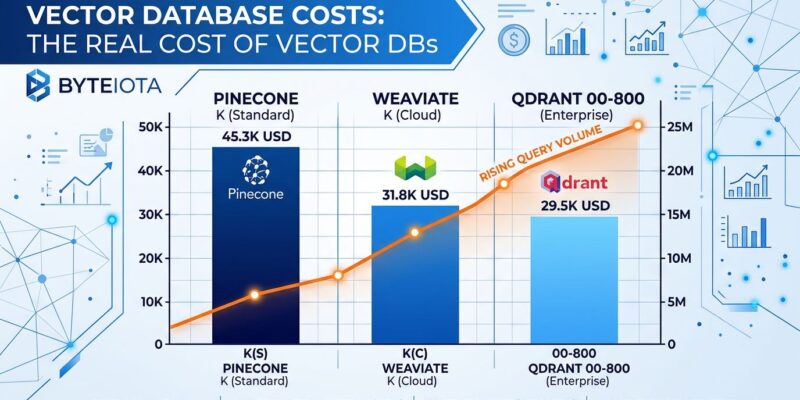
By Vector databases became critical infrastructure for RAG and AI applications in 2026, but pricing models create a 6-10x cost difference between managed and self-hosted solutions at enterprise scale. At 100M vectors, monthly costs range from $500-800 (Qdrant self-hosted) to $5,000+ (Pinecone managed), with a tipping point at 60-80 million queries per month where self-hosted solutions become 3-10x cheaper. But one enterprise case study revealed the hidden trap: Qdrant cost $120/month vs Pinecone’s $200/month, yet the engineering team spent 20+ hours monthly on operations—worth $3,000+ at their cost rate. The “cheaper” option became 15x more expensive when factoring in total cost of ownership.
The Tipping Point: When Self-Hosted Becomes Cheaper (and When It Doesn’t)
The critical decision point for vector database economics is 60-80 million queries per month. Below this threshold, managed services like Pinecone and Weaviate Cloud win on convenience and predictable costs. Above it, self-hosted solutions like Qdrant deliver 3-10x cost savings—but only if you factor ops burden correctly.
Consider the math at 100M queries monthly on Pinecone: 100M reads × $16/million = $1,600/month in query costs alone, plus storage. Same workload self-hosted on Qdrant runs on a DigitalOcean 32GB RAM droplet at $192/month total. That’s $1,408/month savings, or $16,896 annually. Looks like an easy decision, right?
Not quite. The migration effort costs 40 hours at $150/hour ($6,000 one-time). Monthly operations consume 10 hours at $150/hour ($1,500/month). Effective self-hosted cost becomes $192 + $1,500 = $1,692/month—barely cheaper than Pinecone when ops time is factored in. The break-even point isn’t just about query volume. It’s about whether your ops team can maintain self-hosted infrastructure in under 5 hours monthly. If not, managed services win even at high scale.
Storage Costs Are a Trap: Query Pricing Dominates at Scale
Storage pricing varies 3x between providers: Pinecone charges $0.30/GB/month, Weaviate $0.095/GB/month (cheapest), and Qdrant $0.28/GB/month. Teams obsess over these numbers and miss the bigger trap—query costs dwarf storage at production scale. Pinecone’s $16/million reads turns storage costs into a rounding error.
Real scenario at 50GB vectors, 50M queries monthly: Pinecone storage (50GB × $0.30 = $15/month) plus queries (50M reads × $16/million = $800/month) totals $815/month. Storage represents 2% of the bill. Query costs dominate 98%. At 100M vectors for typical enterprise RAG, Pinecone runs $5,000+/month, Weaviate managed hits ~$3,000/month, and Qdrant self-hosted costs $500-800/month in infrastructure alone.
The mistake is modeling costs based on storage alone, then getting shocked when query volume drives bills up 10x. Always model BOTH storage AND expected query volume. Storage looks cheap until production traffic hits.
Related: Cloud Waste Hits 30%: Why Companies Can’t See Costs
Total Cost of Ownership: The $120/Month Database That Cost $3,000
Self-hosted vector databases have zero software costs but significant hidden costs in engineering time. One enterprise case study captures the trap perfectly: Qdrant self-hosted at $120/month vs Pinecone at $200/month looked like obvious savings. The team chose Qdrant, then spent 20+ engineering hours monthly on monitoring, upgrades, and troubleshooting—worth $3,000+ at their cost rate. The “cheaper” option cost 15x more.
Typical self-hosted ops burden breaks down as: Initial setup (20-40 hours for cluster setup, monitoring, backups, testing), monthly operations (10-20 hours for monitoring, upgrades, troubleshooting, performance tuning), and disaster recovery testing (4-8 hours quarterly). At $150/hour engineering rate, that’s $1,500-3,000/month in hidden costs nobody budgets for.
Disaster recovery failures cost more. One enterprise search platform shared: “Our self-hosted Qdrant instance crashed. No backups. Rebuilding 100M vector index from source data took 36 hours. Business was down for 1.5 days.” The lesson is brutal: Calculate total cost of ownership including engineering time, not just infrastructure costs. Self-hosted only makes sense if your ops team can maintain it in under 5 hours monthly OR query volume is so high (>100M/month) that savings justify ops burden.
Decision Framework: Which Database for Your Scale
The decision isn’t “which database is best” but “which deployment model fits your scale and team.” Use this three-tier framework: For under 10M vectors with PostgreSQL already deployed, choose pgvector (zero additional cost, 60-80% TCO reduction). For 10-100M vectors with under 60M queries monthly, choose managed services (Pinecone or Weaviate Cloud). For over 100M vectors OR over 60M queries monthly, choose self-hosted (Qdrant or Milvus) IF ops team is available.
pgvector is the most underrated option. It works for the majority of RAG use cases under 5 million vectors, and pgvectorscale achieves 471 QPS at 99% recall on 50M vectors—competitive with dedicated vector databases. TCO runs $3,600-15,000 annually (60-80% cheaper than dedicated vector databases). pgvector works until you hit 10-50M vectors, then migration becomes necessary.
Pinecone and Weaviate shine for unpredictable query volume, small ops teams, fast time-to-market needs, and enterprise SLA requirements. Serverless auto-scaling handles traffic spikes without capacity planning headaches. Qdrant self-hosted wins at over 80M queries monthly when ops teams have 10-20 hours monthly capacity available, cost optimization is the priority, and scale is predictable. At that volume, cost savings (3-10x) justify ops investment. Most teams pick databases based on features or hype rather than economics and ops capacity—wrong approach.
When Bills Explode: Query Cost Surprises and How to Avoid Them
Usage-based pricing creates cost surprise risk when traffic patterns change. Real scenario from a social media app: “We launched a viral feature. Query volume went from 10M/month to 200M/month in a week. Pinecone bill went from $200 to $3,500. We had no query-level cost alerts.” Serverless convenience becomes a budget nightmare fast.
Common cost surprise scenarios include viral traffic spikes (20x query increase means 20x bill increase with no auto-scaling cost caps), inefficient query patterns (fetching top-100 results when top-10 suffices wastes 10x on unnecessary query costs), no caching layer (repeated queries for same vectors when cache could save 50-80% query costs), and dev/staging pollution (one team discovered $1,200/month waste from test queries hitting production indexes).
Cost optimization tactics work. One e-commerce startup added Redis caching for popular queries and cut Pinecone costs 70%. A content platform switched from real-time upserts to hourly batches, dropping Pinecone write costs from $400/month to $80/month with zero UX impact. Use namespaces to separate dev/staging/prod environments. Set up usage alerts at 75% and 90% of budget thresholds. Monitor query volume weekly. Managed services make sense when costs are predictable; self-hosted makes sense when costs are variable but you need control.
Why Vector Database Costs Matter Now
RAG (Retrieval-Augmented Generation) drove vector databases from experimental to production-critical in 2026. Gartner projects over 70% of enterprise generative AI initiatives require structured retrieval pipelines. The RAG market grew from $1.94 billion in 2025 to a projected $9.86 billion by 2030—38.8% annual growth. Enterprises report 30-70% efficiency gains in knowledge-heavy workflows after RAG deployment.
RAG is the killer app: LLMs generate embeddings for queries, vector databases retrieve relevant documents, and LLMs synthesize answers grounded in actual data. This architecture reduces hallucinations and enables LLMs to access proprietary enterprise knowledge. Document retrieval in legal, healthcare, and finance sectors accounts for 32.4% of RAG revenue—the sectors where accuracy and compliance matter most.
Most startups operate on vector database free tiers for 6-12 months, then hit paid plans where costs can balloon unexpectedly. Architecture decisions made during prototyping (Pinecone free tier chosen for convenience) have massive financial implications at scale (Pinecone $5,000/month at 100M vectors). Two years ago, vector databases were niche infrastructure. In 2026, they’re mission-critical for enterprise AI. Companies making architecture decisions now will live with cost implications for years. Understanding economics upfront prevents expensive migrations later.
Key Takeaways
- Vector database costs vary 6-10x between managed ($5,000+) and self-hosted ($500-800) at 100M vectors, but infrastructure costs tell only part of the story
- The 60-80M query/month tipping point determines economic choice: self-hosted wins above this threshold (3-10x cheaper), managed wins below it (convenience and predictability)
- Hidden ops burden is the cost trap nobody budgets for—self-hosted requires 10-20 hours monthly; calculate total cost of ownership including engineering time ($1,500-3,000/month), not just infrastructure ($192/month)
- Query costs often eclipse storage costs 10-50x at production scale—model BOTH when choosing managed services (Pinecone $16/million reads turns $15/month storage into $815/month total bill)
- pgvector is the zero-cost entry point for under 50M vectors, delivering 60-80% TCO reduction versus dedicated vector databases—most teams don’t need specialized infrastructure until they scale beyond PostgreSQL’s capabilities
The vector database market matured from experimental tooling to mission-critical AI infrastructure in 2026. Choosing the right deployment model requires understanding not just features but economics, ops capacity, and query patterns. Calculate total cost of ownership before committing to architecture decisions you’ll live with for years.