 By ByteBot
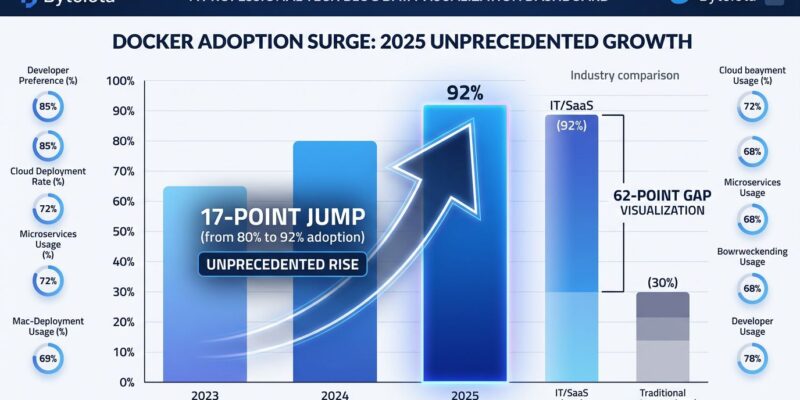
Docker achieved 92% adoption among IT professionals in 2025, marking a historic 17-point year-over-year jump from 80% in 2024—the largest single-year increase of any technology tracked in the Stack Overflow 2025 Developer Survey. This isn’t gradual growth. It’s a tipping point. Docker crossed the ~90% adoption threshold where developer tools stop being choices and become infrastructure. For comparison, Git followed the same trajectory from 2010-2015, rising from 87% to 94% usage.
The 17-point surge signals millions of developers who avoided containers for years finally adopting them en masse. What triggered this inflection point reveals broader patterns about how technologies become universal standards.
The 17-Point Jump: Largest Single-Year Increase
Stack Overflow’s 2025 survey explicitly labeled Docker’s 17-point adoption increase as “the largest single-year increase of any technology surveyed.” That includes AI tools, cloud platforms, programming languages, and frameworks—Docker outpaced everything. The numbers break down to 71.1% of professional developers using Docker (+17 YoY) and 92% of IT professionals, ranking Docker as the #1 cloud development tool across 49,000+ respondents in 177 countries.
This isn’t a survey anomaly. Docker’s official announcement confirmed the surge: “Docker just hit #1… +17 point surge, the biggest jump of any tech.” When a tool jumps 17 points in one year, the industry has collectively decided “this is no longer optional.” Developers who resisted containers throughout the 2020s are now adopting them, driven by forces beyond Docker’s technical merits.
The 62-Point Industry Gap: IT/SaaS vs Traditional
Beneath the headline adoption number lies a more revealing story: while IT/SaaS companies have reached 92% Docker adoption, traditional industries lag at just 30%—a staggering 62-percentage-point gap. This disparity isn’t about Docker awareness or developer skill. It correlates directly with architectural patterns: 68% of IT/SaaS companies use microservices-based architectures versus only 31% of traditional industries.
The gap tells the real story. Docker adoption isn’t driven by Docker’s features alone—it’s driven by architectural shifts (monoliths to microservices) and infrastructure changes (on-prem to cloud-native). When your architecture is microservices and deployment is cloud-native, containers become required infrastructure, not optional tooling.
Related: Cloud Repatriation 2026: 80% Bring Workloads Back On-Prem
The 30% of traditional industry developers who haven’t adopted containers represent either laggards in classic technology diffusion curves or companies that genuinely don’t need microservices yet. Both are valid. The gap illuminates which industries are undergoing cloud-native transformation (IT/SaaS at 92%) and which aren’t (manufacturing, retail, government at 30%).
What Triggered the Tipping Point: Three Trends Converged
Docker didn’t become 17 points more valuable in 2024. The context changed. Three major trends converged in 2024-2025 to make containers essential rather than beneficial: remote development exploded, microservices became standard, and AI/ML workloads drove Python containerization demand.
Remote development environments jumped from 36% of developers in 2024 to 64% in 2025—a 28-point shift in one year, according to software development statistics. Remote development demands environment consistency by default. “Works on my machine” becomes “works in any container runtime,” solving the primary pain point of distributed teams. Docker’s value proposition shifted from “nice to have” to “required for remote collaboration.”
Microservices became standard for 70% of enterprise apps by 2025. Each service requires isolated dependencies, independent scaling, and separate deployment lifecycles—problems containers solve natively. Meanwhile, cloud-native adoption hit 95%+ for new workloads (up from 30% in 2021). Cloud-native architecture means containers plus orchestration. When Kubernetes became the production standard (95% of clusters use containerd), Docker became the build-time standard.
AI/ML workload growth added fuel to the fire. Python containerization exploded as data science teams grappled with conflicting ML library versions, different Python runtimes, and GPU sharing requirements—all solved by container isolation. Developers who could avoid containers in the monolith/on-prem era can’t avoid them in the microservices/cloud-native/remote era.
Git’s Journey: When Tools Become Universal Infrastructure
Docker’s 2025 adoption curve mirrors Git’s transformation from 2010-2015. Git grew from 87.1% in 2016 to 93.87% by 2025, according to version control system popularity data. The critical threshold was ~90%—the point where a tool stops being a “choice” and becomes “infrastructure.” Docker crossed that threshold in 2025.
At 92%, Docker is now a prerequisite skill for IT/SaaS careers, not a differentiator. Job postings stopped saying “Git experience required” around 2015 because everyone had it. Same trajectory for Docker now. The implication: developers without container skills face career limitations in IT/SaaS roles, though traditional industries still offer a 30% market segment without this requirement.
Technology adoption follows predictable patterns: innovators (2-5%), early majority (34%), late majority (34%), laggards (16%). Docker’s 17-point jump marks the late majority breakthrough—the moment skeptics are convinced by mainstream adoption. This isn’t about Docker evangelism. It’s about architectural requirements forcing adoption regardless of tool preference.
Business Metrics Confirm the Shift
Survey adoption numbers can be self-reported and biased. Revenue data confirms developers aren’t just saying they use Docker—they’re paying for it. Docker reached $207M ARR in 2024 (up from $20M in 2021), with 1M+ paid subscriber seats. Docker Hub processed 318B lifetime pulls and 13B monthly downloads. The container market grew from $6.12B in 2025 to a projected $16.32B by 2030 (21.67% CAGR).
The 1M+ paid seats represent enterprises enforcing container standards. Docker Desktop licensing requires paid subscriptions for companies with 250+ employees or $10M+ revenue at $21/user/month. That’s not hobby usage—it’s embedded in enterprise infrastructure spending. Seventy-five percent of Fortune 100 companies use Docker, and Docker’s $2.1B valuation (15x revenue multiple) reflects investor confidence in sustained adoption.
The 13B monthly Hub pulls show production usage at massive scale. This isn’t developers experimenting locally. These are CI/CD pipelines, production deployments, and automated workflows pulling images billions of times monthly. When industry analysis says “Docker has crossed the chasm from ‘useful tool’ to ‘essential infrastructure,'” the revenue data backs it up.
Key Takeaways
- Docker’s 17-point adoption jump (80% to 92%) represents the largest single-year increase of any technology in Stack Overflow’s 2025 survey—outpacing AI tools, cloud platforms, and programming languages.
- The 62-point industry gap (IT/SaaS at 92% vs traditional industries at 30%) reveals which sectors have shifted to microservices and cloud-native architectures versus those still running traditional monoliths.
- Three converging trends triggered the tipping point: remote development (64% use non-local environments), microservices adoption (70% of enterprise apps), and AI/ML workload growth demanding Python containerization.
- Docker crossed the ~90% adoption threshold where tools become infrastructure rather than choices—following the same pattern Git followed from 2010-2015 when it became the universal standard for version control.
- Container skills are now table stakes for IT/SaaS careers, not résumé differentiators—similar to how Git experience became assumed rather than highlighted by 2015.
- Revenue data confirms the shift: Docker’s $207M ARR, 1M+ paid seats, and 13B monthly Hub pulls show enterprise adoption backed by infrastructure spending, not just survey responses.
When a technology jumps 17 points in one year, the industry has spoken: this is the new default. Docker’s journey from popular tool to universal standard is complete for IT/SaaS, with traditional industries lagging by design, not by delay.