 By
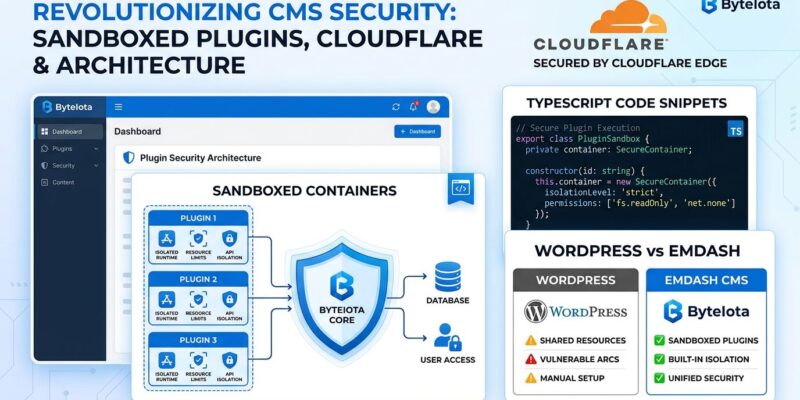
By WordPress plugin vulnerabilities hit a record 48,185 CVEs in 2025, with 96% of WordPress security issues originating in third-party plugins according to Patchstack’s mid-year report. The numbers tell a grim story: 19,000 high or critical severity vulnerabilities, 135 unpatched flaws by year’s end, and examples like the Post SMTP plugin breach (CVSS 9.8) affecting 400,000 sites. Cloudflare’s response launched April 1, 2026: EmDash, a TypeScript CMS built on Astro 6.0 that isolates each plugin in sandboxed Dynamic Workers with explicit permission manifests. The catch? EmDash ships with zero plugins while WordPress maintains 60,000+ and 43% CMS market share, framing the fundamental question: Can superior architecture overcome ecosystem lock-in?
Sandboxed Plugins: How EmDash Fixes WordPress’s Root Flaw
Traditional WordPress plugins receive unrestricted access to your database, filesystem, and network by default—any plugin can do anything. EmDash’s architecture inverts this model entirely. Each plugin runs in an isolated Cloudflare Dynamic Worker sandbox and “can only perform the actions explicitly declared in its manifest,” according to Cloudflare’s announcement. Permissions work like OAuth scopes: a notification plugin might request read:content and email:send capabilities, with network access limited to declared hostnames like api.mailgun.com. Administrators see every requested permission before installation—no hidden access, no surprise security breaches.
The technical stack reflects modern web development: TypeScript throughout, Astro 6.0 for content-focused sites, serverless-first design optimized for Cloudflare Workers, and Portable Text (structured JSON) replacing WordPress’s HTML storage. MIT licensing instead of WordPress’s GPL offers additional flexibility. When a plugin fails or gets compromised in EmDash, the blast radius stays contained within its sandbox. In WordPress, a single vulnerable plugin can cascade across your entire site.
The Ecosystem Paradox: Right Architecture, Empty Shelves
CMSwire’s verdict captured the tension perfectly: “Right Architecture, Empty Ecosystem.” EmDash launches with zero plugins against WordPress’s 60,000+. No themes. No community. No 23 years of accumulated ecosystem development. History offers uncomfortable lessons here—superior technology doesn’t guarantee success. VHS beat Betamax despite worse quality. WordPress dominated MovableType not through technical superiority but ecosystem advantages. PHP won web development via hosting ubiquity, not language elegance.
Migration complexity amplifies the challenge. EmDash’s WordPress import tool handles content only—themes and plugins require manual recoding from PHP to TypeScript. Portable Text versus HTML storage creates additional conversion friction. AI-assisted migration exists in theory, but InfoQ’s analysis notes “replicating an existing WordPress site in EmDash will not be easy.” The realistic use case? New projects, not migrations.
Developer reactions split predictably. Praise for “TypeScript and Worker plugins” as technical improvements, skepticism about market viability. WordPress co-founder Matt Mullenweg dismissed EmDash as “created to sell more Cloudflare services,” arguing plugin security only works on Cloudflare’s platform—vendor lock-in masquerading as innovation. Hacker News called it “the polar opposite of the direction CMSes need to go,” and critics noted the missing point-and-click builder that makes WordPress accessible to non-developers.
Cloudflare vs. WordPress: Infrastructure Giant Meets Entrenched Incumbent
The market matchup reveals asymmetric advantages. Cloudflare brings global edge infrastructure, serverless Workers platform already deployed at scale, developer credibility in modern stacks, and capital for long-term investment. WordPress counters with 43% market share, 60,000 plugins, 23 years of community knowledge, and self-hosting options decoupled from any single vendor.
Cloudflare’s Achilles heel? Zero CMS credibility and the perception that EmDash exists primarily to drive Workers adoption. Mullenweg’s counterattack focused precisely here—security benefits vanish outside Cloudflare’s platform, creating classic lock-in. He suggested “OpenClaw” as a more credible WordPress successor, positioning EmDash as a vendor play rather than genuine open-source innovation.
WordPress’s vulnerability remains equally real. The 48,185 CVEs in 2025 validate EmDash’s problem statement. Legacy PHP architecture looks dated against modern TypeScript. Centralized hosting competes poorly with edge/serverless trends. A 23-year-old codebase carries technical debt that sandboxed, greenfield architecture doesn’t.
Practical Decision Framework: When EmDash Makes Sense
Consider EmDash if you’re starting new projects on Cloudflare infrastructure with developer-focused teams comfortable in TypeScript and Astro, prioritize security above ecosystem breadth, embrace edge-first/serverless architecture, and can build custom functionality rather than relying on plugins. The limited ecosystem becomes acceptable when you’re writing code anyway.
Stick with WordPress for existing sites where migration complexity outweighs security gains, projects requiring specific plugins unavailable in EmDash, non-technical content teams needing point-and-click builders, self-hosting requirements independent of Cloudflare, or risk-averse scenarios where ecosystem maturity matters more than architectural elegance.
What to Watch: Success and Failure Signals
Plugin ecosystem growth rate will determine EmDash’s fate. Zero plugins at launch must reach meaningful scale—hundreds at minimum—within 12 months to signal traction. Major theme developers adopting EmDash would validate commercial viability. Enterprise or agency migrations would signal institutional confidence. Active community contribution velocity separating genuine adoption from Cloudflare astroturfing.
Failure looks like ecosystem staying minimal, no significant WordPress migrations materializing, community contribution stalling after initial launch buzz, platform lock-in persisting without Cloudflare-independent deployment options, or better alternatives emerging—Mullenweg’s OpenClaw mention hints at WordPress ecosystem countermoves.
The Architecture vs. Ecosystem Question Remains Open
EmDash’s sandboxed plugin architecture genuinely solves WordPress’s root security flaw—capability-based permissions and isolated execution prevent the cascade failures that generated 48,185 CVEs in 2025. The TypeScript/Astro/Edge stack aligns with modern development preferences. Cloudflare’s infrastructure scale provides deployment advantages WordPress can’t match.
But ecosystem effects are real. Network effects compound over decades—WordPress’s 23-year head start and 60,000 plugins create switching costs EmDash must overcome. History suggests better technology loses to better ecosystems more often than not. EmDash’s challenge isn’t building a superior CMS—Cloudflare arguably succeeded there. The challenge is building a superior CMS that enough developers choose despite starting from zero.
For new projects on Cloudflare with security-conscious developer teams, EmDash offers genuine advantages today. For everyone else, watch the ecosystem growth metrics over the next 12 months. Superior architecture matters, but market adoption matters more. EmDash’s fate depends on which force proves stronger.