PostgreSQL hit 55.6% developer adoption in the 2025 Stack Overflow survey, the largest annual expansion in its history. New projects choose PostgreSQL over MySQL at a 3:1 ratio. The database wars are over. PostgreSQL won.
The Numbers Behind the Shift
The 2025 Stack Overflow Developer Survey tells the story in hard numbers. PostgreSQL jumped from 48.7% adoption in 2024 to 55.6% in 2025, a 7 percentage point leap that represents the fastest growth in PostgreSQL’s 35-year history. MySQL sits at 40.5%, a 15 percentage point gap that widens every year.
Among professional developers, the gap is even starker: 58.2% use PostgreSQL. That’s an 18.6 point lead.
PostgreSQL won first place in all three database metrics for the third consecutive year: most used, most admired (65%), and most desired (46%). The DB-Engines ranking confirms the trend. PostgreSQL gains points consistently year over year. MySQL plateaus.
For new projects in 2026, developers choose PostgreSQL over MySQL at a 3:1 ratio. The default shifted.
Why PostgreSQL Won
PostgreSQL didn’t win through marketing. It won because developers choose it bottom-up for technical merit. The extension ecosystem is the capability gap MySQL can’t close.
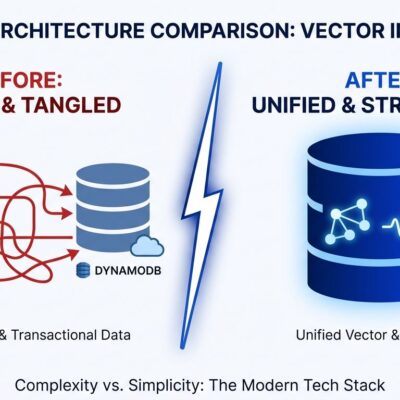
pgvector made PostgreSQL the default data layer for AI applications. Vector embeddings for semantic search, recommendation engines, and RAG implementations run on PostgreSQL. MySQL isn’t even in the conversation. When you need to query vectors alongside relational data, PostgreSQL does it natively. MySQL requires a separate database.
PostGIS turned PostgreSQL into a geospatial database without adding complexity. Citus enables horizontal scaling. TimescaleDB handles time-series data. One database covers relational, JSON, vector search, geospatial, and time-series workloads. MySQL requires multiple specialized systems for the same range.
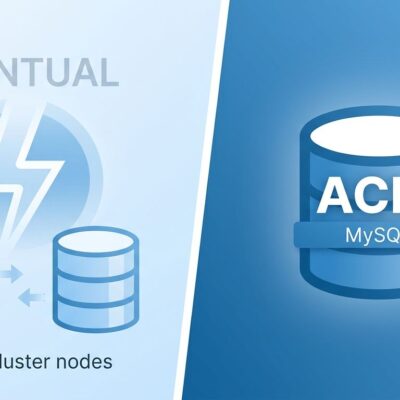
The 2026 benchmarks back it up. PostgreSQL 17 and 18 deliver 4.9x faster inserts and 3.5x lower write latency than MySQL. In specific tests, PostgreSQL hit 23,441 queries per second with 1.372ms mean latency. MySQL managed 6,300 QPS with 12.813ms latency.
MySQL retains a 20-30% edge in simple reads. For complex queries with CTEs, window functions, and JSONB filtering inside joins, PostgreSQL’s optimizer has a fundamentally deeper understanding.
MySQL Isn’t Dead
40.5% adoption isn’t marginal. MySQL powers millions of production systems and won’t disappear.
WordPress alone ensures MySQL’s relevance for decades. The entire WordPress ecosystem runs on MySQL. Migrating WordPress off MySQL makes no technical sense. That’s millions of sites running MySQL forever.
MySQL 8.4 LTS makes sense for simple read-heavy OLTP where 90% of queries are basic SELECTs. For straightforward CRUD operations, MySQL’s operational simplicity is an advantage. Teams with deep MySQL expertise and no PostgreSQL knowledge shouldn’t rewrite working systems.
MySQL excels at what it was designed for: fast, simple, reliable reads for web applications. If your application is basic CRUD with no complex queries, no vector search, and no JSON operations, MySQL is fine. Sometimes simpler is better.
MongoDB and the NoSQL Position
MongoDB holds 25% developer adoption in the Stack Overflow 2025 survey, ranking fifth overall. In the NoSQL space, MongoDB dominates with 45.60% market share. Amazon DynamoDB sits at 11.15%.
More than 70% of the Fortune 100 run MongoDB in production. The NoSQL market grew from $16.95 billion in 2025 to a projected $22.22 billion in 2026.
MongoDB thrives because the document-oriented data model fits specific use cases. Flexible schemas for agile development, unstructured data, and rapid iteration favor documents over relational tables. MongoDB’s Atlas Vector Search expansion shows NoSQL adapting to AI workloads.
PostgreSQL’s JSONB support challenges MongoDB for some workloads. Developers who need both relational structure and document flexibility choose PostgreSQL. But for truly schema-less, document-heavy applications, MongoDB still wins.
What This Means for Developers
PostgreSQL is the default for relational data in 2026. New projects start with PostgreSQL unless you have a specific reason to choose otherwise.
Choose MySQL if you’re building for WordPress, running simple CRUD with existing MySQL expertise, or optimizing for basic reads. Choose MongoDB if your data model is document-oriented, schemas change frequently, or you need true schema flexibility.
But for general-purpose relational data with any possibility of needing JSON, vectors, geospatial queries, or complex analytics, PostgreSQL is the answer. The 3:1 new project ratio reflects that reality.
The database wars ended not with a dramatic announcement but with thousands of developers making the same choice independently. PostgreSQL solves more problems out of the box. The numbers prove it.