Half of all developers lose 10 or more hours per week. Not to debugging. Not to complex algorithms. To organizational overhead—email chains, scattered documentation, and bureaucratic friction that has nothing to do with writing code. According to 2026 developer surveys, 90% lose at least six hours weekly, and for companies with 500 developers, that translates to $8 million in wasted productivity annually.
Here’s the paradox: companies pour millions into productivity tools—AI assistants, DevOps platforms, project management software—while the real bottleneck goes ignored. The tools aren’t broken. The organizational processes are.
The AI Productivity Paradox
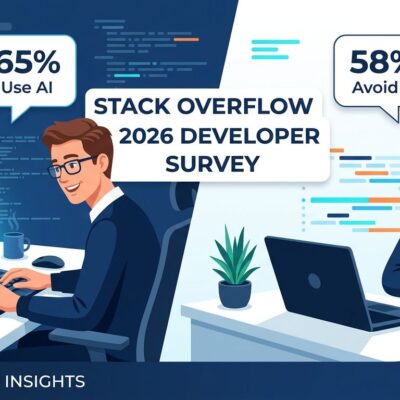
Between November 2024 and February 2026, AI coding tool usage increased by 65%. Pull request throughput? Up just 9.97%. Developers are coding faster, but they’re not shipping faster.
The numbers tell the story. Today, 84% of developers use AI tools, and 42% of committed code is AI-generated or assisted. Seventy-two percent of those who tried AI assistants now use them daily. Yet 96% don’t trust the code they generate, and 38% report that reviewing AI-generated code takes more time than reviewing human-written code. Teams now spend 24% of their work week just checking, fixing, and validating AI output.
The cruel irony? Developers using AI take 19% longer to complete tasks but estimate they’re 20% faster. AI generates code quickly, but the subtle bugs it introduces take longer to debug. The speed gains in coding get consumed by verification bottlenecks downstream.
This isn’t an indictment of AI—it’s an indictment of organizational dysfunction. AI is a band-aid on a broken process. You can’t tool your way out of chaos.
The Real Bottleneck: Organizational Overhead
Developers don’t lose hours to coding problems. They lose hours to everything around coding: documentation scattered across five platforms, critical context buried in Slack threads no one can find, and the same information rewritten in three different tools because nobody knows where the source of truth lives.
Consider the meeting tax. GitHub research found that developers with one meeting per day have a 99% chance of hitting their daily goals. Two meetings drops that to 74%. Three meetings? Fourteen percent. Every additional meeting doesn’t just cost its scheduled time—it fragments focus and destroys flow state.
Then there’s the organizational cruft: documents that no one reads, legacy processes that serve no purpose, useless metrics that get collected but never acted upon, and status meetings that could have been an async update. Companies add Jira, then Asana, then Linear, each adding its own overhead, notifications, and context switching demands. More tools don’t solve the problem—they multiply it.
The Hidden Tax: Context Switching Costs
Gloria Mark’s research at UC Irvine found that it takes an average of 23 minutes and 15 seconds to return to a task after an interruption. Knowledge workers switch tasks every three minutes on average, with significant interruptions every 11 minutes. The arithmetic is brutal: 40% of productivity drains away daily from task-switching alone. In the U.S., context switching costs an estimated $450 billion annually.
The damage isn’t just to efficiency—it’s to mental health. Interruptions elevate cortisol, increase cognitive fatigue, and drive burnout. Sophie Leroy’s research at the University of Washington identified “attention residue”—part of your mind stays stuck on the previous task even after you’ve switched. The more engaging the interrupted task, the greater the residue. A Slack ping doesn’t just cost 23 minutes of recovery time. It costs cognitive bandwidth you can’t get back.
Measurement Is Broken
Traditional DORA metrics capture deployment frequency, lead time, change failure rate, and mean time to recovery. What they don’t capture: the 47% of developer time spent in communication and coordination, the collaboration overhead, the context switching costs, or the developer wellbeing that determines whether your team ships sustainable code or burns out building technical debt.
A team with perfect DORA scores might be delivering fast while burning out or building unmaintainable systems. You manage what you measure, and if you measure story points instead of time-to-value, you optimize for the wrong outcome. Modern frameworks like SPACE (Satisfaction, Performance, Activity, Communication, Efficiency) and DX Core 4 (feedback loops, cognitive load, flow state) try to address this gap. Research shows each one-point improvement in developer experience saves 13 minutes per developer per week—but only if you measure and act on it.
What Actually Works
The solution isn’t another tool. It’s process discipline. Teams that adopted async-first communication, documentation consolidation, and deep work protection report measurable gains—85% of remote businesses see productivity improvements after implementing async collaboration practices. GitLab, Doist, and Basecamp prove async-first works at scale.
Here’s what works: Default to asynchronous, written communication. Batch responses into two windows per day instead of real-time replies. Pick one documentation tool—Notion or Confluence, not both—and kill everything else. Consolidate to a single source of truth and enforce it with organizational discipline, not more software.
Protect deep work ruthlessly. Time-block 50 to 90-minute focus sessions with 10 to 20-minute recovery breaks. Limit meetings to one per day. Use Slack status to signal when you’re unavailable. Kill useless processes: the documents no one reads, the status meetings that should be async, the metrics that don’t drive decisions. Reducing interruptions improved daily progress from 7% to 82% in GitHub’s research. That’s not marginal—it’s transformational.
Stop buying tools to fix broken processes. Async-first communication, documentation consolidation, and deep work protection cost nothing. What they require is organizational discipline—the one thing no vendor can sell you.