 By ByteBot
TanStack has evolved from a single data-fetching library (React Query) into a nine-tool ecosystem that’s challenging how developers build React applications. The March 2026 TanStack Start framework delivered 5.5x throughput improvements and emerged as the SSR performance leader with 13ms average latency at 1,000 req/s—while Next.js struggles at the same load. Combined with TanStack Intent’s AI-ready npm packages (announced March 4, 2026), the ecosystem now spans data fetching to full-stack frameworks to agent-driven development. The question for React developers: adopt the TanStack ecosystem for type-safety and performance, or stick with Next.js’s mature ecosystem and battle-tested conventions?
## Nine Tools, One Type-Safe Philosophy
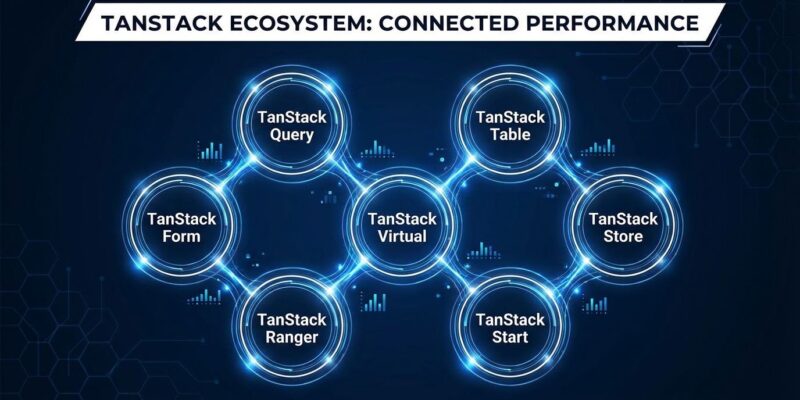
TanStack has expanded to nine interconnected, framework-agnostic libraries: Query (data fetching), Router (type-safe routing), Table (headless datagrids), Form (form state), Virtual (list virtualization), Store (client state), DB (reactive database, v0.6 alpha), AI (framework-agnostic AI SDK, alpha), and Start (full-stack framework, v1.0). Each library is standalone—use Query without Router, Table without Form—but they share end-to-end type safety across the stack.
The ecosystem follows a “client-first with server capabilities” philosophy. TanStack Start treats apps as SPAs that gain SSR benefits, not server apps with client exceptions. This architectural choice differs fundamentally from Next.js’s “server-first with client hydration” approach. Developers get explicit primitives instead of convention-based magic—you see the wiring, you control the flow.
Maturity varies dramatically across the ecosystem. Query, Router, Table, Form, and Virtual are production-ready and battle-tested. Start reached v1.0 in March 2026 alongside Store, making them stable but newer. DB (v0.6) and AI remain in alpha—too early for production but revealing TanStack’s full-stack ambitions. Incremental adoption matters: start with proven tools, wait on experimental ones.
## Performance Benchmarks That Separate Hype From Reality
TanStack Start’s March 2026 benchmarks delivered numbers that matter. Throughput jumped from 427 req/s to 2,357 req/s (5.5x improvement). Average latency dropped from 424ms to 43ms (9.9x faster). P99 latency improved from 6,558ms to 928ms (7.1x faster). Independent Platformatic benchmarks confirmed TanStack Start handling 1,000 req/s with 13ms average latency, outperforming React Router (18ms) and Next.js (which “continues to have trouble” at the same load).
The developer experience gains are equally stark. Built on Vite, TanStack Start delivers 2-3s local startup versus Next.js’s 10-12s. Hot module replacement drops from 836ms to 335ms. Production builds run 7x faster in CI. The baseline bundle shrinks from Next.js’s 92KB gzipped to 42KB. These aren’t theoretical improvements—they’re the numbers developers report when migrating from Next.js to TanStack Start.
Performance leadership doesn’t happen by accident. TanStack Start’s 252x improvement across seven versions demonstrates active optimization focus. The Vite foundation explains why TanStack feels “lighter and faster” than Webpack-based frameworks. When performance is critical—globally distributed APIs, latency-sensitive operations—the benchmarks provide objective criteria for choosing TanStack Start over Next.js.
## AI-Ready Development: TanStack Intent Ships Agent Skills
TanStack Intent (announced March 4, 2026) positions the ecosystem ahead of the AI-driven development curve. It enables library maintainers to ship AI agent skills alongside npm packages using the Agent Skills spec (open standard, December 2025 by Anthropic). When developers run @tanstack/intent install, the CLI discovers intent-enabled packages and wires skills into agent configuration—AI assistants (VS Code, GitHub Copilot, Claude Code, Cursor) understand TanStack tools natively.
Skills travel with libraries via npm update, not model training cutoff or copy-pasted rule files. Each skill declares its source docs, and when those docs change, @tanstack/intent stale flags the skill for review. Running it in CI gets a failing check when sources drift—skills become part of your release checklist. The Agent Skills spec is already adopted by VS Code, GitHub Copilot, OpenAI Codex, Cursor, Claude Code, Goose, and Amp.
This isn’t a gimmick. As agent-driven development becomes mainstream, libraries that ship agent skills will have a competitive advantage. TanStack Intent represents the future: tools that AI assistants understand automatically, reducing friction between human intent and machine execution. Most TanStack articles miss this angle, focusing only on frameworks and performance. The AI integration is where TanStack’s strategic thinking shines.
## When to Adopt TanStack: The Decision Framework
Start with Query. Add Router if you’re starting fresh. Add others only when you hit a specific pain point they solve. This incremental approach, recommended by the TanStack community’s comprehensive 2026 guide, prevents ecosystem overwhelm. For small projects (<5 routes), Query alone with React Router suffices. Medium apps (SaaS, internal tools) benefit from Query + Router, conditionally adding Table or Form. Large enterprises should validate Query + Router + Table as proven, evaluate Form and Store carefully, and wait on DB and AI.
TanStack Start wins on specific criteria: deployment flexibility (Cloudflare Workers, not locked to Vercel), performance (13ms latency beats Next.js), and explicit architecture (less “magic,” more control). Next.js wins on ecosystem maturity, React Server Components (TanStack Start doesn’t support RSC yet), and enterprise support. The trade-offs are real and project-specific.
Kyle Gill’s migration advice cuts through the noise: “Do not migrate for the sake of migrating. If your Next.js app works, your team is productive, and you’re not hitting significant pain points, stay where you are. Framework migrations are expensive and the grass is not always greener.” Greenfield projects needing deployment flexibility justify TanStack Start. Existing Next.js apps working well don’t. The decision framework isn’t about TanStack being “better”—it’s about matching architectural philosophy to team needs.
## Developer Sentiment: Clarity Versus Maturity
Community reactions split predictably. Developers migrating from Next.js praise TanStack’s experience: “When I first tried it, I thought I was missing something because it was so easy—it just worked. The developer experience made me question several choices I made with Next.js.” They appreciate getting “back control over how things actually work” and TanStack’s “clarity and lightness.” The Vite performance gains (10x faster HMR, 7x faster builds) validate frustrations with Next.js’s Webpack toolchain.
Concerns center on ecosystem immaturity and learning curve. TanStack Start just hit v1.0—fewer production stories, fewer Stack Overflow answers, fewer community tutorials than Next.js. The data loading mental model shift (Server Components → loaders, Server Actions → createServerFn) isn’t trivial. Hiring market realities matter: more developers know Next.js than TanStack, creating onboarding friction.
Common pitfalls trip up new users predictably. First, duplicating server state by mapping TanStack Query data to Redux or Context—Query IS your server state, don’t copy it elsewhere. Second, query keys missing dynamic values: ['todo'] instead of ['todo', id] means data never updates. Third, creating QueryClient inside components instead of module level. For TanStack Start specifically, pnpm version matters (use v9+, not v7), SSR library integration needs correct Node.js polyfills, and server/client loader behavior differs from Next.js (initial load = server-side, subsequent navigations = client-side). These gotchas are documented but not obvious.
// src/routes/user.$id.tsx - File-based routing with type-safe params
export const Route = createFileRoute('/user/$id')({
  component: RouteComponent,
})

function RouteComponent() {
  const { id } = Route.useParams()  // Fully type-safe!
  return User {id}
}
## Key Takeaways
- TanStack expanded from React Query to a nine-tool ecosystem with end-to-end type safety, offering production-ready tools (Query, Router, Table) and experimental ones (DB, AI in alpha)—incremental adoption prevents overwhelm
- Performance benchmarks show TanStack Start leading SSR frameworks with 13ms latency at 1,000 req/s, 5.5x throughput improvements, and 7x faster builds versus Next.js, driven by Vite’s foundation
- TanStack Intent (March 4, 2026) ships AI agent skills with npm packages via the Agent Skills spec, positioning the ecosystem for agent-driven development as AI assistants understand TanStack tools natively
- Adopt TanStack for greenfield projects needing deployment flexibility and performance, but don’t migrate existing Next.js apps unless hitting specific pain points—framework migrations are expensive and often unjustified
- TanStack’s client-first philosophy (SPAs with SSR benefits) differs fundamentally from Next.js’s server-first approach (server apps with client hydration), making architectural fit more important than performance alone