 By ByteBot
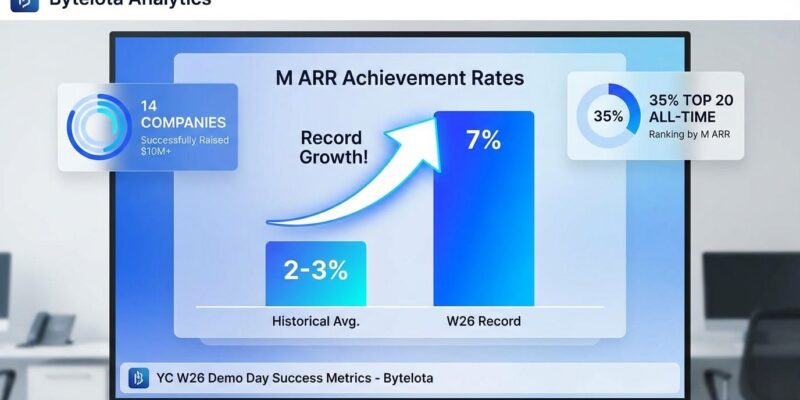
Y Combinator’s Winter 2026 Demo Day wrapped up last week (March 24-26) with 14 startups hitting $1 million in annual recurring revenue before presenting—seven percent of the roughly 190-company batch. That’s the highest milestone achievement in YC’s history, where typically only 3-5 companies per batch (~2-3%) reach this mark. More striking: Rebel Fund’s machine learning algorithm, which has scored every YC batch since 2013, determined that 35% of W26 startups rank in the top 20% of all YC companies ever evaluated. No previous batch has come close.
The numbers aren’t impressive because YC selected better founders. They’re impressive because the environment changed. AI has compressed the timeline from idea to $1M ARR by 10x, with companies like Hex Security reaching the milestone in just eight weeks versus the traditional 12-18 months for SaaS startups.
YC W26 Demo Day Performance Breaks Records
The 14 companies hitting $1M+ ARR represent more than a statistical outlier. According to YC CEO Garry Tan, “About 7 percent of YC startups do it”—and W26 delivered exactly that percentage in a single batch. For context, historical averages sit at 2-3% per cohort. One company even entered Demo Day at $27 million ARR, the highest in the batch.
Rebel Fund’s analysis adds weight to these claims. Founder Jared Heyman noted that “35% of W26 startups score in the top 20% of all YC companies ever evaluated.” Rebel Fund has invested millions developing Rebel Theorem 4.0, a machine learning algorithm that analyzes hundreds of features across 13 years of YC data. When more than a third of a batch scores in the all-time top quintile, the implications are clear: W26 could be YC’s highest-returning cohort ever.
Moreover, the distribution itself shifted. The algorithm showed improvements at the 25th, 50th, and 75th percentiles simultaneously—more predicted successes, fewer predicted zombies. This isn’t about a handful of outliers carrying a mediocre batch. The entire curve moved right.
How AI Startups Hit $1M ARR in 8 Weeks
Hex Security hit $1M ARR in eight weeks. Luel approached $2M ARR in six weeks. These aren’t anomalies—they’re symptoms of a fundamental acceleration in how fast companies can build and scale revenue in 2026.
The driver is obvious: AI tools have compressed every aspect of company building. Development cycles are faster with code generation. Customer acquisition accelerates through automated outreach and AI-powered sales tools. Operations run leaner with AI handling tasks that previously required entire teams. According to analysis from Tremendous.blog, “AI has made every aspect of running a company faster. You can code faster, contact leads faster, even raise money faster.”
Consequently, this creates a virtuous cycle. Enterprises desperate to avoid AI-driven obsolescence rush to adopt AI solutions, creating ready markets for AI-powered products. Vendors can scale revenue explosively because customers are eager and budgets are open. The old baseline—$100k ARR meant you were a top performer—no longer applies. In 2026, $1M ARR is the new elite tier, and $100k is the expected minimum.
B2B Infrastructure Wins, Consumer Fades
The batch composition tells the story investors care about: 64% B2B, only 5% consumer-facing, 60% AI-powered. This is the starkest B2B domination in YC’s history. The startups winning are building infrastructure, vertical agents, and AI-native workflows for hard technical problems.
Notable examples include Constellation Space (AI for satellite mission assurance, founded by SpaceX and NASA veterans), Vela (AI-powered complex scheduling), Captain (automated RAG setup in three minutes), and Hex Security (infrastructure security, $1M ARR in eight weeks). These aren’t consumer apps with viral growth dreams. They’re enterprise tools solving expensive operational problems.
Furthermore, YC’s Spring 2026 Requests for Startups confirms the trend. All ten priority areas are B2B or infrastructure: AI-native product management tools, stablecoin financial services, AI for government operations, LLM training infrastructure. Consumer is dead for now. If you’re building a consumer product, you’re fighting against a 64-to-5 funding ratio.
Lessons for Developers from YC W26 Demo Day
The bar has permanently risen. Investors now expect $100k ARR minimum for serious consideration, and $1M ARR is becoming standard for top performers—up from the historical 2-3% to 7% of elite batches. Speed matters: an eight-week path to $1M ARR is achievable, but it requires AI-native development, B2B focus, and enterprise customers desperate for solutions.
Rebel Fund’s predictive factors offer a roadmap: younger founders correlate with success (W26 skews younger), Bay Area location matters (batch is more Bay Area-heavy than recent cohorts), B2B focus is critical (64% of batch), and AI infrastructure plays win (60% AI-powered). Top performers in W26 are raising at $50-100M valuations, with the highest reaching $200M—the steepest Demo Day valuation in six years.
However, the good news: the barrier to building successful companies has lowered. AI tools accelerate development, modern infrastructure is mature and accessible, and iteration cycles are faster than ever. The bad news: expectations rose in lockstep. Investors want revenue traction, not just potential. Building AI-native products for enterprise customers isn’t optional anymore—it’s table stakes.
Key Takeaways
- Fourteen companies (7% of YC W26) hit $1M+ ARR by Demo Day, shattering the historical 2-3% average and proving AI has fundamentally compressed revenue growth timelines
- Rebel Fund’s ML algorithm scored 35% of W26 startups in the all-time top 20%—unprecedented in 13 years of YC batch analysis, suggesting this could be the highest-returning cohort ever
- AI tools compressed the path to $1M ARR from 12-18 months to 6-8 weeks for top performers like Hex Security and Luel, creating a new speed baseline developers must match
- B2B infrastructure dominates with 64% of batch (vs 5% consumer), signaling where smart money flows: vertical agents, AI-native workflows, and hard technical problem-solving
- The bar has risen permanently—$100k ARR is now the expected minimum, $1M ARR is the new elite tier, and slow execution gets punished in the AI era
The W26 data isn’t just about one exceptional batch. It’s evidence that the playbook for building successful startups has fundamentally rewritten itself in 2026, and developers ignoring these trends are competing with one hand tied behind their backs.