 By ByteBot
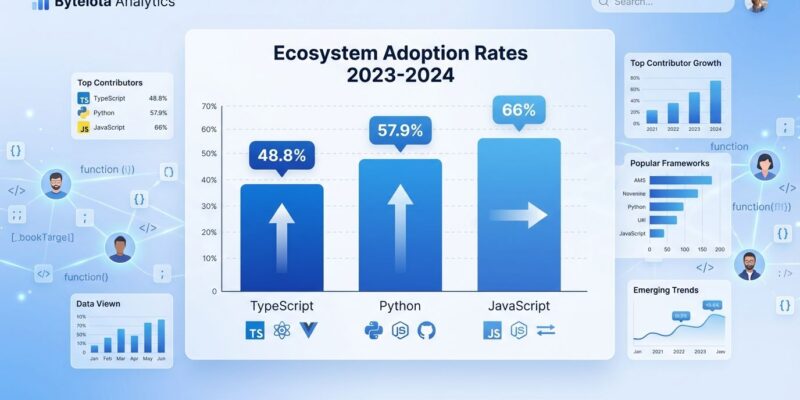
TypeScript reached a historic milestone in August 2025: it overtook both JavaScript and Python to become the #1 language on GitHub by contributor count, hitting 2.6 million monthly contributors with 66% year-over-year growth. Meanwhile, Python experienced its most dramatic single-year surge in over a decade, jumping 7 percentage points to 57.9% adoption in the Stack Overflow 2025 survey, driven by explosive AI/ML adoption. But the most surprising trend isn’t what’s growing—it’s what’s plateaued. JavaScript, PHP, and SQL have hit their “maturity plateau” according to JetBrains: still dominant, but no longer growing.
These shifts aren’t just statistics. They’re reshaping hiring priorities, training budgets, and technology adoption decisions at thousands of companies. Developers face critical career questions: double down on type-safe languages, pivot to AI-adjacent skills, or embrace low-code? CTOs need this data to justify tech stack choices. Hiring managers need it to forecast talent availability.
TypeScript’s Historic GitHub Takeover
In August 2025, TypeScript became the #1 language on GitHub by contributor count for the first time ever, reaching 2,636,006 monthly contributors and overtaking Python by roughly 42,000 developers. GitHub called it “the most significant language shift in more than a decade.” The numbers tell the story: 66% year-over-year growth, 48.8% of GitHub repositories now use TypeScript, and 73% of developers are switching from JavaScript to TypeScript.
This represents the triumph of type safety over flexibility. After decades of “move fast and break things,” the industry now prioritizes catching errors before production. AI-assisted development amplified this shift: a 2025 study found 94% of LLM-generated compilation errors were type-check failures. Type systems reduce ambiguity and catch AI-generated bugs before they ship.
Every major framework now scaffolds TypeScript by default: Next.js 15, Angular 18, SvelteKit 2, Astro 3, Remix. Starting a new project in vanilla JavaScript means swimming upstream against the ecosystem. The data backs this up: 78% of job postings now require TypeScript. It’s no longer an optional skill—it’s the default expectation.
// JavaScript: Error at runtime (production bug)
function calculateDiscount(price, percent) {
  return price * (percent / 100);
}
calculateDiscount(100, 150); // Returns 150 (bug: 150% discount!)

// TypeScript: Error at compile time (caught before production)
function calculateDiscount(price: number, percent: number): number {
  if (percent  100) {
    throw new Error('Percentage must be 0-100');
  }
  return price * (percent / 100);
}
// TypeScript catches this error before code ships
Python’s AI-Driven 7-Point Surge
Python experienced its most dramatic single-year growth in over a decade, surging 7 percentage points from 2024 to 2025 to reach 57.9% adoption in the Stack Overflow 2025 survey. This isn’t organic growth—it’s AI-driven. Python is the lingua franca of AI/ML, and as AI dominates tech investment, Python becomes essential. The Stack Overflow report noted: “After more than a decade of steady growth, Python’s adoption has accelerated significantly.”
The job market confirms this shift. There are 64,000+ open AI/ML positions in the US alone, nearly all requiring Python skills. But Python’s surge isn’t just about data science notebooks and model training. It’s also reshaping backend development through FastAPI, which jumped +5 points in the Stack Overflow survey to reach 14.8% adoption—the fastest-growing Python framework. Among Python developers specifically, FastAPI adoption hit 38%, up from 29% in 2023, a 40% year-over-year increase.
Over 50% of Fortune 500 companies now use FastAPI in production, including Netflix, Uber, and Microsoft. The reason? Async-first design, automatic API documentation, and tight integration with AI/ML workflows. Python’s growth engine isn’t traditional CRUD applications—it’s AI agent development, LLM orchestration, and machine learning infrastructure. Developers who ignore Python risk missing the biggest platform shift since mobile.
JavaScript’s Maturity Plateau
JavaScript, PHP, and SQL have hit their “maturity plateau” according to JetBrains’ Language Promise Index 2025, based on 24,534 developers across 194 countries. JavaScript still dominates at 66% adoption in Stack Overflow’s survey, but it’s no longer growing. The question shifted from “Should I learn JavaScript?” to “Should I *still* use vanilla JavaScript for new projects?”
The State of JavaScript 2025 survey captured the mood: “After a decade of relentless churn, constant framework launches, and collective ‘JavaScript fatigue,’ the ecosystem has settled. The framework wars are effectively over.” React solidified dominance, Vue is stable, Angular went TypeScript-only. The data bears this out: 40% of State of JS 2025 respondents now use TypeScript *exclusively*, signaling vanilla JavaScript’s decline for new projects.
Maturity plateau doesn’t mean death. JavaScript remains essential—it runs the web, and that’s not changing. But growth has stalled. For developers, this means: keep JavaScript skills sharp, but add TypeScript on top. Don’t abandon JavaScript—you still need to understand the language underneath. For new projects, however, TypeScript-by-default is the new norm. The ecosystem consolidation is actually good news. After years of framework churn, stability beats novelty.
Low-Code Explosion: 70% of New Apps
The biggest disruption isn’t a programming language—it’s who writes code. Low-code platforms show 37.7% CAGR, the fastest growth rate in dev tools. Gartner predicts 75% of large enterprises will deploy at least four low-code tools by 2026. More strikingly, 70% of new enterprise applications will use no-code/low-code by 2026, up from less than 25% in 2020. This isn’t adoption—it’s a fundamental shift in who builds software.
The ROI drives this trend. Traditional custom development for a workflow automation: 3-4 weeks. Low-code approach using Microsoft Power Automate: 2 hours. This isn’t theoretical. Microsoft Power Platform now has over 20 million monthly active users, and 87% of enterprise developers report using low-code for *some* work. The vendors have figured out the sweet spot: use low-code for CRUD apps, workflow automation, and internal tools. Write custom code for complex logic and performance-critical systems.
Developers who dismiss low-code as “not real programming” will miss opportunities. Low-code isn’t replacing developers—it’s shifting them from building CRUD apps to building complex systems and integrations. The smart play: position yourself as a “low-code + custom code” hybrid. Build integrations between low-code platforms and custom APIs. Use low-code for rapid prototyping, write code for the hard 30%.
Growth Languages: The Slow Burn Strategy
While TypeScript and Python dominate headlines, Rust, Go, and Kotlin continue steady year-over-year gains without explosive growth. Rust remains “most admired language” for the 5th year running at 72% admiration rate in the Stack Overflow survey. Go shows 55.8% desire rate with steady traction in backend infrastructure, microservices, and CLI tools. Kotlin maintains Android dominance with 6% of developers wanting to learn it next, per JetBrains.
These languages represent the “slow burn” strategy: high satisfaction, steady growth, but not explosive adoption. Rust is the language you learn for systems programming, embedded development, or performance-critical systems—not general web apps. Companies like Microsoft, Amazon, Dropbox, Discord, and Cloudflare use Rust in production, and the Linux kernel is gradually introducing Rust for safer module development. But job market reality lags: Rust job postings are far behind TypeScript, Python, and Java.
The career advice is clear. Don’t learn Rust expecting immediate job prospects—learn it for systems programming or personal satisfaction. Do learn Go if you work on backend infrastructure or cloud-native systems. Kotlin is essential if you’re in mobile development, where Google’s backing makes it the default for new Android apps. These are niche-dominant languages, not general-purpose winners.
Related: Developer AI Trust Paradox: 84% Use It, 46% Distrust It
Key Takeaways
- TypeScript is now the default for new projects. With 48.8% of GitHub repos using TypeScript and every major framework scaffolding it by default, vanilla JavaScript for new projects means swimming upstream. Keep JavaScript skills, but add TypeScript as the primary layer.
- Python is essential for AI/ML, FastAPI for APIs. Python’s 7-point surge is AI-driven, not backend-driven. If you’re building AI agents, LLM orchestration, or ML infrastructure, Python is mandatory. FastAPI has become the de facto standard for new Python APIs, overtaking Flask and challenging Django.
- JavaScript’s maturity plateau doesn’t mean death. JavaScript still dominates at 66% adoption, but growth has stalled. It’s not dying—it’s mature. For career planning, this means: don’t abandon JavaScript fundamentals, but recognize TypeScript is the growth layer on top.
- Low-code will power 70% of new enterprise apps. This isn’t a fad—it’s a 37.7% CAGR market reality. The hybrid approach wins: use low-code for the easy 70% (CRUD, workflows, internal tools), write custom code for the complex 30%. Developers who dismiss it will miss opportunities.
- Rust, Go, and Kotlin are slow-burn languages. High satisfaction, steady growth, but niche-dominant. Learn Rust for systems programming, Go for backend infrastructure, Kotlin for Android. Don’t expect immediate job market returns—these are long-term strategic bets.
These trends drive real decisions at thousands of companies. CTOs use this data for tech stack choices. Hiring managers forecast talent availability. Developers plan career pivots. The 2026 developer ecosystem has spoken: type safety wins, AI drives Python, JavaScript matures, and low-code disrupts. Ignore at your peril.