 By ByteBot
TypeScript 7.0 launched on January 15, 2026, with a complete compiler rewrite from JavaScript to Go—delivering 10.8x faster compilation, 30x faster type checking, and 2.9x less memory usage. Microsoft’s Project Corsa represents the first major compiler rewrite in TypeScript’s 10+ year history, now production-ready for type checking in large codebases. However, the headline “10x faster” needs context: these gains scale with project size, and the full feature set won’t land until mid-2026.
The Benchmarks: 10x Real for Large Projects
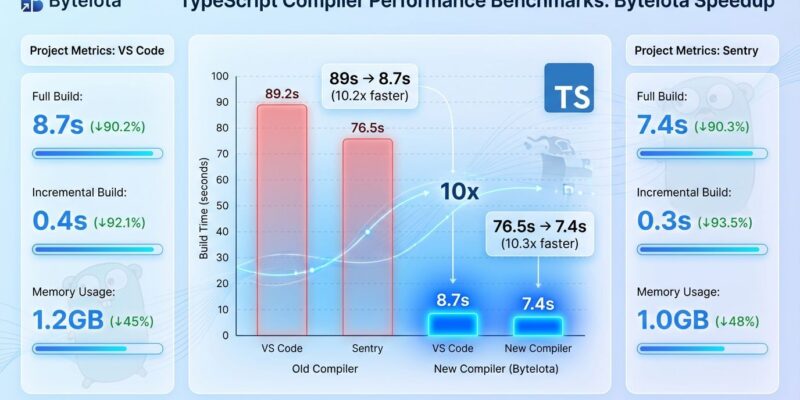
Microsoft’s official benchmarks show dramatic speedups across real-world codebases. VS Code’s 400,000-line TypeScript repo drops from 89 seconds to just 8.74 seconds—a clean 10.2x improvement. Sentry’s build time shrinks from 133 seconds to 16 seconds. Playwright goes from 9.3 seconds to 1.24 seconds.
Here’s the nuance most coverage skips: project size determines your actual gains. Small projects under 100,000 lines see 2-5x speedups—significant, but nowhere near the headline number. Moreover, medium codebases (100k-300k lines) hit 5-8x improvements. Only large projects (400k+ lines) approach that full 10x benchmark. Consequently, if you’re working on a typical web app, expect 3-4x faster builds, not ten.
The memory story is clearer. TypeScript 7 consistently uses 2.9x less memory across all project sizes—23MB versus 68MB peak on Microsoft’s own TypeScript repository. For CI/CD environments where every megabyte of RAM costs money, that’s an immediate win regardless of codebase size.
Why Microsoft Chose Go Over Rust
The language choice reveals Microsoft’s priorities: ship fast, maintain compatibility, avoid complexity. TypeScript dev lead Ryan Cavanaugh explained it plainly: “Do a complete from-scratch rewrite in Rust, which could take years and yield an incompatible version of TypeScript that no one could actually use, or just do a port in Go and get something usable in a year or so.”
Rust would theoretically deliver peak performance, but the borrow checker adds months of development overhead when porting a 200,000-line codebase. In contrast, C++ brings toolchain nightmares and platform-specific build issues. Go hit the sweet spot: native compilation eliminates Node.js startup overhead and V8 garbage collection pauses, goroutines enable straightforward parallelization across files, and the clear memory model made the port manageable.
As a result, Microsoft shipped TypeScript 7’s type checker in under a year. That pragmatism beats chasing theoretical 5-10% extra performance three years from now. Furthermore, Go’s shared-memory parallelism enables multi-threaded single-project builds and parallel multi-project compilation—features that would’ve been significantly harder in Rust.
What Works Now vs What’s Coming Mid-2026
TypeScript 7 (tsgo) is production-ready for type checking today—specifically the --noEmit mode. Type-checking compatibility sits above 98%, with only 74 edge cases differing from tsc 6.0 (most intentional changes). The language service works: code completions, auto-imports, Go-to-Definition, Find-All-References, hover tooltips, and formatting all function correctly.
However, what’s still incomplete? The full JavaScript emit pipeline. Currently, tsgo only supports es2021 and later targets—no downlevel compilation to older JavaScript versions, no decorator support yet. Watch mode (--watch) and incremental compilation (--build) are in progress. Additionally, the VS Code extension with full editor integration lands mid-2026.
This means your migration path looks like: use tsgo for CI type checking immediately (10x faster builds, 2.9x less memory), but keep tsc 6.0 for actual JavaScript output until the emit pipeline completes. Therefore, early adopters report 75% reduction in typechecking time on CI, which translates directly to compute cost savings.
How to Install and Test TypeScript 7 Today
You can benchmark TypeScript 7 on your codebase right now:
# Install TypeScript 7 preview
npm install -g @typescript/native-preview

# Type check your project
npx tsgo --noEmit

# Works with existing tsconfig.json
npx tsgo -p tsconfig.json
The migration strategy is straightforward: install @typescript/native-preview alongside your existing typescript package as a dev dependency. Next, update your typecheck scripts in package.json to replace tsc with tsgo. Test with --noEmit first, benchmark before and after, then integrate into your CI pipeline.
One critical detail: TypeScript 6.0 is a mandatory stepping stone. Microsoft describes it as “the last JavaScript-based release” of TypeScript. Getting your codebase working on 6.0 first means the 7.0 upgrade becomes a simple compiler swap rather than a debugging marathon. Consequently, don’t try to jump directly from 5.x to 7.0.
JavaScript Tools Going Native: The Broader Trend
TypeScript 7 isn’t an isolated decision—it’s the latest datapoint in the JavaScript ecosystem’s wholesale abandonment of JavaScript-based tooling. SWC (Rust) delivers 20x faster transpilation. esbuild (Go) hits 100x faster bundling. Bun (Zig) provides a native JavaScript runtime. Oxc (Rust) rebuilds the parser and linter from scratch.
The pattern is consistent: Node.js startup overhead and V8 garbage collection pauses make JavaScript fundamentally unsuitable for build tooling. Native languages unlock genuine parallelism (threads, not async) and eliminate runtime overhead. When Microsoft—creator of TypeScript—rewrites the official compiler in Go, it validates what the community already knew: getting 10x faster by switching languages isn’t controversial anymore, it’s expected.
This has implications beyond TypeScript. Expect more JavaScript tools to follow: formatters, linters, bundlers, test runners. The entire development toolchain is migrating to native code. Developers win with faster builds, but the ecosystem faces short-term disruption as tools migrate.
The Trade-Offs: Breaking Changes and Ecosystem Friction
TypeScript 7 ships with breaking changes that will cause ecosystem friction. --strict mode becomes the default (no more opt-in). ES5 target support is gone—the minimum is now es2015. --baseUrl is removed. Similarly, --moduleResolution node10 is deprecated in favor of bundler or nodenext. The old TSServer API (Strada) is replaced, requiring tools like ESLint and formatters to migrate to the Language Server Protocol.
Hacker News reactions capture the community ambivalence: “This is huge! A 10x speedup is game-changing” sits alongside “I’m not looking forward to yet another round of refactoring for all the linters, formatters, bundlers.” One developer worried about “IDEs using one version of TypeScript and builds using another” during the transition period.
The migration cost is real. Weigh 10x faster builds against the effort of updating tooling, fixing strict mode errors, and potentially maintaining dual compiler versions temporarily. For large teams with extensive CI infrastructure, the math favors migration immediately. However, for smaller projects, waiting until mid-2026 when the full feature set lands might make more sense.
Key Takeaways
TypeScript 7’s Go compiler rewrite delivers measurable performance gains, but expectations matter. Large projects (400k+ lines) hit the headline 10x improvements. Smaller codebases see 2-5x—still valuable, just not revolutionary. Memory usage drops by 2.9x across all project sizes, making this a clear win for resource-constrained CI environments.
Install @typescript/native-preview and test tsgo’s type checking on your codebase today. Integrate it into CI pipelines for immediate build time reductions. However, wait for the full emit pipeline and editor integration (mid-2026) before switching local development entirely. Upgrade to TypeScript 6.0 first—it’s the mandatory migration path.
The bigger story: JavaScript’s development tooling ecosystem is abandoning JavaScript. TypeScript 7 joins SWC, esbuild, Bun, and Oxc in proving native rewrites unlock 10-100x performance gains. Expect this trend to accelerate across formatters, linters, and test runners. Developers get faster tools, but the short-term cost is ecosystem migration friction.