 By ByteBot
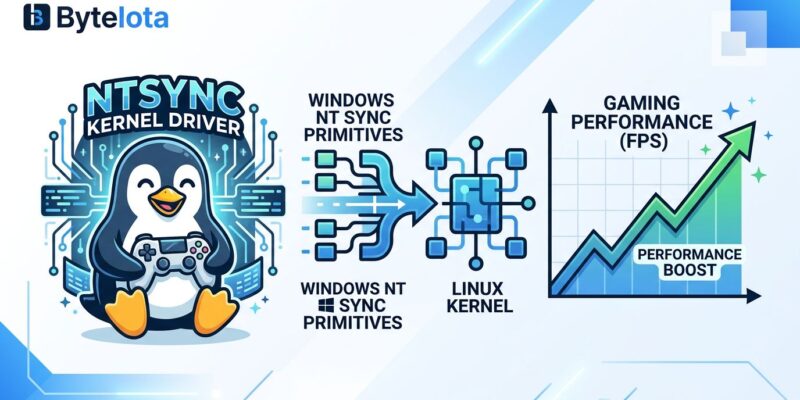
NTSYNC landed in Linux kernel 6.14 this January, bringing Windows NT synchronization primitives directly into the kernel for the first time. Developed by CodeWeavers engineer Elizabeth Figura, the driver eliminates costly round-trip RPC calls to wineserver that historically bottlenecked Windows game performance on Linux. Dirt 3 jumped from 110 to 860 FPS—a 678% gain that grabbed headlines. Wine 11 and Proton 11 adopted NTSYNC in Q1 2026, and Linux gaming hit 5.33% Steam market share in March, an all-time high representing 7 million active gamers.
This isn’t just optimization. It’s a paradigm shift—Linux integrating Windows APIs at the kernel level instead of approximating them in userspace.
From Userspace Emulation to Kernel Integration
Windows games rely on NT synchronization primitives—mutexes, semaphores, events—to coordinate threads. Multi-threaded games generate thousands of these calls per second. Wine historically emulated these through RPC requests to a dedicated wineserver process: game makes synchronization call, Wine sends request over socket, wineserver performs operation, replies back. For sync-heavy games, the round-trip overhead was a genuine bottleneck.
NTSYNC changes this by exposing a /dev/ntsync character device that handles Windows NT synchronization natively in the kernel. No userspace round trips. No approximations. Exact Windows NT semantics. The driver implements WaitForMultipleObjects—a Windows API that waits on multiple synchronization objects atomically—which Linux’s poll() fundamentally can’t replicate without race conditions. As one Hacker News developer noted: “NTSYNC isn’t faster, it’s more correct. It fixes subtle edge cases like hitches and deadlocks.”
The correctness matters more than raw speed. Wine’s previous approaches (esync, fsync) approximated Windows behavior using Linux primitives like eventfd and futex. They improved performance but couldn’t guarantee semantic correctness. NTSYNC doesn’t compromise—it implements the Windows NT synchronization model exactly, solving architectural gaps that poll-based methods couldn’t address.
Benchmark Reality: 678% Is an Outlier
Dirt 3’s 678% FPS gain is real but misleading. Most games see 10-50% improvements in synchronization-heavy scenarios, with many showing minimal gains if the bottleneck was GPU or I/O. Resident Evil 2 nearly tripled (26 to 77 FPS), Call of Juarez more than doubled (99.8 to 224.1 FPS), and Tiny Tina’s Wonderlands improved 177% (130 to 360 FPS). However, these benchmarks compare against vanilla upstream Wine, which almost nobody uses for gaming anymore.
Real-world gains over existing Wine/Proton setups with esync or fsync are more modest. However, developers report benefits that benchmarks don’t capture: better alt-tab behavior without freezing, no game lockups, stable desktop compositing, and improved frame pacing. The 1% and 0.1% low frame rates—metrics that measure consistency—improved more dramatically than raw average FPS in many cases.
Frame pacing matters more than headline numbers. A game locked at 60 FPS with consistent frame times feels smoother than one fluctuating between 70 and 90 FPS with irregular pacing. NTSYNC delivers consistency, not just speed. For fighting games and rhythm games where input delay and timing precision are critical, that consistency is the difference between playable and unplayable.
Linux Gaming Crosses 5% Steam Market Share
Linux hit 5.33% Steam market share in March 2026, representing roughly 7 million active gamers out of Steam’s 132 million monthly users. That’s double macOS’s 2.35% share. The milestone is driven by three converging factors: Steam Deck adoption (5.6 million units shipped, capturing 48% of the handheld gaming PC market), Proton expanding compatibility from 9,000 native Linux titles to 106,000 playable Windows games, and Windows 10 reaching end-of-support in October 2025.
April saw a slight pullback to 4.52%, but the upward trajectory is clear. NTSYNC arrived at a critical inflection point—Wine 11 and Proton 11 both shipped with native NTSYNC support in Q1 2026, and SteamOS 3.7.20 beta loads the NTSYNC kernel module by default. Every Steam Deck user and millions of desktop Linux gamers can now benefit from kernel-level Windows synchronization.
The numbers validate Linux gaming as viable, not aspirational. Seven million gamers represent real market presence. Proton’s 12x expansion in playable titles means Windows game compatibility is no longer the barrier it was five years ago. The question isn’t “Can I game on Linux?” anymore—it’s “What trade-offs am I accepting?”
AMD Dominates Linux Gaming
AMD GPUs own Linux gaming due to open-source drivers—amdgpu kernel driver and RADV Vulkan userspace driver. Nvidia’s proprietary drivers suffer persistent issues: unexplained latency spikes, frame rate inconsistencies, and dramatic performance regressions. One Hacker News developer reported Persona 5 running at 2 FPS on Nvidia versus 60 FPS on AMD Steam Deck hardware. The gap isn’t close.
Valve contributes directly to RADV development through its Proton compatibility layer, reinforcing Steam Deck’s AMD hardware choice. Open-source drivers integrate seamlessly with kernel-level optimizations like NTSYNC, while Nvidia’s closed approach creates friction. The community consensus is unambiguous: AMD for Linux, Nvidia for Windows. If you’re building or buying a Linux gaming rig, choose AMD or accept significant performance compromises.
Windows Still Ahead, But the Gap Narrows
Linux gaming trails Windows by 5-30% in most benchmarks. NTSYNC closes the gap but doesn’t eliminate it. Real-world tests show Windows maintaining performance advantages across the majority of titles, particularly with Nvidia GPUs. However, developer sentiment is shifting from “Linux will never be viable” to “Linux is good enough for 7 million gamers.”
The performance difference is comparable to GPU generation gaps—significant for competitive esports where every frame counts, less critical for casual gaming. If you’re playing Counter-Strike 2 at 240Hz, that 15% deficit matters. For most single-player games, the gap is imperceptible. Anti-cheat systems remain the bigger blocker—Easy Anti-Cheat and BattlEye often block Linux despite Proton compatibility, locking out multiplayer titles regardless of performance parity.
The pragmatic threshold: Linux works if you’re not chasing maximum competitive advantage or playing anti-cheat-protected multiplayer games. For the 7 million Steam users on Linux, that trade-off is acceptable. NTSYNC didn’t make Linux beat Windows—it made Linux viable enough that the 5-30% gap stopped mattering for a meaningful market segment.
Key Takeaways
- NTSYNC integrates Windows NT synchronization at Linux kernel level instead of userspace emulation—a paradigm shift from approximating Windows APIs to implementing them natively
- Benchmark gains vary wildly: Dirt 3’s 678% is an outlier, most games see 10-50% improvements, and many show minimal change where synchronization wasn’t the bottleneck
- Correctness matters more than speed—NTSYNC fixes race conditions and deadlocks that poll-based approaches couldn’t solve, delivering consistent frame pacing and stability
- Linux gaming hit 7 million active Steam users (5.33% market share in March 2026), driven by Steam Deck adoption and Proton expanding compatibility to 106,000 games
- AMD GPUs dominate Linux gaming due to open-source drivers—Nvidia’s proprietary drivers suffer persistent latency spikes and frame rate inconsistencies
- Linux still trails Windows by 5-30% in most benchmarks, but the gap narrowed enough that 7 million gamers consider it viable—the trade-off shifted from “unacceptable” to “good enough”
The NTSYNC story isn’t about Linux beating Windows—it’s about Linux innovating by integrating compatibility at the kernel level. The approach validates pragmatic engineering over ideological purity. Windows APIs in the Linux kernel aren’t defeat; they’re solving real problems for 7 million users who’ve decided the remaining performance gap doesn’t matter.