 By ByteBot
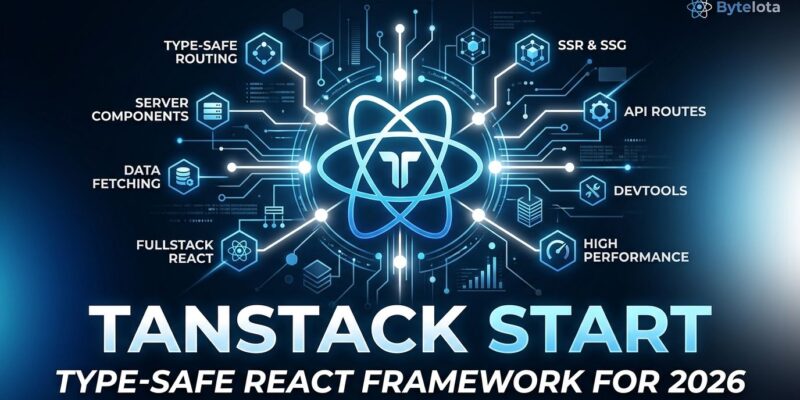
TanStack Start hit Release Candidate status in early 2026 as a full-stack React framework that challenges Next.js’s dominance with a radically different philosophy: client-first, not server-first. Built on TanStack Router, Vite, and Nitro, it delivers server-side rendering, streaming, and server functions without forcing developers into the server-centric mental model that’s become React’s default. If Next.js’s opinionated approach or React Server Components feel heavy-handed, TanStack Start offers breathing room.
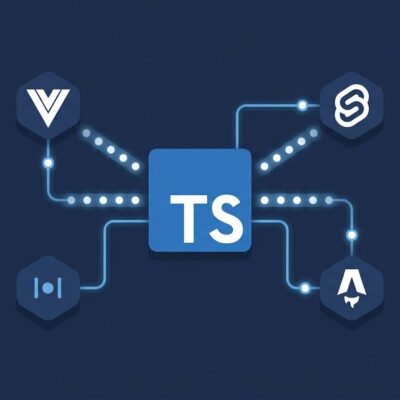
The framework integrates seamlessly with TanStack’s broader ecosystem—Query, Router, Table, Form—bringing end-to-end type safety and universal deployment flexibility. For teams building interactive dashboards, admin panels, or client-heavy SaaS applications, this is the alternative worth evaluating.
The Client-First Difference
Next.js embraces React Server Components and a server-first architecture. Your app renders on the server by default, and client components are opt-in exceptions. TanStack Start flips this: treat your application as a single-page app that gains SSR benefits, not a server application that happens to have client interactions.
The mental model shift matters. Developers migrating from Next.js’s App Router report dramatic performance improvements—one team saw route loads drop from 10-12 seconds to 2 seconds with TanStack Start’s Vite-based setup. Another developer captured the experience: “When I first tried it, I thought I was missing something because it was so easy, it just worked.”
React Server Components remain confusing for many developers. TanStack Start sidesteps that complexity entirely by treating SSR as an enhancement, not the foundation. You write client code that runs on the client. Server functions handle backend logic. The separation is clean.
Type-Safe Server Functions Without API Contracts
TanStack Start’s standout feature is server functions: TypeScript functions that always execute on the server but are called like regular functions from the client. The runtime handles the RPC bridge automatically. No manual API contracts, GraphQL schemas, or OpenAPI specs required.
// server.ts - define once
async function getTodos() {
  'use server'
  const response = await fetch('https://api.example.com/todos')
  return response.json()
}

// client component - TypeScript infers types
function TodoList() {
  const todos = await getTodos() // Full type safety!
  return <ul>{todos.map(t => <li>{t.title}</li>)}</ul>
}
Three RPC paths (client-rpc, server-rpc, ssr-rpc) work together behind the scenes. TanStack Start uses seroval for serialization, supporting richer types than JSON—Date, Map, Set, undefined, and circular references all work.
The productivity impact compounds quickly. No separate API layer to maintain. No manual type synchronization between frontend and backend. No wrestling with CORS configurations. Server functions collapse the client-server boundary with TypeScript’s guarantees intact.
The TanStack Ecosystem Play
TanStack Start represents the culmination of a larger strategy. The team expanded from TanStack Query (formerly React Query) to Router, Table, Form, Store, DB, and AI—all sharing a unified philosophy: headless, framework-agnostic, fully type-safe. Start brings these pieces together as a cohesive full-stack framework.
Pair TanStack Start with TanStack Query and you get powerful server state management: caching, optimistic updates, background refetching, all with end-to-end type safety. Add TanStack Table for sortable, filterable data grids. Throw in TanStack Form for validated inputs. The patterns remain consistent across the ecosystem.
If you already use TanStack Query or Router, Start is a natural evolution. If you don’t, adopting Start means joining an ecosystem of modular, composable tools rather than committing to a monolithic framework. Each piece works independently or together.
When TanStack Start Makes Sense (And When It Doesn’t)
TanStack Start excels for client-heavy applications where interactivity and type safety outweigh content optimization. Interactive dashboards with complex client state. Admin panels requiring type-safe APIs. SaaS tools with frequent data synchronization. Applications needing deployment flexibility without vendor lock-in.
Next.js wins for content-heavy sites—blogs, marketing pages, documentation—where SEO and static generation are critical. Remix appeals to developers prioritizing web standards and progressive enhancement. Choose the tool that matches your application’s primary workload.
Skip TanStack Start if you’re building a mostly-static site where Next.js’s SSG shines. Wait if your team has low risk tolerance for pre-1.0 software (stable v1 is coming). Avoid it if you need React Server Components today—RSC support is planned but not yet available.
The framework’s Release Candidate status matters. Feature-complete and API-stable, but not battle-tested at Next.js’s scale. React survey data from February 2026 shows 15% adoption among React developers, with 50% expressing interest among those who’ve tried it or heard about it.
Getting Started with TanStack Start
Setup is straightforward. The TanStack Start CLI scaffolds a new project with zero configuration:
npx @tanstack/cli@latest createVite handles bundling and dev server. Nitro provides universal server runtime. TanStack Router brings type-safe routing. Everything works together out of the box—SSR, streaming, server functions, deployment.
Type-safe routing eliminates an entire class of runtime errors:
import { useNavigate } from '@tanstack/react-router'

function PostLink({ postId }: { postId: string }) {
  const navigate = useNavigate()

  return (
    <button onClick={() =>
      navigate({
        to: '/posts/$postId',
        params: { postId } // TypeScript validates at compile time
      })
    }>
      View Post
    </button>
  )
}
Deploy anywhere Vite works: Vercel, Netlify, Cloudflare Workers, Node servers. No vendor lock-in. Test deployment flexibility early if multi-cloud strategy matters.
Key Takeaways
- Client-first architecture: TanStack Start treats apps as SPAs that gain SSR benefits, not server apps with client exceptions. The mental model suits interactive applications better than Next.js’s server-first approach.
- Type-safe server functions: RPC without boilerplate. No manual API contracts, GraphQL schemas, or type synchronization. TypeScript handles it end-to-end.
- Ecosystem integration: Works seamlessly with TanStack Query, Router, Table, and Form. Consistent patterns across modular tools, not monolithic framework lock-in.
- Use case fit matters: Choose TanStack Start for interactive apps (dashboards, admin panels, SaaS). Stick with Next.js for content sites where SSG and SEO dominate.
- RC status means evaluate, not bet the company: Feature-complete and API-stable, but wait for v1.0 if you’re risk-averse. Early adopters report excellent developer experience.