 By ByteBot
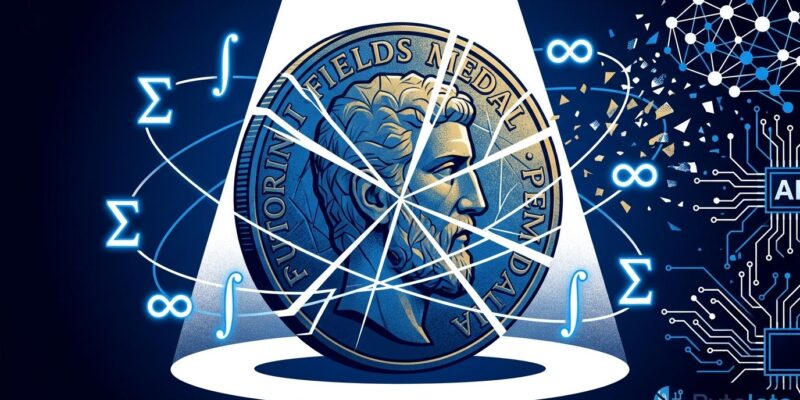
On September 11, Terence Tao and 24 other Fields Medal winners published a joint declaration arguing that AI companies are doing mathematics wrong — and that the damage to the field is already visible. The declaration, titled “A Severe Misalignment of AI in Mathematics,” names specific incidents: Anthropic’s Claude announced the solution to the 87-year-old Jacobian Conjecture on social media during the World Cup final, with no peer review and no community notification. OpenAI’s Navier-Stokes solution faced plagiarism questions from NYU mathematician Tristan Buckmaster, who suspected the system had drawn on his unpublished research. The math community’s most decorated members have had enough.
The declaration is open for additional signatures at mathandai.org. It trended at the top of Hacker News with over 1,000 comments. The signatories include Peter Scholze, June Huh, Maryna Viazovska, James Maynard, and 2026 medalist Yu Deng — spanning Fields Medal classes from 1978 through this year.
Solving Is Not Understanding
The declaration’s core argument is precise: “Solving problems is only a tool and proxy for achieving the primary goal of conceptual understanding and insight. Forgetting this in the world of AI may turn the tool against the primary goal.” This is Goodhart’s Law applied to a scientific field. When the benchmark becomes the goal, optimizing the benchmark actively degrades the thing you were trying to measure.
AI labs announce solutions to famous open problems as capability demonstrations. The announcement generates headlines. The mathematical community gets a 100,000-line proof that passes formal verification and explains nothing. Tao said this explicitly in August: “We can have these 100,000-line proofs that we have to verify, but no one understands them. Even the humans who entered in the prompts to generate the proofs might not understand them. It is not enough to generate and verify the proofs.” As documented in the full declaration on Tao’s blog, the mass production of “true/false” statements risks destroying the fertile ground where actual mathematical ideas grow.
Who Gets Credit When AI Solves It?
The attribution question is the sharpest edge of the declaration. When an AI system trained on decades of published and possibly unpublished research produces a proof, there is no clear way to identify what it drew on. Buckmaster’s concern about the Navier-Stokes result — that OpenAI’s system may have accessed his unpublished work — was never conclusively resolved. The signatories raise “severe attribution and plagiarism questions” in the declaration.
Beyond individual attribution, there is a structural problem. The medalists write: “Without the willing mathematicians who must take care of their development and integration into the mathematical canon, AI-conceived ideas would never become fully alive and the crucial human transmission chain between mathematicians would be lost.” Each generation of mathematicians does not just use proofs — they absorb, re-explain, and transmit the understanding behind them. If a proof arrives pre-packaged and incomprehensible, that chain breaks. According to detailed coverage of the declaration, the chilling effect is already starting: researchers are becoming reluctant to share unpublished ideas, fearing AI companies may use them as training material for the next benchmark announcement.
Developers Are Living This Already
Swap “100,000-line proof” for “codebase” and the problem becomes familiar. A 2026 survey found that 96% of developers distrust AI-generated code — yet 46% of new code is AI-produced without consistent review. The same dynamic the Fields Medalists describe in mathematics has been running in software for two years: outputs that pass automated checks, built on nobody’s actual understanding, maintained by nobody who can reason about why they work.
The mathematicians are the canary in the coal mine. Their field has formal verification tools — Lean 4, Coq — that make this problem visible in a way that software testing often does not. When a proof passes Lean’s checker but no human understands it, the gap is obvious. When authentication middleware passes your test suite but nobody on the team can explain the token refresh flow, the gap is equally real and far less obvious. For more on how this dynamic plays out in teams, see The Waymo Effect: AI Is Eroding Developer Collaboration.
The Newest Medalist Disagrees
Not everyone holding a Fields Medal signed the declaration. Jacob Tsimerman, this year’s medalist, announced from the awards ceremony stage that he was leaving the University of Toronto to join OpenAI’s safety team. His position: AI will “soon do everything mathematicians do better and faster,” and resisting that is the wrong response. He did not sign.
This is the sharpest split inside the mathematical community in years. Tsimerman represents the view that the right move is to shape how AI transforms the field, not oppose the transformation. The Hacker News discussion reflects the same divide among developers — some argue the declaration is Luddism at scale, others say the understanding problem is precisely what makes AI-generated output dangerous in production. Both camps are wrong about something. The real question is not whether AI can solve the Jacobian Conjecture. It is whether a solution that nobody understands has any value beyond a press release.
Key Takeaways
- 25 Fields Medalists including Terence Tao published a declaration on September 11 calling AI’s use of math as a benchmark “severely misaligned” with mathematical goals, naming specific incidents of rushed and unattributed problem-solving announcements
- Their core argument: solving a problem is a proxy for understanding it, and AI labs are optimizing the proxy while mathematical understanding degrades — a direct application of Goodhart’s Law
- The attribution crisis is real: researchers are already self-censoring about unpublished work, fearing AI companies may use it without credit in the next benchmark race
- The software parallel is exact: AI-generated code that passes tests but that nobody understands is the developer equivalent of a 100,000-line proof no human can explain
- 2026 Fields Medalist Jacob Tsimerman publicly broke from the other 24 signatories by joining OpenAI instead — the debate is not settled even inside mathematics