
 By ByteBot
Every meeting you’ve ever had on Zoom has been a black hole. Context goes in — decisions, action items, relationships — the call ends, and it disappears. Zoom just fixed that. At Zoomtopia 2026 on October 20, the company shipped the Unified Context Layer: a live graph database that connects your meetings, calls, and chats and makes them queryable by any MCP-compatible AI agent. Claude, Codex, GPT, Copilot, and Muse can all reach into it. It also dropped 15 new AI Services APIs and a unified developer portal called Platform Studio. If you’re building agent workflows that touch enterprise communication data, this changes your stack.
What the Unified Context Layer Actually Is
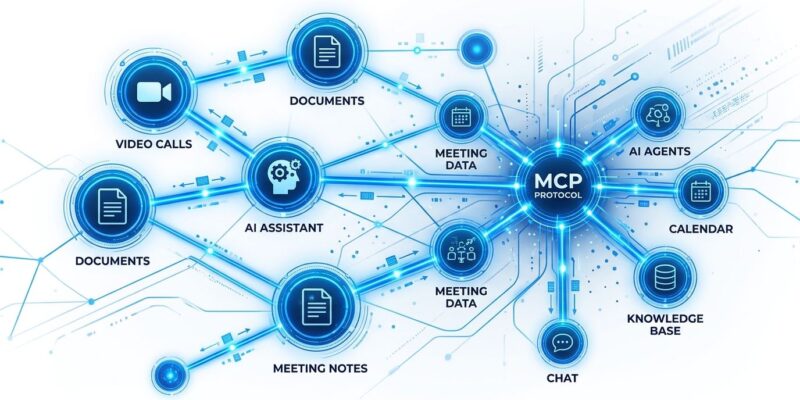
This is not a smarter search bar for your meeting recordings. The Unified Context Layer is a graph database that updates in near real-time, linking people, decisions, topics, and relationships across every Zoom surface: meetings, calls, chats, and connected external systems like Salesforce, ServiceNow, and Workday. Three data streams feed it continuously: dynamic context from live conversations, static enterprise knowledge from documents and connected applications, and general knowledge augmented via web search.
The result: Zoom Virtual Agent, Zoom Contact Center, and Zoom Phone all draw from the same memory layer. No more rebuilding a customer’s history across separate Zoom products. And via expanded MCP servers, external AI agents can query this graph — scheduling, transcription search, participant analytics, and summary retrieval are all live today. Read the official Unified Context Layer announcement for the full architecture breakdown.
The 15 New AI Services APIs
Zoom is externalizing the speech infrastructure it built for its own 300M+ monthly users. Developers get access to the same stack via three new API categories.
The Voice Agent API is the headline addition. It opens a single WebSocket connection and handles the full real-time pipeline: stream microphone audio in, receive live transcripts, synthesized speech, and function call outputs. You can bring your own LLM or use Zoom’s integrated model. This replaces the manual chain of Deepgram (ASR) + your LLM + ElevenLabs (TTS) with a single managed connection.
The Interpreter API (preview) combines transcription, translation, and speech synthesis into a single near-real-time pipeline for speech-to-speech interpretation — useful for support workflows and international customer calls. The Text-to-Speech API adds both synchronous and streaming output. Transcription, translation, and summarization APIs were already available; they’re now consolidated under Platform Studio. Full documentation is at developers.zoom.us/docs/ai-services.
What You Can Build With the MCP Server Right Now
The Zoom MCP server works with Claude, Claude Code, ChatGPT/Codex, Cursor, and VS Code out of the box. From a prompt in any of those tools today, you can:
- Schedule and create Zoom meetings
- Retrieve AI summaries and transcripts from past calls
- Search meeting history in natural language
- Register and manage participants
- Pull participant engagement analytics
Starting in November 2026, Zoom enables CRM automation: from a Claude or Codex prompt, you’ll be able to trigger Salesforce, ServiceNow, or Workday updates based on decisions made on a call. The full developer announcement from Zoomtopia 2026 covers all 15 API categories and the MCP expansion scope.
Platform Studio: One Portal for All Zoom APIs
Zoom’s developer tooling was previously scattered across separate portals. Platform Studio consolidates AI Services, Video SDK, and Co-Browse SDK under one set of credentials — one place to create projects, generate API keys, monitor usage, and manage billing. Access it at developers.zoom.us/docs/build/platform-studio.
The Governance Gap
Here’s the part worth flagging for any team with compliance requirements. Zoom shipped the agent capabilities well ahead of the governance controls:
- ZoomMate Agent Teams (multi-agent coordination): live now
- Centralized AI Management (admin visibility into agents): December 2026
- Compliance Manager (retention and supervision for AI-generated content): January 2027
- AI Guardrails (account-level rules for agent behavior): Q1 2027
Microsoft Purview label sync is live, which helps with data classification for M365 shops. But behavioral guardrails — rules governing what agents can generate or access — don’t ship until next year. If your team operates under retention or supervision requirements, this analysis from beri.net puts the risk clearly: wait for the controls before enabling agent features. For everyone else, there’s a window here.
What to Do Now
The MCP server is live, Platform Studio is open, and the 15 AI Services APIs are available. The November 2026 CRM automation unlocks the most practical enterprise use case. Q1 2027 is when behavioral guardrails arrive for regulated environments.
Zoom is positioning itself as ecosystem-neutral infrastructure: the same MCP server that feeds Claude also feeds Copilot, Codex, and Gemini. That’s a bet that MCP becomes the dominant enterprise AI integration layer. Given the adoption curve across Cloudflare, Anthropic, and now Zoom this year, that bet looks increasingly reasonable.


