 By ByteBot
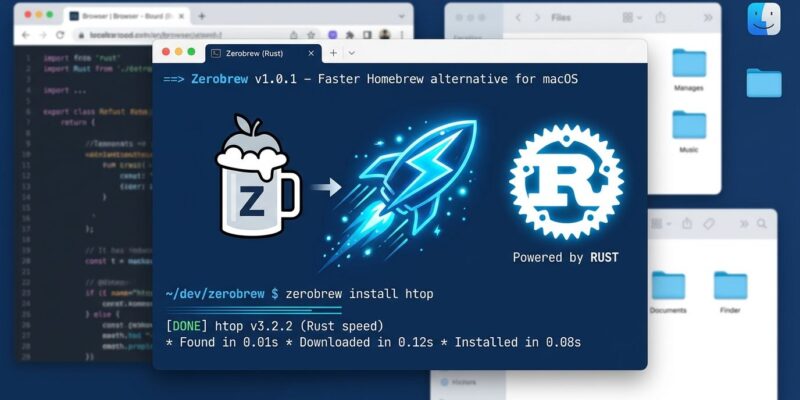
If you have a Mac and use Homebrew, you know the spinner. “Updating Homebrew…” hangs for seconds before anything happens. Multiply that across every brew install in your day and you’ve lost real time to Ruby’s startup tax. Zerobrew, a Rust-written drop-in that reuses Homebrew’s formula ecosystem, hit v0.4.0 on October 8. On warm reinstalls it’s up to 20x faster. The switch costs one word: replace brew with zb.
The Real Reason Homebrew Is Slow
Homebrew’s speed problem isn’t your internet connection — it’s architecture. Every invocation pays the Ruby interpreter startup cost, imports a large dependency tree, and shells out to bootstrapped tools to paper over macOS gaps. Mach-O relocation — rewriting binary paths after installation — happens via Ruby code after the fact. The result is a package manager that’s sequential where it should be parallel, and interpreted where it should be compiled.
Zerobrew eliminates all of that. It’s a Rust binary. No interpreter startup. Mach-O relocation happens in-process. Downloads, extractions, and linking run concurrently.
The Technical Stack: APFS Clonefiles and a Content-Addressable Store
The warm reinstall speedups — up to 69x in some cases — come from two macOS-specific features most developers don’t know exist.
Content-addressable store. Zerobrew stores packages by SHA-256 hash at /opt/zerobrew/store/{sha256}/. Shared dependencies like openssl or zlib are stored once and referenced everywhere. Reinstall a package you’ve installed before? It’s already in the store. The install is near-instant.
APFS clonefiles. On macOS, Zerobrew uses the Apple File System’s copy-on-write capability. When materializing a package from the store it creates a clonefile — a filesystem reference to the existing data blocks, with no actual duplication until something writes. Zero disk overhead. Near-zero install time for cached packages.
Layer on parallel downloads with CDN connection racing, streaming extraction while downloading, and aggressive HTTP caching — and you have a meaningfully different architecture underneath familiar commands.
What the Benchmarks Actually Say
Measured on an M3 Pro (18 GB RAM, macOS 26.6.2, ~410 Mbit/s) in September 2026:
- Cold installs: 3.0x faster overall, 2.7x median per package
- Warm reinstalls: 4.5x faster overall, 5.7x median, with some packages reaching 69x
- 100 packages warm: 59 seconds (Zerobrew) vs. 452 seconds (Homebrew)
The cold install gains are real but modest — network is the bottleneck, and Zerobrew can’t fix your connection. The warm story is where this tool earns its keep: CI caches, fresh Mac setups, and development environments that repeatedly install the same stack.
What’s New in v0.4.0
The October 8 release focused on compatibility and reliability. Zerobrew now leaves installed dependencies untouched during installs — previously it could disturb things it shouldn’t. It links directories the way Homebrew does, passing byte-for-byte parity tests in CI. It reuses download connections, indexes the formula API for faster lookups, and unpacks bottles while downloading. The author also added built-in timing comparisons against Homebrew, so you can benchmark your own setup without extra scripting.
The Caveats Worth Knowing
Zerobrew is experimental — the author says so directly, and you should believe it. Three specific limitations matter:
- No cask support. DMG mounting, .app bundle copying, pkg installers — all out of scope. Zerobrew handles CLI formulae only.
- Default tap only. Third-party Homebrew taps aren’t supported yet.
- Keep Homebrew installed. The author’s own recommendation. It’s your fallback for anything Zerobrew can’t handle.
Install It in 30 Seconds
# Direct install
curl -fsSL https://zerobrew.rs/install | bash

# Or via Homebrew
brew install cachebag/zerobrew/zerobrew
Once installed, zb install ripgrep works the same as brew install ripgrep. If you use mise, there’s a community backend plugin that routes formula installs through Zerobrew automatically.
Worth Trying Today
Zerobrew earns a spot in a macOS developer’s toolkit because the switching cost is essentially zero. You keep Homebrew. You keep your formulas. You run zb for the things it handles, and fall back to brew for the rest. The warm reinstall advantage is real — 59 vs. 452 seconds for 100 packages on commodity hardware isn’t a cherry-picked outlier.
For CI, test carefully before committing. For your dev machine, there’s no reason not to try it. The full source is on GitHub, the project has active Hacker News traction, and v0.4.0 is the most compatibility-focused release yet. The Homebrew spinner will be the thing you miss least.