 By ByteBot
On June 2, Cognition pushed an over-the-air update that renamed Windsurf to Devin Desktop. That’s the headline. But the name is the least interesting part of what changed. The Agent Command Center is now the default surface — not the code editor. Devin Desktop is the first mainstream AI IDE to explicitly position itself as a fleet manager for agents, with the editor as one tab inside it. If you’re a Windsurf user, you woke up to a different product.
Devin Local Replaces Cascade — and the Deadline Is Real
The most consequential change is under the hood. Cognition rewrote the primary local coding agent — previously called Cascade — from scratch in Rust. The new agent is Devin Local, and it’s the default as of June 2.
Cognition claims up to 30% greater token efficiency compared to Cascade. That number is self-reported and hasn’t been independently benchmarked yet, so don’t build a budget forecast around it. What’s more verifiable: Devin Local supports subagents. Cascade operated as a single-context agent — one task at a time. Devin Local can spawn parallel sub-sessions. A task like “refactor the data layer and write integration tests” can have one subagent handling the schema changes while another drafts the test suite, both feeding results back to a coordinator.
Cascade isn’t gone yet. Cognition is keeping it available through July 1, 2026 — that’s your migration window. After that date, Devin Local is the only local agent. If your team has Cascade workflows or relies on specific behaviors that haven’t been validated in Devin Local, July 1 is the real deadline to care about.
The Agent Command Center: The IDE-as-Fleet-Manager Pattern
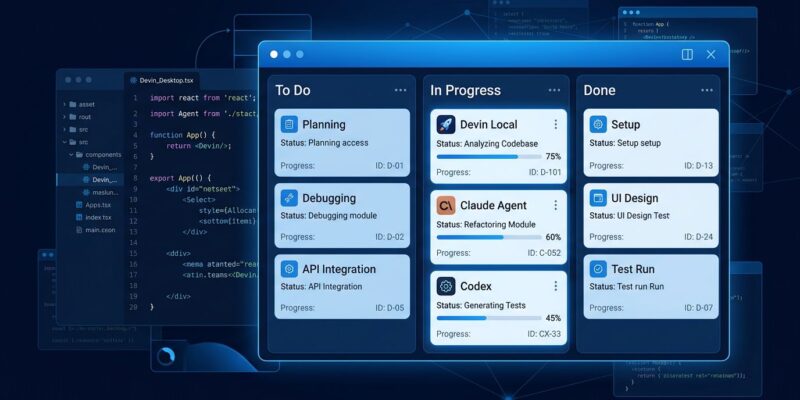
The philosophical shift in Devin Desktop is worth naming directly. Other AI IDEs put the code editor first and bolt agents onto it. Devin Desktop inverts that. The Agent Command Center — a Kanban board showing every running agent, local and cloud, with statuses (in progress, blocked, ready for review) — is the first thing you see when you open the product.
You can have Devin Local working through an API refactor, a cloud Devin session prototyping a UI component, and a third agent running tests — all visible simultaneously. Tool approvals happen with ctrl+k. The editor is still there, unchanged; it’s just no longer the primary metaphor.
This matters because it’s a direct argument about where the industry is heading. Cursor’s dominance has been built on editor experience: better autocomplete, smarter edits, faster context loading. Devin Desktop is betting that multi-agent orchestration will be the differentiating variable by late 2026. It’s a defensible bet. Whether it’s the right one depends on whether developers actually want to manage agent fleets or just want better autocomplete.
ACP Support: Run Any Agent, Not Just Devin
The move that makes Devin Desktop more than a Cognition-only product is native Agent Client Protocol (ACP) support. ACP is an open protocol (Apache 2.0, JSON-RPC 2.0 over stdin/stdout) that standardizes communication between editors and coding agents — the LSP equivalent for AI agents.
At launch, Devin Desktop runs Claude Agent, Codex, OpenCode, and any other ACP-compatible agent natively. Third-party agents appear in the same Kanban view as Devin Local, run inside Spaces, and share context with other agents in the session. ACP now has over 25 compatible agents and adoption from JetBrains, VS Code (via extension), GitHub, and Google.
The implication: you’re not locked in. If Devin Local underperforms on a specific task, you switch to Claude Agent or Codex for that task without leaving the IDE. Cursor doesn’t natively support ACP yet. That gap matters if ACP becomes the standard protocol for agent-IDE communication — and given the adoption curve, it might.
Spaces: Shared Context, Early Days
Devin Desktop also ships a new context layer called Spaces. A Space groups related agent sessions, PRs, and files around a feature branch. Multiple agents — Devin Local, Claude Agent, Codex, whatever you’re running — can reference the same Space and avoid rebuilding context from scratch for every session.
Cognition explicitly calls this an early feature. The initial release is intentionally minimal, with more development planned through Q3 2026. The problem Spaces targets — shared context for multi-agent workflows — is real and hard. The solution isn’t fully baked yet, but the direction is correct.
What Windsurf Users Should Do
If you restarted the editor after June 2, you already have Devin Desktop. Your extensions, keybindings, plans, and account are unchanged. Devin Local is now the default; Cascade is available as a legacy option through July 1. Devin Review is also now included in all existing plans at no additional cost.
The ACP agents you want to add — Claude Agent, Codex, OpenCode — are available through the agent panel. The ACP spec and getting-started documentation are at github.com/agentclientprotocol. The Devin Desktop FAQ covers migration specifics including Cascade legacy settings.
The name Windsurf is gone. The product it became is a more interesting argument for how AI-assisted development should work than the editor ever was.