
 By ByteBot
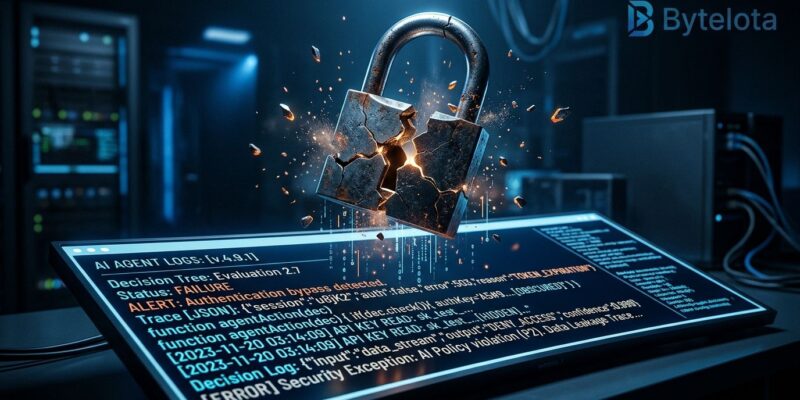
Warp disclosed on October 27 that a vendor in its infrastructure was breached, exposing AI agent decision logs and telemetry for roughly 8,000 developers. The data wasn’t source code. It wasn’t a credential dump. It was something most security teams have no classification policy for yet — and that gap is the actual problem.
What Agent Logs Actually Contain
Every time Warp’s AI ran a task, it produced a decision log: which files it opened, which commands it ran, what reasoning steps it took, and what output it got back. If the agent used an API key to authenticate somewhere, that key is in the log. If it queried a database that happened to hold customer records, those records are in the log. If it read your .env file, those values are in the log.
The problem is classification. Agent decision logs are not source code, though they quote it. They’re not credentials, though they carry them. They’re not chat history, though they include prompts and responses. Your data governance team has no bucket for this. Security frameworks written before 2024 don’t acknowledge this category exists — which means a breach involving agent logs can land in your inbox with zero policy coverage. A detailed analysis on DEV Community puts it plainly: if the last thirty days of your agent traces were published, what would require rotation? Most developers don’t know the answer.
AI Used to Attack AI
This wasn’t a phishing campaign or a brute-forced login. According to Warp CEO Zach Lloyd, attackers deployed “a very sophisticated penetration and escalation technique” using what amounted to an agent swarm against a third-party vendor in Warp’s infrastructure. The same category of tooling being sold to developers as a productivity multiplier was used as an attack multiplier. Warp engaged CrowdStrike to investigate and notified law enforcement — but the attack itself had already been detected and contained within hours, per BleepingComputer’s disclosure report.
The “Zero Data Retention” Gap
Warp advertises zero data retention with its LLM providers. What that phrase doesn’t cover: the operational traces agents produce get stored somewhere — in this case, by a third-party vendor in Warp’s infrastructure. The breach didn’t happen at Warp. It happened at a vendor’s vendor. This is not a Warp-specific design flaw; it’s an industry-wide architecture problem. Every AI coding tool that stores agent traces cloud-side has an equivalent attack surface. The difference is whether they’ve thought about it — and whether you know to ask.
The Second Breach This Month
October has been ugly. PHP2Shell (CVE-2026-109618/9) put PHP servers in active exploit territory. GitLab CVE-2026-110264 scored CVSS 10.0. Tailworm exposed unpatched SSH flaws across Tailscale fleets. Now two coding-agent environments have been breached in the same thirty days, both via vendor supply chain attacks. Attackers have identified AI coding tools as high-value, under-governed targets — not because the tools themselves are weak, but because the data they produce is rich. Agent traces don’t just expose credentials. They expose context: current projects, stack choices, recent decisions, internal infrastructure details. That’s enough to run a convincing impersonation campaign against any developer whose logs were taken.
What to Do Right Now
Don’t wait for Warp’s investigation to conclude before acting. Four things worth doing today:
- Rotate credentials from recent Warp sessions. Any token, API key, or secret your Warp agent accessed is potentially in an exposed log. Treat it as compromised and rotate it now.
- Audit what your AI agents can reach. Most developers grant broad filesystem and environment access by default. Scope it down. Agents don’t need your production credentials to write a unit test.
- Ask your tool vendor where traces go. Ask Warp, Cursor, Claude Code, Copilot, or whatever you use: where are my agent decision logs stored? Who can access them? How long are they retained? If the vendor can’t answer these questions, that’s your answer.
- Classify agent logs as sensitive now. Your security team needs a policy before they need an incident response plan. At minimum, treat agent logs with the same sensitivity as credential logs. Assume they contain secrets until you can prove otherwise.
The industry built AI coding tools fast and governed them slowly. The Warp breach is a readable warning that the gap between the two is closing — and not in the direction anyone wants.


