 By
Walmart just drew a line in the sand. While Amazon has spent the last two weeks blocking AI shopping agents — kicking out Meta’s Muse two weeks after its launch and then Perplexity’s agent shortly after — Walmart went the other direction entirely. On October 21, it announced the Walmart Agent Gateway, an MCP server that lets approved AI agents search inventory and place orders at Walmart and Sam’s Club on customers’ behalf. If you’re building a shopping agent, there’s now a legitimate, structured way to plug into the world’s largest retailer. No scraping. No terms-of-service gray areas. Just an official MCP integration.
What the Agent Gateway Actually Is
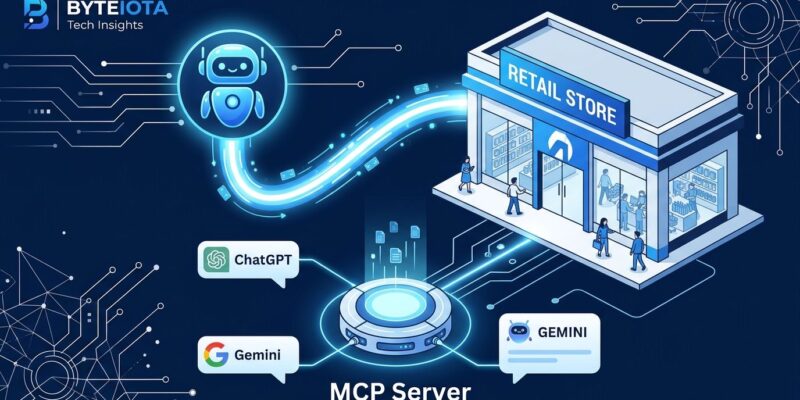
The Walmart Agent Gateway is an MCP server — built on Anthropic’s open-source Model Context Protocol — that connects approved AI agents directly to Walmart’s backend fulfillment systems. That means real-time product and inventory data from Walmart.com and Sam’s Club, not web scraping with all the fragility and legal risk that comes with it.
Agents currently integrated or in the pipeline include ChatGPT, Gemini, Meta’s Muse, and Walmart’s own Sparky assistant. Third-party agents get verified identities, controlled permissions, and explicit rate limits and category restrictions — so Walmart knows exactly what’s hitting its systems and can revoke access if something goes wrong.
The gateway is currently invite-only beta, aimed specifically at companies and developers. Request access through Walmart’s developer portal. There is no public timeline for a general release.
Agent Profiles: How the Customer Control Layer Works
The most interesting design choice is how Walmart handles user authorization. Each AI agent gets its own Agent Profile inside the customer’s Walmart account — separate from regular orders, similar to adding a cardholder on a credit card.
The setup flow kicks in automatically on first use: when a customer completes a purchase through an agent connected to the gateway, Walmart creates an Agent Profile. The customer then authorizes it, sets a spending limit, and links it to their account. Spending limits come in three tiers — 0, 00, and 00 — or customers can require manual approval for every purchase.
The privacy design is worth noting for anyone building agent architectures: agents can find a customer’s “usual items” — enabling replenishment use cases — but they do not receive the customer’s full purchase history. The data stays with Walmart. That is a clean boundary worth implementing in your own systems if you are handling delegated purchasing authority. Agent Profiles are launching in November 2026.
The Amazon Split — and Why It Matters
The Amazon contrast is the real story here. Amazon’s position is that it did not authorize agents to access accounts, scrape data, or process transactions — which is technically accurate. But the practical effect is that Amazon is now the retailer fighting AI agents while Walmart is the one building infrastructure for them.
Amazon’s logic is not irrational. Its recommendation engine and behavioral data are the competitive moat. An AI agent that shops purely on price and availability does not look at sponsored products, does not respond to personalization, and does not generate the behavioral data Amazon sells to advertisers. That is a direct threat to a business model where advertising revenue rivals retail revenue.
Walmart’s logic is different. Its edge is price and selection, not data monetization. Agents that optimize for lowest price and fastest delivery are playing Walmart’s game. So Walmart builds the infrastructure, sets the rules, and wins on the terms it already wins on.
The MCP Context: This Is Infrastructure Now
It is worth stepping back. MCP has grown from 100,000 monthly SDK downloads in November 2024 to over 500 million per month by July 2026. There are now over 18,000 registered MCP servers, and 78% of enterprise AI teams have MCP in production. This week’s AGNTCon + MCPCon in San Jose brought one more signal: MCP is going stateless at the protocol level, meaning it now scales like any standard HTTP service.
Walmart building a production MCP server is not an experiment. It is a signal that the protocol has crossed a threshold: large enterprises with real compliance and liability requirements are now committed to it. Expect other major retailers to announce similar infrastructure — or fall further behind.
For more on the MCP specification and how to build compliant servers, see the official Model Context Protocol documentation.
How to Get Access
The Walmart Agent Gateway is invite-only for now. Request access through Walmart’s developer portal. The gateway page explicitly states access is “limited, available by invitation only, and may be suspended at any time” — standard beta caveats, but not a reason to wait.
Agent Profiles for customers launch in November. The full developer API surface is still being finalized. The right move now is to understand the architecture, start experimenting with MCP server integrations, and get in line for beta access before it becomes competitive.