 By ByteBot
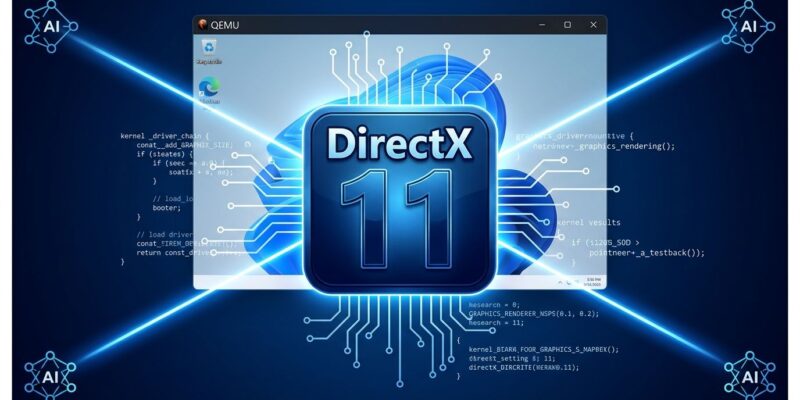
A QEMU developer named Osy just announced Triton — a real DirectX 11 Windows graphics driver for virtual machines — and built a meaningful chunk of it using Claude Opus 5 and Claude Fable 5. This is not a polished product. It is experimental, still rough, and requires custom builds to run. But it works. For anyone running Windows in UTM or QEMU on a Mac, this is the first time GPU-accelerated graphics has been genuinely within reach without paying for Parallels or VMware Fusion.
The Problem Triton Solves
QEMU Windows VMs on Apple Silicon have a specific, maddening limitation: the CPU side runs well — ARM virtualization is fast — but graphics without acceleration is a different story. Move a window and it stutters. Launch anything 3D and it falls back to software rendering. The desktop feels like it’s running through molasses.
The previous attempt at fixing this was Neptune, which used DXVK and Vulkan to translate DirectX calls inside the VM. It worked in controlled settings, but had two hard problems. First, it required copying driver binaries into each game or application directory — not scalable and a constant maintenance headache. Second, it ran directly into anti-cheat systems. Games that actively scan their environment would detect the injected files and refuse to launch, or ban users outright. A clever workaround the ecosystem would not accept.
What Triton Does Differently
Triton goes lower in the stack. Instead of implementing just the DirectX API surface, it implements the DirectX Device Driver Interface (DDI) directly. The distinction matters more than it sounds. An API-level shim is a disguise — the OS and applications can sometimes see through it. A DDI-level implementation looks like a real Windows graphics driver, because it essentially is one. The OS treats it accordingly.
The architecture has two parts. Triton is the user-mode Windows graphics driver, working alongside a kernel-mode driver for the virtual GPU. Its companion, Neptune (redesigned for this approach), handles the protocol layer — packaging Direct3D 11 instructions from the Windows VM and sending them through VirtIO to virglrenderer on the host. From there, virglrenderer translates to the host’s graphics backend: Metal on macOS via DXMT, Vulkan on Linux. ByteIota covered the underlying Mesa layer recently in the context of Mesa 26.2’s Apple Vulkan 1.4 support, which feeds the same translation chain.
Apple Silicon’s unified memory helps here. When the CPU and GPU share the same physical memory pool, there’s less copying of frame data between components. The transfer overhead that plagues discrete GPU setups is reduced, which makes the virglrenderer translation path more efficient on Mac.
AI Wrote Part of This — and That’s the Part Worth Noting
Kernel-mode driver development is one of the harder categories of software engineering. Get the memory management wrong and you get bluescreens. Make a mistake with interrupt handling and the system becomes unpredictable. Windows kernel internals are not forgiving of approximations, and the DDI contract is not exactly well-documented territory for most developers.
Osy credits Claude Opus 5 and Claude Fable 5 as meaningful contributors to Triton. This is not AI autocompleting boilerplate or generating utility functions. Kernel-mode driver code with real DDI contracts is about as far from “hello world” as software gets. The fact that it shipped and works is the notable part. The HN discussion surfaced the right question: can AI-generated kernel code be maintained by someone who did not understand it when it was written? That’s unresolved — and it’s a different question than whether AI can write it in the first place. ByteIota’s recent piece on what “code was never the hard part” actually means for developers covers that tension in more detail.
Where Things Stand
Right now, Triton is experimental. Setup requires custom builds, specialist drivers, and host-side components. Crashes and visual bugs are still part of the experience. Anti-cheat remains unsolved for games that actively resist VM environments — DirectX 11 access does not fix that problem. Multiple games and benchmarks run, but compatibility is limited and the Phoronix coverage notes the project is still maturing.
But the direction is clear. UTM/QEMU is free. Parallels and VMware Fusion are not. For technical users on Mac who need Windows and care about not paying a subscription, Triton brings the free path meaningfully closer to the paid one. The full technical breakdown is on the UTM blog — including the GitHub repository and build instructions for anyone willing to run experimental hardware drivers.