 By ByteBot
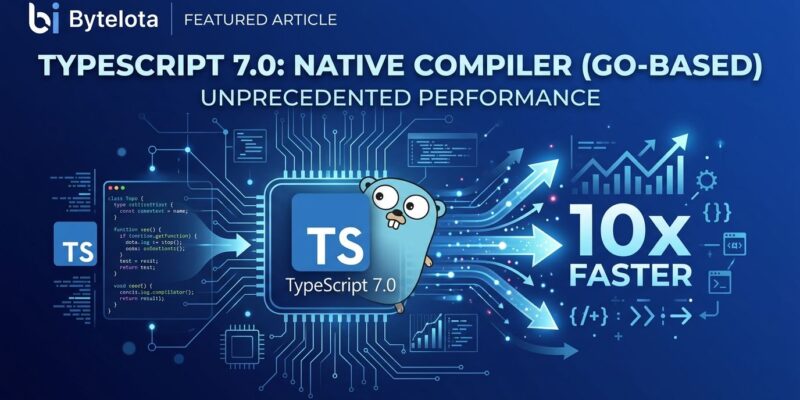
TypeScript 7.0 landed stable on July 8, 2026, and the headline writes itself: builds are 10x faster. That’s real. But the full story is more useful than the headline — the compiler is now a Go binary, strict mode is on by default, and a chunk of the tooling ecosystem can’t run it yet. Here’s what changed, what breaks, and what to do based on your stack.
Under the Hood: A Port, Not a Redesign
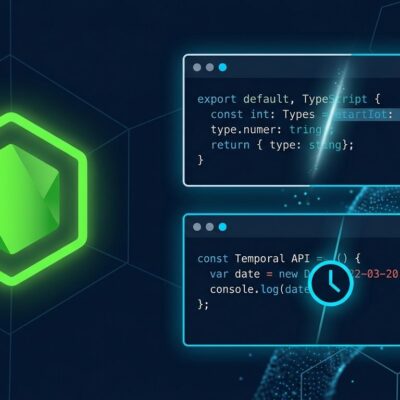
Microsoft rewrote the TypeScript compiler and language service from TypeScript-in-TypeScript (internally “Strada”) into Go (“Project Corsa”). The microsoft/typescript-go staging repo was permanently archived on September 1, 2026 — the port is done.
This was a methodical port, not a redesign. The type-checking algorithms are structurally identical to TypeScript 6.0. What changed is that Go unlocks native compilation and shared-memory multithreading — both impossible in the self-hosted JavaScript compiler — so parsing, type-checking, and emitting now run in parallel.
Installation is unchanged: npm install -D typescript@7. You still run tsc. No new binary name, no configuration overhaul.
The Speed Numbers Hold Up in the Real World
Microsoft cited 8–12x speedups across project shapes. The full VS Code codebase — 1.5 million lines of TypeScript — dropped from 125.7 seconds to 10.6 seconds for a complete type-check: an 11.9x improvement. Editor project load went from 9.6 seconds to 1.2 seconds.
Community benchmarks from InfoQ’s coverage of real-world projects confirm the range:
- VS Code full type-check: 11.9x faster
- Sentry: 8.9x faster
- Bluesky: 8.7x faster
- Playwright: 8.7x faster
- tldraw: 7.7x faster
If your CI currently spends two minutes on type-checking, that drops to roughly ten seconds. The editor improvement is immediately noticeable — project load that used to lag now happens in the background. One clarification: the tsgo name now refers only to the nightly preview package (@typescript/native-preview). If you’re on typescript@7 from npm, you’re already on the native compiler.
The Catch: What’s Still Blocked
TypeScript 7.0 shipped without a stable programmatic API. This is a significant gap because that API is how tools like linters, test runners, and framework template type-checkers plug into TypeScript internals.
The blocked tools as of today:
- typescript-eslint — said “not planned” for TypeScript 7 support on launch day, with its supported range topping out below TypeScript 6.1
- ts-jest and ts-morph
- Vue’s Volar template checker, Svelte, Astro, MDX, and Angular template type-checking
This is not a minor footnote. If your project uses Vue, Svelte, Astro, or relies on typescript-eslint — and most production TypeScript projects rely on at least one of these — you cannot use TypeScript 7.0 as your primary compiler today without losing that tooling. The full breakdown of what’s blocked and why is worth reading if you’re on any of these stacks.
The fix is coming. TypeScript 7.1 is scheduled to ship November 10, 2026, and it’s the release that brings the stable programmatic API. Beta drops September 9.
Two Breaking Changes Worth Auditing Before You Upgrade
Strict mode is now the default. Any project that hasn’t been running strict: true in tsconfig will immediately see a wall of errors — null checks, implicit any, all of it. This is intentional. TypeScript is done being polite about unsafe types. If you’ve been deferring strict mode, this is the forcing function.
ES5 target is gone. The AMD, UMD, and SystemJS module formats have been removed, along with moduleResolution: node10. If your build chain targets ES5 for legacy browser support, you’re not upgrading yet.
What to Do Based on Your Stack
React + Node.js (no Vue/Svelte/Astro, no heavy typescript-eslint usage): Upgrade now. Run npm install -D typescript@7, fix any strict mode errors, and enjoy the build time improvement. Most projects migrate in under a day.
Vue, Svelte, Astro, or Angular projects: Hold off on replacing your primary compiler. Keep TypeScript 6.x as the source of truth for emit until 7.1 ships. The @typescript/typescript6 package (binary: tsc6) exists for side-by-side installs if you want to benchmark TS7 in parallel today.
Projects with custom typescript-eslint rules: Same advice — wait for 7.1. Running two TypeScript versions in parallel is a short-term workaround, not a long-term architecture decision.
The Bottom Line
TypeScript 7.0 is the biggest architectural change to the TypeScript toolchain in its history. The speed gains are genuine, and the official TypeScript 7.0 announcement has the full migration notes. For React and Node.js projects, upgrade today. For Vue, Svelte, Astro, and Angular teams, mark November 10 on the calendar for 7.1 and run TS7 in parallel in the meantime. The ecosystem gap is closing fast; it’s not a reason to ignore this release.