 By
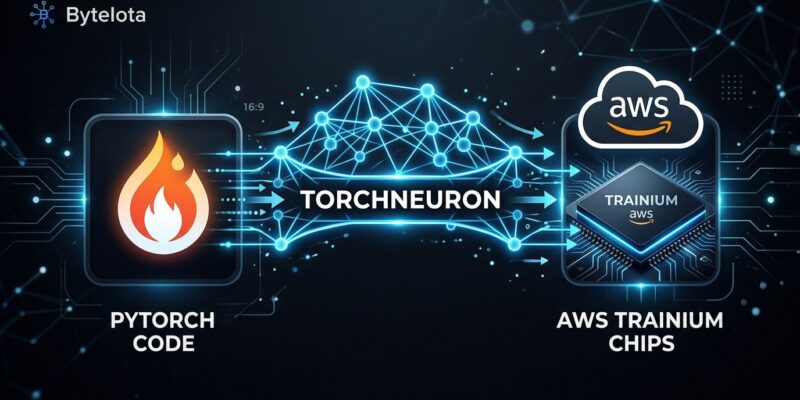
Amazon’s TorchNeuron hit public beta today at PyTorch Conference North America, and the pitch is unusually blunt: change .to(‘cuda’) to .to(‘neuron’) and your existing PyTorch model runs on AWS Trainium instead of Nvidia GPUs. No rewrites. No Neuron-specific APIs. Just a device name swap.
That may sound too good to be true — and there are real caveats — but the underlying architecture backs up the claim. TorchNeuron registers Trainium as a native PyTorch device through PrivateUse1, PyTorch’s official extension point for custom hardware. The result: torch.nn, torch.tensor, torch.autocast, torch.distributed, and torch.profiler all work on the neuron device as written. No translation layer. No XLA-specific workarounds.
The Code Change
For a standard training loop, the only edit is the device target:
model = MyModel().to('neuron')   # the only change
optimizer = torch.optim.AdamW(model.parameters())
for batch in dataloader:
    optimizer.zero_grad()
    loss = criterion(model(batch), targets)
    loss.backward()
    optimizer.step()
For production with torch.compile:
torch.compiler.set_default_backend("neuron")
model = MyModel().to('neuron')
model.compile()
Hugging Face Transformers users need only point from_pretrained at the new device:
model = AutoModelForCausalLM.from_pretrained(
    "Qwen/Qwen3-0.6B",
    device_map="neuron"
)
Install is equally straightforward: pip install torch-neuronx from the AWS Neuron pip repository. The project is open source under Apache 2.0 at github.com/aws-neuron/torch-neuronx.
What Actually Works
Coverage is the first question for anyone who has burned time on a hardware migration before. TorchNeuron supports both eager execution for research and debugging, and torch.compile for production. Distributed training runs on standard PyTorch APIs: DDP, FSDP2, SimpleFSDP, tensor parallelism, pipeline parallelism, and ZeRO all operate on Trainium without custom wrappers.
Hugging Face reports 89% of the top 100 text-generation models work out of the box — compared to 46% with the previous Optimum Neuron approach. TorchTitan, PyTorch’s native large-scale training library, runs on Trainium through TorchNeuron. vLLM Neuron handles LLM serving. Diffusers supports image and video generation including FLUX.1-dev and Qwen-Image with native Tensor Parallelism.
The Real-World Numbers That Matter
The case for Nvidia alternatives has always had two components: the price difference, and the cost of getting there. Porting friction was frequently the dealbreaker. TorchNeuron is a direct attempt to remove that second cost, which makes the first more compelling.
Deepgram — which processes over a quadrillion audio tokens per year — measured 60% more input audio seconds per dollar on Trainium compared to their GPU baseline. CTO Adam Sypniewski said: “Trainium processes about 60% more input audio seconds per dollar than our existing GPU baselines, which helps us bring better models to customers at lower prices.” Uber also committed to Trainium3, citing roughly 50% cost reduction versus Nvidia. On-demand Trainium3 pricing runs around $1.80 per chip-hour versus roughly $4.80 for Nvidia H200 — a gap that widens at scale.
What TorchNeuron Still Can’t Do
Dynamic input shapes are not supported in this release. If your model handles variable-length sequences — which covers most NLP inference workloads — you will need to pad inputs to fixed lengths (multiples of 128 per the Hugging Face guide) and set torch._dynamo.config.automatic_dynamic_shapes = False. About 22,000 PyTorch tests are currently skipped, mostly covering operator edge cases in elementwise, reduction, and advanced indexing. TorchAO and FP8 remain in private beta.
These are production constraints worth understanding before you commit to a migration. They are also clearly documented and have stated resolution timelines.
How to Get Started
TorchNeuron is available now in public beta. Install from the AWS Neuron pip repository, read the full technical breakdown in the PyTorch announcement, and check the Hugging Face integration guide for Transformers and Diffusers workflows. Code examples and the supported operator list live at aws-neuron/torch-neuronx on GitHub.
The practical question for any team running GPU training today: if the porting cost is now a one-line change, what is still keeping your workloads on Nvidia?