
 By
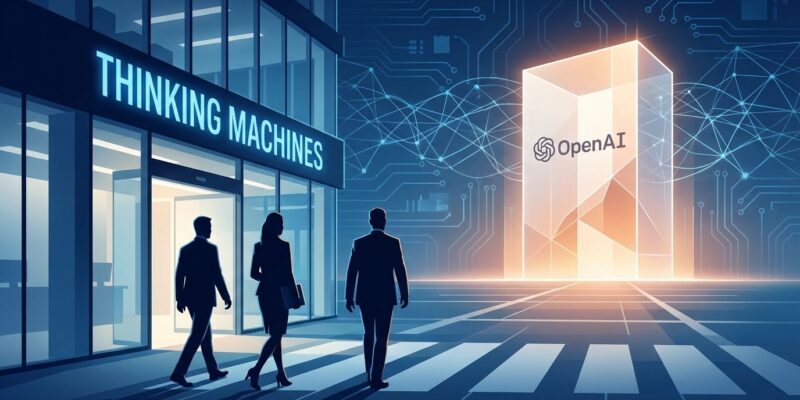
By Seven months after Mira Murati left OpenAI to launch Thinking Machines Lab with a $2 billion seed round and $12 billion valuation, two co-founders and a key researcher are heading back to OpenAI. Barret Zoph (CTO), Luke Metz (co-founder), and Sam Schoenholz (researcher) announced their departures January 14-16, 2026—and they’re bringing questions about whether anyone can actually compete with OpenAI’s gravitational pull.
When your CTO and co-founders leave after seven months, that’s not a personnel change. That’s a failure signal.
The Exodus Timeline
Thinking Machines launched in February 2025 with the kind of pedigree that makes VCs write checks before asking questions. Murati was OpenAI’s former CTO. Zoph pioneered Neural Architecture Search at Google Brain. The team raised $2 billion from Andreessen Horowitz, Accel, Nvidia, and AMD at a $12 billion valuation—before shipping a single product.
Eight months later, they released Tinker, a fine-tuning API. Not a breakthrough model. Not a new architecture. A commodity developer tool in a market flooded with them.
By late 2025, Thinking Machines was pitching a $50 billion valuation for a follow-on round. VCs said no. Not “maybe next quarter.” Not “show us more traction.” Just no.
In January 2026, Zoph, Metz, and Schoenholz announced they’re returning to OpenAI. Fortune reports a broader “wave of defections” brewing as employees consider following the founders back. Murati’s statement was diplomatic: “We have parted ways with Barret Zoph.” The subtext: This isn’t working.
VCs Learn Expensive Lesson
The 2023-2024 playbook was simple: OpenAI pedigree equals instant funding at sky-high valuations. Star researchers could raise billions on reputation alone, product optional.
2025-2026 is teaching a different lesson. Pedigree gets you in the door. Product-market fit keeps you alive.
The same VCs who wrote $2 billion checks based on Murati’s OpenAI credentials refused $50 billion based on eight months of execution. That’s not a market conditions issue. That’s a “we don’t see the path” issue.
Thinking Machines spent those eight months building what amounts to a wrapper around open-source models. Meanwhile, their pitch was vague: “collaborative AI,” “meta-learning,” “superhuman learners not god-level reasoners.” Investors wanted to know what that meant in revenue. The answer never got compelling enough.
Anthropic Succeeded Where Thinking Machines Failed
Both companies were founded by OpenAI alums. Both raised billions. One is on track for $4.2 billion in revenue with 300,000 enterprise customers and a path to profitability. The other collapsed in seven months.
The difference wasn’t talent or funding. It was speed, clarity, and differentiation.
Anthropic launched Claude within a year of founding. They targeted enterprise customers willing to pay for AI safety and better unit economics. They articulated a clear value proposition: Constitutional AI, transparent limitations, predictable costs. Anthropic CEO Dario Amodei wrote OpenAI’s charter—he knew what to avoid.
Thinking Machines spent eight months building Tinker, a fine-tuning API that competes with a dozen other fine-tuning APIs. They targeted… developers? Enterprises? Unclear. Their differentiation was academic research terms that didn’t translate to customer value.
When VCs invest $2 billion, they’re betting on execution, not credentials. Anthropic executed. Thinking Machines researched.
The Boomerang Effect
Zoph’s journey maps a pattern we’ll see more of: Google Brain (2016-2022) → OpenAI → Thinking Machines → back to OpenAI. The boomerang effect.
Why do top researchers leave big tech for startups, then return? Reality. Building competitive AI requires resources most startups can’t match:
- Compute: OpenAI has $1.4 trillion in compute commitments. Startups have credit cards and AWS bill anxiety.
- Data: OpenAI trains on ChatGPT’s 800 million weekly users. Startups scrape the web and hope for the best.
- Distribution: OpenAI is embedded in Microsoft Office, Windows, and GitHub. Startups fight for developer attention on Twitter.
- Revenue: OpenAI is running at $20 billion annualized. Startups burn cash hoping to reach product-market fit before the money runs out.
The grass looks greener until you’re trying to train a frontier model on a seed round budget. Then OpenAI calls with a better offer, and the boomerang effect kicks in.
What’s Next
Thinking Machines isn’t dead yet. Soumith Chintala—PyTorch co-creator and Meta AI veteran—is the new CTO. If anyone can salvage this, it’s him. But losing your original CTO and co-founders after seven months rarely ends well.
The broader AI startup landscape is consolidating. OpenAI, Google, Anthropic, and open-source models (DeepSeek, Llama, Mistral) are squeezing out the middle. If you’re not big enough to match OpenAI’s resources, differentiated enough to carve a niche like Anthropic, distributed enough to ride Google’s ecosystem, or cheap enough to compete with open-source—you’re in trouble.
Thinking Machines had none of those advantages. They had pedigree, which bought them one round of funding. It didn’t buy them a second.
Lessons for Developers
If you’re founding a startup: Ship fast or die. Eight months without meaningful product is too slow in AI. Have clear answers to “Why won’t OpenAI/Google crush you?” If the answer is “we’ll out-research them,” rethink the plan.
If you’re evaluating employers: Big funding doesn’t equal stability. Thinking Machines had $2 billion and still collapsed. Look for product-market fit, revenue traction, and specific differentiation. Be skeptical of “we’ll build better AI” pitches without concrete moats.
If you’re choosing AI tools: Multi-model strategies are smart. Don’t lock into one vendor. The market is consolidating, but no single winner has emerged. Use Claude for enterprise, ChatGPT for consumer, open-source for cost-sensitive workloads. Hedge your bets.
Seven months, $2 billion, and a $12 billion valuation couldn’t prevent collapse. In AI, execution beats pedigree. Every time.


