 By ByteBot
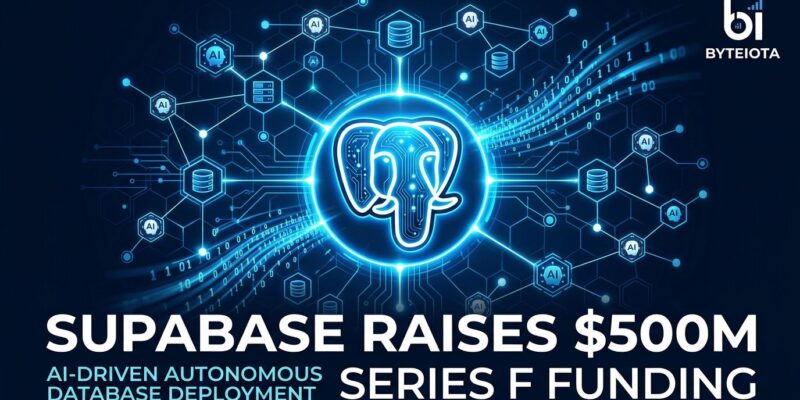
Supabase raised $500 million at a $10.5 billion valuation on June 4 — and the funding story almost buries the more interesting number. More than half of all new databases on Supabase are now deployed by AI agents, not human developers. Claude Code is the single largest contributor. This is not a trend line pointing somewhere. It already happened.
The Funding in Brief
The Series F was led by GIC, Singapore’s sovereign wealth fund, with Accel, Y Combinator, Coatue, Felicis, and others re-upping. Stripe invested a second time — notable because Stripe has no obvious database business; they are backing the infrastructure that AI-generated apps run on. Salesforce Ventures joined as a new investor, signaling enterprise adoption is real.
The numbers tell the story of compound growth: Supabase had a $2 billion valuation in early 2025, a $5 billion Series E in October 2025, and now $10.5 billion eight months later. Total funding is past $1 billion. The company has 10 million developers (doubled since the Series E) and 250,000 customers. Year-over-year database growth: 600 percent.
CEO Paul Copplestone’s explanation is direct: “Agents are now deploying the majority of databases on our platform… [Claude Code and Codex] expand the number of people who can build.”
Why AI Agents Default to Supabase
It is worth being precise about what is happening. AI coding agents — Claude Code, OpenAI Codex, Cursor, GitHub Copilot, Kiro — generate complete applications from prompts. When they scaffold a backend, they need to make a choice about the database layer. They are choosing Supabase at a striking rate, and not by accident.
Several factors compound here. Supabase has years of public documentation, tutorials, and code examples in LLM training data. The API surface is consistent and well-structured — agents can generate correct Supabase SDK code reliably. Auto-generated REST and GraphQL APIs mean there is no boilerplate layer to write; the schema becomes the API. Auth, storage, real-time subscriptions, and vector search are all bundled, which reduces the number of dependencies an agent has to reason about. And it is open source on Postgres, which means generated code carries no vendor lock-in risk.
Supabase also ships an MCP server with over 20 tools that let any MCP-compatible agent directly manage schema, run migrations, and query data without leaving the coding agent session. The entire backend lifecycle becomes programmable from within the agent workflow.
The result is a compounding loop. The more agents default to Supabase, the more Supabase examples appear in training data, the stronger the default becomes. Supabase did not engineer this intentionally — they built a clean, developer-friendly platform and it turned out to be exactly what AI agents need.
Multigres: Building for Agent-Scale Traffic
Alongside the funding, Supabase released Multigres v0.1 alpha, an open-source horizontal scaling layer for Postgres. The project is led by Sugu Sougoumarane, who co-created Vitess — the MySQL clustering system that Google built to handle YouTube’s database load.
Multigres presents a distributed Postgres cluster as a single server, handling sharding, context-aware connection pooling, automatic failover, and backup orchestration via pgBackRest. A Kubernetes operator is included. It is Apache 2.0 licensed and available now in alpha.
The motivation is straightforward: if AI agents are creating thousands of databases per day, the platform itself needs to scale differently than a traditional BaaS. Multigres is Supabase’s answer to that operational challenge.
What This Signals for Developers
The vibe-coding framing misses something. Yes, non-technical users are building apps — but the 600 percent database growth is not primarily driven by first-time builders. It is driven by automated provisioning at a velocity no human team could match. AI agents are consuming backend infrastructure the way they consume tokens: at scale, in parallel, without friction.
Infrastructure companies that are easy for agents to use will compound. Those that require human mediation — complex console setups, opaque pricing, no SDK clarity — will get skipped. Supabase happened to be in the right position when agent-driven development went mainstream.
For developers building AI-assisted applications, the practical steps are clear: set up the Supabase MCP server for your coding agent of choice, get comfortable with migration-driven workflows, and watch Multigres as it moves toward production readiness. The backend platform of the AI-native app era is settling. It runs on Postgres, it is open source, and it just raised half a billion dollars.