 By ByteBot
At Stripe Sessions 2026, something crossed a line. Stripe shipped Stripe Projects to general availability—a CLI and API that lets an AI agent provision a production Postgres database in 350 milliseconds, spin up hosting, configure authentication, and pay for all of it through a single billing layer. No dashboard. No IAM policies. No human in the loop. The dev stack just became something an agent can purchase.
One Command, Entire Stack
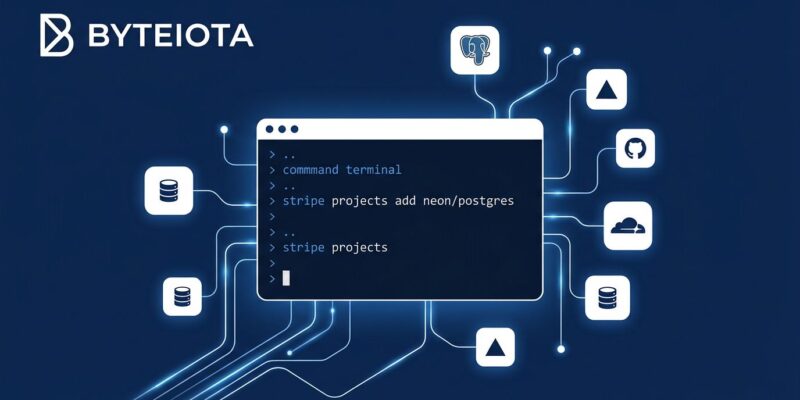
Stripe Projects is a plugin for the Stripe CLI. The interface is blunt: stripe projects add [provider]/[service]. Run it and credentials land in your environment automatically—connection strings, API keys, everything an agent needs to keep building. Here is what a full provisioning run looks like:
stripe projects init
stripe projects add neon/postgres    # production DB in 350ms
stripe projects add vercel/hosting
stripe projects add clerk/auth
# credentials auto-synced to .env
That sequence—from empty project to database, hosting, and auth—is what an agent can execute today, without a human anywhere in the chain. The Stripe Projects CLI is free; you pay each provider for the resources provisioned.
32 Providers, One Bill
Stripe announced 14 new providers at Sessions 2026, bringing the ecosystem to 32: Vercel, Cloudflare, Supabase, Neon, Clerk, PostHog, Render, Twilio, Sentry, WorkOS, Browserbase, GitLab, ElevenLabs, Databricks, PlanetScale, Hugging Face, and more. That covers the stack most production teams actually run. Unified billing means one Stripe dashboard shows what every provider charges, broken down by project.
Neon is the standout integration. A production-ready Postgres database is provisioned in 350 milliseconds—no account signup, no configuration form, according to Neon’s integration announcement. The Nous Research open-source agent Hermes already ships Stripe Projects as a built-in skill. AWS Bedrock AgentCore and Factory Droids have integrated too. The agent ecosystem is treating Projects as standard infrastructure.
The Guardrails Developers Actually Need
Giving an agent access to infrastructure provisioning is the kind of thing that sounds good until an agent runs a loop and charges $4,000 to your card. Stripe addressed this directly. The default spend cap is $100 per month per provider, enforced at the protocol level—not the app level. The agent cannot override it. Raising the cap requires an explicit developer action.
Agent credentials are scoped separately from your Stripe API key. Each agent instance gets its own credentials that can be issued, rotated, and revoked independently. For Cloudflare, existing accounts go through a standard OAuth grant; new accounts are created by Projects automatically, as Cloudflare’s integration post details. Spend monitoring gives you a unified cost view across all providers per project.
This is not bulletproof—there is no rollback if an agent over-provisions before hitting the cap—but it is materially better than the alternative of handing agents your root credentials and hoping for the best.
MPP: The Protocol Under the Hood
Stripe Projects runs on top of the Machine Payments Protocol (MPP), which launched in developer preview in March 2026. MPP gives each agent instance a cryptographic identity, separate from the developer’s human identity. Agent authentication uses an agent-specific API key plus a wallet ID, verified on the Tempo blockchain—a payments-focused chain backed by Stripe and Paradigm. The MPP announcement has the full technical breakdown.
Settlement is in USDC. That will give some teams pause, and it should: MPP is still in developer preview even though Projects itself is GA. But the stablecoin layer exists because card rails cannot handle what comes next: streaming payments.
Streaming payments combine Metronome (token-level usage tracking) with Tempo (stablecoin micropayments). The use case is AI-native billing—charging customers per token, at the moment it is consumed. Card rails cannot handle amounts this small at this frequency. Stripe is building the financial plumbing for a billing model that does not yet exist on traditional infrastructure.
What This Actually Changes
The easy framing is “this saves developers time.” That is true but undersells it. Before Stripe Projects, an agent’s job ended at the code. A developer still had to create accounts, configure services, and wire credentials. That is the part that turned “autonomous agent” into “autonomous code writer with a human babysitter.”
Stripe Projects removes the babysitter. When an agent can write code, provision the database, deploy the app, and pay for all three—the human’s role shifts from operator to policy setter. You define the spend caps, the allowed providers, the environment boundaries. The agent executes within them.
To start, install the Stripe CLI, run stripe projects init, and browse the full provider catalog at projects.dev/providers. The official Sessions 2026 blog post covers the new provider integrations and developer controls in detail.