 By ByteBot
SolidStart 2.0 went stable on September 19, 2026 — and within days of shipping, the framework announced it is entering maintenance mode. That’s not a bad release story. It’s actually the right one. After 25+ pre-release builds and more than a year of development, the SolidJS meta-framework completed its ground-up modernization: Vinxi is out, Vite 8’s Environment API is in. The timing of the retirement isn’t a coincidence — Solid 2.0 RC absorbed everything SolidStart used to provide, making the wrapper unnecessary. It shipped its best version precisely so it could bow out cleanly.
What Changed in v2: Vinxi Is Gone
The core architectural shift is the removal of Vinxi, the build-coordination layer that SolidStart 1.x depended on. Vinxi existed because Vite 5 had no native way to manage separate client and server build environments. Vite 8 ships with a native Environment API that solves exactly that problem. The abstraction Vinxi provided is no longer needed.
Replacing Vinxi with direct Vite 8 integration brings concrete wins: better plugin compatibility (Tailwind CSS v4 now works without workarounds), native deployment adapters for Nitro v3, Cloudflare, and Netlify, and Vite 8’s Rolldown-powered toolchain. A long-standing bug — flashes of unstyled content when lazy-loading components during SSR — is fixed as a side effect of the rebuild.
Migration: Four Changes, One Hard Requirement
The migration from SolidStart 1 to 2 is mostly mechanical. The one thing to flag before you start: Node.js 24 is required. If your deployment environment can’t run Node 24, that needs to be sorted first.
Everything else is a find-and-replace operation:
- Delete
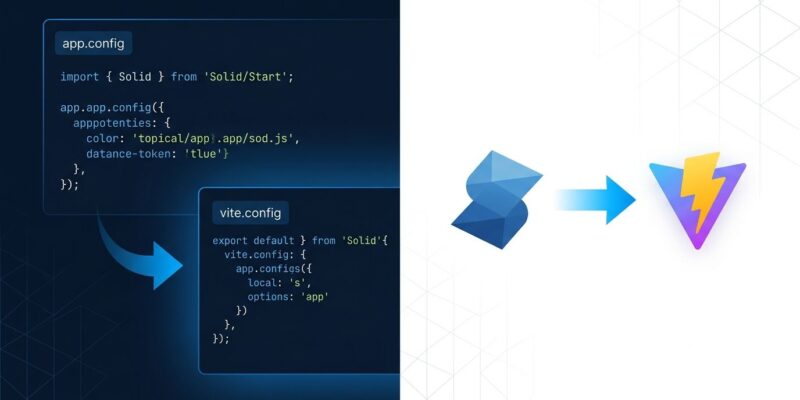
app.config.ts, createvite.config.ts— configuration moves into standard Vite config that callssolidStart() - Update scripts —
vinxi dev,vinxi build,vinxi previewbecomevite dev,vite build,vite preview - Swap TypeScript types —
vinxi/types/clientto@solidjs/start/envin tsconfig.json - Check CSP settings — v2 defaults to JSON serialization (CSP-safe); v1 defaulted to JS format, which requires
unsafe-eval. If you were relying on the old behavior, addserialization: { mode: "js" }to yoursolidStart()call
The resulting vite.config.ts looks like this:
import { defineConfig } from 'vite'
import solidStart from '@solidjs/start/vite'
import nitro from 'nitro'

export default defineConfig({
  plugins: [solidStart(), nitro()]
})
Remove Vinxi from your dependencies and clean .vinxi from your .gitignore. That’s the migration.
The Maintenance Announcement: Why Now Makes Sense
The timing feels abrupt — v2 ships, maintenance starts — but the logic is sound. Solid 2.0 RC, released concurrently, migrated every capability that SolidStart provided into core libraries:
- Server functions moved to
@solidjs/web/server-functions("use server"as a language primitive) - File-system routing is now a router-neutral package that handles HMR, code splitting, and typed route emission
- The serving layer lives in the Vite plugin’s start mode —
solid({ start: true, ssr: true })— withhandleRequest(request)as the single production contract
Ryan Carniato, the framework’s creator, put it plainly: “Start mode replaces SolidStart.” The meta-framework layer became redundant because Solid 2.0 grew up enough to not need it.
Maintenance mode means security patches, not end-of-life. Existing SolidStart applications keep running without incident.
What Solid 2.0 Start Mode Offers
If you’re considering the forward path, Solid 2.0 RC is worth understanding. The framework ships a new Rust-based compiler built on the Oxc project, and the performance numbers are significant: an 88-file project compiles in 19ms instead of 440ms. A 1MB module that previously took 24 seconds now takes 70ms. That’s not incremental improvement — it’s a different category of build speed.
The API also simplifies meaningfully. createResource is gone; async flows through regular memos. Automatic batching runs on microtasks by default. JSX lost its Solid-specific prefixes (attr:, bool:, on:). The framework is getting closer to reading like standard TypeScript rather than a custom DSL.
What Should You Do?
- Migrate to SolidStart 2.0 now — if you’re on SolidStart 1.x, this is a mechanical upgrade. Node 24 is the only real requirement, and it keeps you on supported software.
- Watch Solid 2.0 stable — start mode is available in RC today. Full stable is expected soon. Once it lands, the path forward is clear.
- Consider TanStack Start — a valid alternative if the SolidJS 2.0 transition feels disruptive and you want a meta-framework under active feature development.
The consolidation of SolidStart’s capabilities into Solid 2.0 core is a healthy signal. Meta-frameworks disappear when the core framework grows capable enough to not need them — and in SolidJS’s case, that’s exactly what happened.