 By ByteBot
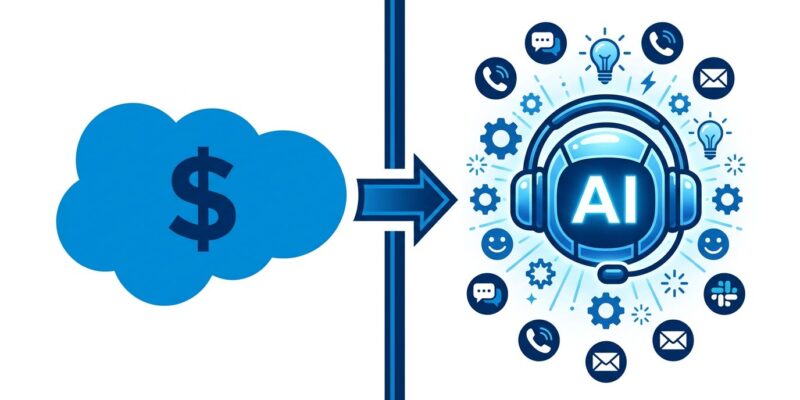
Salesforce just agreed to buy Fin — the AI customer service agent formerly known as Intercom — for $3.6 billion. The deal was announced today, June 15, 2026, and it reveals something important about enterprise AI that Agentforce’s press releases don’t: building the most powerful agentic platform in history isn’t enough if it takes five months to deploy.
What Fin Is, and Why It’s Worth $3.6 Billion
Fin isn’t a chatbot. It’s a purpose-built AI agent that resolves roughly 76% of customer support volume end-to-end — no escalation, no human handoff. It works across live chat, email, WhatsApp, SMS, phone, and Slack with a single unified agent. The technology is driven by Apex, Fin’s proprietary AI model built specifically for customer service.
Apex is worth paying attention to. Launched as Fin Apex 1.0 earlier this year, it outperforms GPT-5.4 and Claude Sonnet 4.6 on customer support resolution tasks — 73.1% automated resolution rate versus roughly 70% for frontier models. It also produces 65% fewer hallucinations and responds 0.6 seconds faster. For enterprise customers with 250,000+ monthly conversations, Fin backs Apex with a performance guarantee: hit 65% resolution or they pay you $1 million. That’s how confident they are in a domain-specific model beating general-purpose AI at a narrow task.
Fin serves over 30,000 companies globally. Salesforce is paying roughly $120,000 per customer — expensive or a bargain depending on what those companies are worth to Salesforce’s broader platform.
The Real Reason Salesforce Needed This Deal
Agentforce is a genuine success story. $1.2 billion in ARR in Q1 FY27, up 205% year-over-year, 29,000 enterprise deals closed in a single fiscal year. By any measure it’s the fastest-growing agentic AI platform ever built. And yet Salesforce needed to spend $3.6 billion to buy a company whose core value proposition is “deploys in days, not months.”
That’s the tell. Agentforce takes an average of 4.8 months from strategy to full deployment. For large enterprises with dedicated implementation teams, that’s manageable. For the SMBs and commercial organizations that make up the bulk of the market, it’s a dealbreaker. Fin fills that gap. Marc Benioff framed it diplomatically in the official announcement: “Fin brings proven agent technology, a deep commitment to customer success, and an incredible AI team that will complement Agentforce.” Read between the lines: Agentforce alone wasn’t closing the accounts that wanted something ready today.
The Consolidation Pattern No One Is Calling Out
Salesforce isn’t the first platform company to run this play. ServiceNow bought Moveworks for $2.85 billion — closed December 2025 — for the same reason: powerful enterprise platform, needed a packaged AI agent to compete at every tier of the market. That’s over $6 billion in AI customer service M&A in roughly six months. The playbook is identical: build the configurable platform, then buy the “just works” product for everyone who can’t handle the implementation.
Zendesk is now the odd one out. They’ve been building their own resolution platform — trained on 20 billion ticket interactions, priced on outcomes rather than seats — but without a deep enterprise platform underneath. Post-acquisition, Fin’s 30,000 customers sit inside Salesforce’s orbit. That means Zendesk faces a combined Salesforce+Fin opponent across every market segment simultaneously.
What Salesforce’s Fin Acquisition Means for Developers
Fin opened an API platform to developers in April 2026, giving programmatic access to Apex, Fin RAG, Fin Retrieval, and Fin Reranker. The minimum commitment was $250,000 per year — clearly targeting enterprise buyers. Post-acquisition, that model is likely to change. Salesforce might fold these capabilities into Agentforce’s developer ecosystem, expand access through their platform, or restrict them to Salesforce-integrated builds. Nobody outside the negotiating room knows yet.
For teams already building on Agentforce, the upside is real: Fin Apex and Fin’s domain-specific RAG pipeline could become components you drop into an Agentforce build. For teams using Fin as a standalone product, the risk is equally real: enterprise-ification has a way of complicating things that used to be simple.
The Bigger Takeaway
The Apex story is what the industry should be studying. A domain-specific model — post-trained on customer service data — outperforms the best frontier models at a narrow task. That pattern is going to repeat across every vertical where volume and specificity matter more than breadth. Customer service is just the first obvious target.
Salesforce gets Fin’s customers, Fin’s model, and Fin’s team. What it’s really buying is proof that simple beats complex when most companies can’t afford complex. The $3.6 billion is the market’s verdict on that insight.