 By ByteBot
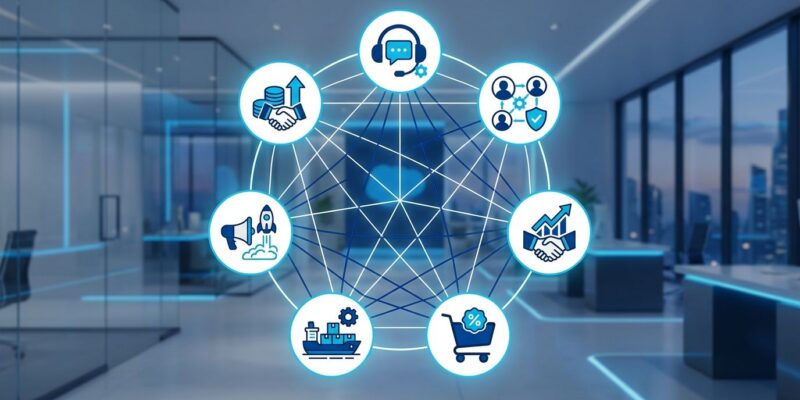
Salesforce launched seven named AI agents on September 11, four days before Dreamforce 2026 opened in San Francisco. The agents have job titles, persistent memory spanning months, and one — Hunter, the outbound sales agent — runs on a runtime built to pursue goals over weeks without stopping. This is not a chatbot update. The unit of work is no longer the conversation. It is the goal.
Seven Agents, Six Available Now
Each agent ships preconfigured with the skills, actions, and data models for its role. You can rename them and tailor them to your company’s rules and permissions, but the starting point is a working role, not a blank prompt.
- Casey — Customer service across voice, SMS, WhatsApp, and web chat, including returns and escalation
- Paige — Employee IT and HR requests
- Carter — Shopping assistance, product questions, in-chat checkout
- Hunter — Outbound sales pipeline (pilot now, GA November 2026)
- Marshall — Supply chain workflows
- Piper — Inbound lead qualification and conversion for B2B sales and marketing
- Fin — Complex customer operations workflows, powered by Fin Apex custom models
Six are generally available today. Hunter is in pilot access with general availability planned for November 2026, per Salesforce’s official announcement.
Hunter: The Agent That Works While You Sleep
Hunter is built on a new long-horizon runtime — Salesforce’s first production agent designed to keep working toward a goal over days or weeks. This is a meaningful departure from how most production agents work today: a single session, a bounded context window, a response, done.
The runtime has three components. Memory carries context and progress across sessions — a plan survives the end of a conversation. Durable execution keeps that plan running; the agent resumes or corrects course when circumstances change. Dynamic steering adjusts behavior based on feedback and user direction over the course of the run.
The developer implications here are real and mostly unsolved. Testing an agent that runs for a week is not the same as running a unit test. Observability for durable state means tracking what an agent knew, decided, and acted on across sessions spanning days. Cost management changes when execution is continuous rather than per-request. And memory spanning months raises privacy and compliance questions that most AI governance frameworks are not built for yet.
Salesforce says more agents will move to this runtime over time, and eventually developers will be able to build their own long-horizon agents using Agentforce. That capability is not here yet — but the roadmap is explicit.
The Governance Layer Is the Real News
The most practically significant announcement this week is not the named agents. It is the Agent Fabric AI Control Plane — a governance layer that covers Salesforce agents and third-party agents from Amazon Bedrock, Microsoft Foundry, OpenAI, and Gemini from a single surface.
The real enterprise problem in 2026 is not a shortage of AI agents. It is ungoverned proliferation: dozens of agents from different vendors, no unified audit trail, no cost visibility, no consistent identity verification. Agent Fabric addresses this with five components: AI Gateway governs LLM calls; MCP Bridge governs tool connections; Trusted Agent Identity authenticates every invocation; Agent Broker orchestrates across vendors; Agent Script declares deterministic rules for critical handoffs.
The last point — guided determinism — is worth pausing on. Agent Script lets you define hard rules for steps that cannot be left to probabilistic reasoning: processing a refund, escalating a complaint, routing a compliance issue. The agent reasons freely in between, but the critical handoffs are locked. This is the right architectural model for enterprise workflows, and it is more honest about where LLMs should and should not have discretion than most “fully autonomous” agent pitches.
How to Access These Agents From Your Code
The integration layer is Salesforce Headless 360, which exposes the entire Salesforce platform as REST APIs, MCP tools, and sf CLI commands. There are 60+ MCP tools and 30+ preconfigured coding skills available, compatible with Claude Code, Cursor, OpenAI Codex, and Windsurf. The Agentforce REST API lets external systems invoke agent sessions and receive structured responses without a logged-in Salesforce user in the loop.
If you are at Dreamforce this week, the Developer Theater and Camp Mini Hack have hands-on sessions with Agentforce and Headless 360 running through September 17. The developer guide for Dreamforce 2026 covers the full session schedule.
What Developers Should Do Now
- If you are building on Salesforce Service Cloud or Commerce Cloud: check which of the six GA agents intersect your workflows — the starting configuration may cover more than you expect
- If you are orchestrating agents across multiple AI vendors: Agent Fabric’s AI Control Plane is worth evaluating as a governance layer before your agent count grows
- If you are integrating external systems with Agentforce: review the Headless 360 MCP tools and the Agentforce REST API — invoking agent sessions without a logged-in user changes your integration architecture
- Watch Hunter: the long-horizon runtime is the preview of where enterprise agent architecture is heading. The developer tooling for it will matter more than the sales use case