 By ByteBot
The Hard Truth: No Migration Path
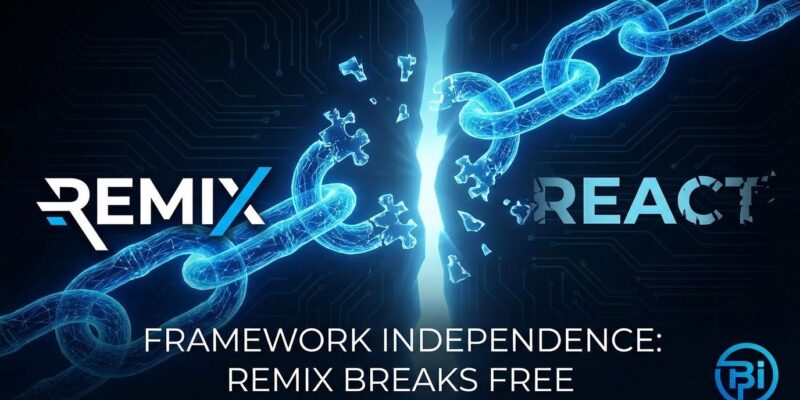
Despite Remix’s reputation for having one of the best upgrade policies in the industry, there is no migration path from Remix 2 to Remix 3. The changes are too fundamental. This isn’t a version bump; it’s a ground-up rewrite that forces existing Remix users into a binary choice: stick with React Router 7, which keeps the React ecosystem while absorbing Remix features like loaders and actions, or rewrite for Remix 3’s web standards foundation.
For developers with production apps on Remix 2, this is a fork in the road, not an upgrade path. React Router 7 is the safe bet—stable, React-based, minimal disruption. Remix 3 is the experiment—web standards, AI-designed architecture, fresh start. The framework creators acknowledge there’s no automatic migration tooling because the philosophies diverge too sharply.
React’s Dominance Gets Its First Real Test
Remix 3 is the only major framework to break from React after being React-based. Built on a fork of Preact, it replaces React’s declarative model with an imperative approach: this.update() instead of useState, native browser events instead of props, and Fetch API primitives instead of framework abstractions. It’s a technical bet that web standards outlast framework churn—and a philosophical statement that React’s assumed necessity in meta-frameworks isn’t gospel.
The risks are obvious. Eighty-four percent of developers use AI tools built for React, according to the 2025 Stack Overflow survey. Remix 3’s Preact fork means a smaller ecosystem, fewer libraries, less community support. But the creators argue the rewards justify it: minimal dependencies, full control over the stack, and a framework designed for web platform primitives rather than React’s virtual DOM. Whether this web standards purity is genuine or marketing differentiation remains to be seen.
AI-Designed Architecture: Substance or Hype?
Ryan Florence and Michael Jackson have been “very vocal about AI’s role in both designing and implementing the framework,” according to DEV Community reporting. This positions Remix 3 as part of a broader 2026 trend toward AI-native development, where frameworks are designed with AI agents in mind and development cycles are cut by 40% through automation. But does AI involvement guarantee better architecture, or just better marketing?
The framework’s “AI-ready architecture” aligns with industry shifts toward agentic AI frameworks like MetaGPT, which simulates full-stack product teams as coordinated AI agents. Yet the fundamental question remains: Does automation equal quality? Remix 3 will be a test case for whether AI-designed frameworks can compete with decades of human-refined patterns in React and Next.js.
The Fork in the Road: Which Path Are You On?
Existing Remix users face a straightforward decision matrix. If you have production apps on Remix 2, React Router 7 is the intended upgrade path—it keeps React, maintains compatibility, and absorbs the features that made Remix valuable. If you’re starting a new project and want to embrace web standards with minimal dependencies, Remix 3 is the greenfield experiment. There’s no middle ground.
Appwrite’s technical analysis notes that React Router 7 merged nearly everything that made Remix unique—loaders, actions, nested routing—into a stable React foundation. Meanwhile, Remix 3 rebuilds from scratch with no bundler required (experimental), direct Fetch API integration, and an imperative model that ditches React’s lifecycle entirely. The frameworks share a name and creators, but little else.
What It Means for Meta-Framework Evolution
Remix 3’s React breakup challenges the orthodoxy that React is the only serious foundation for production meta-frameworks. The New Stack calls it “the end of React-centric architectures,” though that’s likely premature. Next.js remains the market leader, React’s ecosystem is too strong to abandon overnight, and 84% of developers aren’t switching tools anytime soon.
But Remix 3 tests a critical thesis: web standards vs. framework abstractions. If Remix 3 delivers on performance, developer experience, and ecosystem growth despite breaking from React, other frameworks may follow. If it struggles with adoption and tooling support, React’s dominance is validated. Either way, the decision to offer no migration path from Remix 2 is a statement: sometimes frameworks shouldn’t compromise vision for backward compatibility.
The early 2026 release is imminent. Developers making framework decisions now have two Remix-branded options: the React-based stability of Router 7, or the web standards experiment of Remix 3. Choose wisely. There’s no upgrade path between them.