 By ByteBot
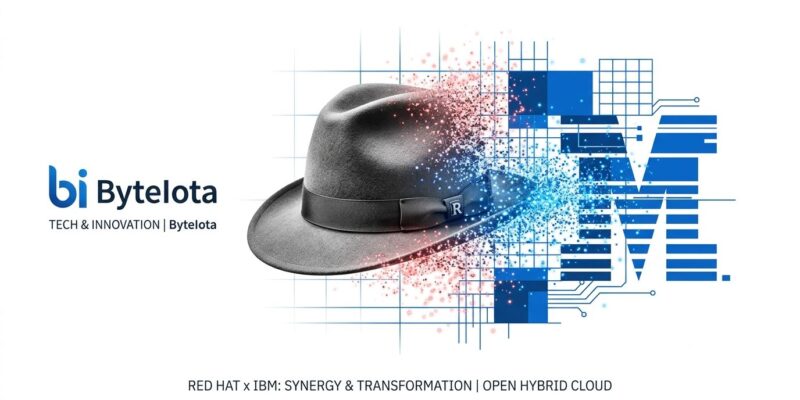
On October 1, 2026, IBM erased the Red Hat brand. Employees came to work and their badges said IBM. The team remained. The products remained. The name, however, was gone. For anyone paying attention since the $34 billion acquisition closed in 2019, this moment was never a surprise — just a seven-year countdown reaching zero.
Red Hat was not just a company. It was, in fact, the proof of concept that open source software could sustain a serious commercial business. It employed engineers to work on the Linux kernel full-time, upstream and without preconditions. It funded systemd, contributed to GNOME, and built RHEL into the backbone of enterprise infrastructure. The badge change is symbolic. What got lost along the way is not.
How IBM Dismantled Red Hat
The dissolution did not happen in a day. IBM ran it as a staged process, each step calibrated to extract value while softening community backlash. December 2020: Red Hat killed CentOS 8 eight years ahead of schedule, with 12 months’ notice, stranding millions of servers that relied on the free enterprise Linux clone. Moreover, in June 2023, Red Hat moved RHEL source code behind a paywall — paying customers only — ending the publicly accessible upstream that Rocky Linux and AlmaLinux depended on. Subsequently, in February 2025, Red Hat’s middleware teams were folded into IBM’s organization. January 2026: Some 19,000 back-office staff — HR, finance, legal, accounting — migrated to IBM. As a result, by April 2026, 300+ OpenShift, QEMU, and libvirt engineers were laid off, roughly triple the standing US senior OpenShift pool at the time.
October 1 was, consequently, the final act: a badge that now reads IBM. When employee Thomas Wilson posted, “Today the badge says IBM. The team is still here. The work continues,” he meant it as reassurance. It read as an epitaph.
The CentOS Decision Was the Real Tell
The CentOS killing in 2020 was the canary. That is when it became clear that IBM-era Red Hat would prioritize revenue extraction over community trust — and that those two things were in direct conflict. CentOS ran production infrastructure at Disney, Toyota, Verizon, and GoDaddy, among millions of others. Furthermore, it was the free on-ramp that drove RHEL adoption across the enterprise world. Killing it with 12 months’ notice was not a business pivot; it was a breach of an implicit contract with a community that had trusted Red Hat for over a decade.
The 2023 source code restrictions confirmed it. Consequently, prominent Red Hat community contributor Jeff Geerling — author of Ansible for DevOps and a longtime RHEL advocate — wrote that he was done with Red Hat Enterprise Linux. His post became a touchstone because it said what many were thinking: the company that built its reputation on open source had, step by step, closed itself off. In fact, LWN.net’s analysis of the source code restriction made clear this was legally defensible under GPL but violated the spirit that made RHEL trustworthy.
Related: CERN Ditches Red Hat for Debian 13: The CHF 5.4M Decision
What Actually Changes for Developers
The products survive. RHEL, OpenShift, Ansible, and Fedora are not going away. IBM generates roughly $6.5 billion annually from the Red Hat portfolio, and OpenShift alone carries $1.3 billion in annual recurring revenue. However, the organizational context around those products has shifted permanently. Engineering decisions now flow through IBM’s product strategy. Community commitments are, therefore, subordinate to quarterly targets. Fedora — the upstream community distribution that feeds RHEL — has reportedly seen its QA team halved over the past year. Upstream health matters for downstream quality, and that upstream health is declining.
The alternatives are credible. AlmaLinux and Rocky Linux provide binary-compatible RHEL replacements at no cost, with optional paid support. Meanwhile, RHEL server subscriptions start at $349 per server per year. The Register reported in September 2025 that the organizational separation was coming, and organizations that heeded that signal have had 12 months to evaluate alternatives. CERN made its move — switching to Debian 13 — in a migration that saved CHF 5.4 million annually. Additionally, Techrights documented the October 1 changes in detail, including firsthand employee accounts of the transition.
The Bigger Pattern
Red Hat is the latest entry in a familiar corporate open source acquisition cycle. Sun bought MySQL; the community forked MariaDB. Oracle absorbed Sun; MariaDB accelerated and Percona Server emerged. Moreover, IBM acquired Red Hat; Rocky Linux and AlmaLinux now run on hundreds of thousands of servers that would have been RHEL. The community insures itself against corporate failure, every time.
The badge change is not where the real loss happened. In contrast, the real loss was the culture of Red Hat — engineers paid to work upstream without conditions, corporate backing for projects that did not directly monetize — and that loss occurred incrementally between 2020 and 2026. IBM managed it slowly enough that no single moment felt catastrophic. Collectively, however, it was.
Key Takeaways
- IBM erased the Red Hat brand on October 1, 2026 — the final step in a seven-year absorption, not a sudden decision.
- The real turning point was the CentOS killing in 2020, which signaled IBM-era Red Hat would sacrifice community trust for revenue extraction.
- RHEL, OpenShift, and Ansible continue and are commercially strong — but without the open source culture that made Red Hat trustworthy to begin with.
- AlmaLinux and Rocky Linux are credible enterprise alternatives; CERN’s CHF 5.4M migration is a useful benchmark for organizations evaluating the switch.
- The community self-organizes when corporate stewards fail: MySQL/MariaDB, VMware/forks, and now RHEL/Rocky are the same pattern repeating.