 By
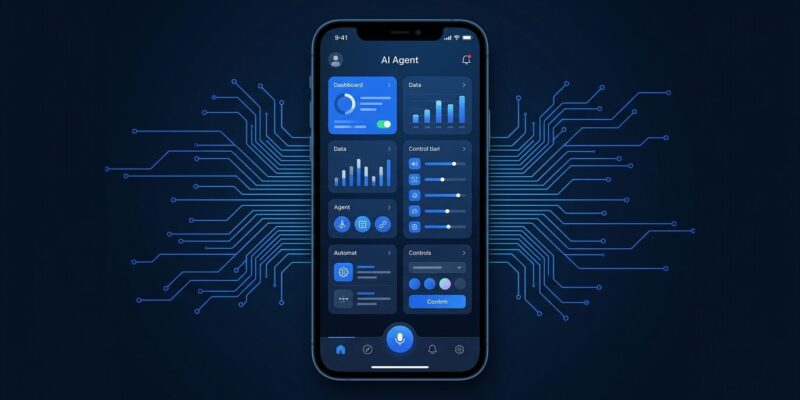
By Alibaba launched Qwen-UI-Agent this week — a GUI agent that beats GPT-5.6 Sol and Claude Opus 4.8 by 12–14 percentage points on mobile device control. That margin is large enough to matter. What makes the benchmark credible is what most people skip over: while OpenAI and Anthropic largely trained their agents on simulators, Alibaba ran their training loop on a farm of 100+ real physical smartphones. The simulation-to-real gap has been the quiet failure mode of every computer-use agent deployed in production. Alibaba addressed it directly.
What Qwen-UI-Agent Is
Qwen-UI-Agent is a foundation GUI agent that operates across four environments: mobile devices (Android), desktop computers, web browsers, and deep-search tasks. It comes out of Alibaba’s Tongyi-MAI team, and the technical report dropped on arXiv on July 29, 2026, with the official launch following this week.
What distinguishes it architecturally is its unified action space — the agent can issue GUI clicks and bash CLI commands within the same trajectory, without switching modes. About 40% of its action outputs are batched, meaning it executes multiple actions per model turn. Faster execution, fewer round-trips. For developers building agentic workflows that straddle GUI interaction and terminal operations, that hybrid capability is genuinely useful.
The Benchmark Numbers
On mobile, the gap is decisive. Qwen-UI-Agent scores 82.1% on MobileWorld, compared to GPT-5.6 Sol at 70.1% and Claude Opus 4.8 at 67.5%. On their real-device benchmark, MobileWorld-Real — 400+ tasks running on actual phones — it hits 92.2%. AndroidDaily success rate: 97.5%.
On web and deep search, it holds up: 73.6% on WebArena, 64.1% on BrowseComp. You can track the independent desktop leaderboard at BenchLM’s OSWorld-Verified rankings.
Desktop computer use is more competitive. Qwen-UI-Agent scores 79.5% on OSWorld-Verified — solid, but behind Claude Fable 5 at 85.0% and Qwen3.8-Max at 86.1%. Worth noting: for desktop-specific use cases, Alibaba’s own general-purpose model outperforms the dedicated GUI agent. The GUI-specialized model wins on mobile; on desktop the picture is messier.
Terminal and coding tasks remain GPT-5.6 Sol’s turf. On Terminal-Bench 2.1, GPT-5.6 Sol scores 88.8% against Qwen’s 86.6%. Not a huge gap, but it holds.
| Benchmark | Qwen-UI-Agent | GPT-5.6 Sol | Claude Opus 4.8 |
|---|---|---|---|
| MobileWorld | 82.1% | 70.1% | 67.5% |
| MobileWorld-Real | 92.2% | — | — |
| WebArena | 73.6% | competitive | competitive |
| OSWorld-Verified | 79.5% | 83.2% | 85.0% |
Why Real-Device Training Changes the Equation
This is the part that matters most for production deployments. Agents trained on Android emulators and screenshot datasets run into a predictable problem: the emulator behaves differently from real hardware. App timing varies. Rendering glitches that never appear in simulation show up constantly on physical devices. The benchmark score you see does not survive contact with a user’s actual phone.
Alibaba’s approach was to build a live mobile environment with 100+ physical smartphones running 150+ apps — used not just for evaluation but throughout training and online reinforcement learning. They ran RL over trajectories exceeding 100 steps, with approximately 10,000 parallel environments to accelerate rollout. The project page details the full pipeline. The 92.2% on MobileWorld-Real (their real-device benchmark) versus 82.1% on the simulated MobileWorld is the key data point: performance held. That is unusually rare in this space.
Accessing It Today
Qwen-UI-Agent is available through Alibaba Cloud Model Studio (the platform formerly branded DashScope) on a pay-as-you-go basis. Third-party access through OpenRouter is live. New Alibaba Cloud accounts get 1 million tokens per eligible model, valid for 90 days on the Singapore endpoint — a reasonable amount to evaluate the model against your specific tasks. Full pricing is on Alibaba Cloud’s documentation page.
Model weights are not public yet. Alibaba says they are completing safety evaluations and expect to release weights within roughly two weeks — a similar timeline to what GLM-5.3 followed earlier this month. If you need to self-host or fine-tune, wait. For API-based evaluation, you can start today.
What to Watch
GUI agents in 2026 are no longer the exclusive domain of OpenAI and Anthropic. Qwen-UI-Agent is a serious entrant — not a curiosity — and its mobile numbers are hard to argue with. The desktop story is weaker, and the weights being locked behind a safety review is a real limitation for teams who need control over their stack.
If you are building mobile automation, cross-platform workflows, or any agentic use case where the agent needs to control a real phone, Qwen-UI-Agent is worth evaluating now. If your primary environment is desktop or terminal-heavy, Claude Fable 5 or GPT-5.6 Sol remain stronger options. The competition just got more specific — and that is better for developers than one provider winning everything.