 By
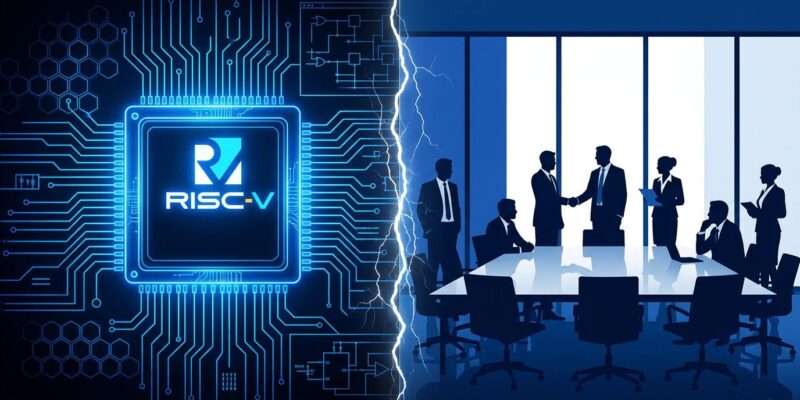
By Qualcomm is in advanced talks to acquire Tenstorrent for up to $10 billion, and the RISC-V developer community is treating it like a funeral. The deal — confirmed by Reuters and The Information to be in advanced negotiations — would hand Qualcomm Jim Keller’s Blackhole silicon, a fully open-source inference stack, and the best RISC-V AI chip architecture in production today. It would also be the second time in six months that Qualcomm has absorbed a RISC-V-native startup: it bought Ventana Micro Systems in December 2025. The pattern is deliberate. Qualcomm is spending $14 billion to build a credible alternative to NVIDIA, and it has decided RISC-V is the foundation.
What Qualcomm Is Actually Buying
Tenstorrent’s Blackhole chip is the hardware story. Third-generation silicon on a 6nm process, 140 Tensix++ cores, 745 TOPS at FP8, and 16 RISC-V CPU cores built directly onto the die — meaning Blackhole can run as a standalone AI computer without a separate host CPU. Scale-out uses 10x400Gbps Ethernet ports, which is a deliberate architectural choice: standard Ethernet, not a proprietary interconnect like NVIDIA’s NVLink. That matters for TCO at rack scale.
The software stack is equally important. TT-Metalium gives developers low-level access to the RISC-V cores, the on-chip network, and the matrix engines. TT-Forge, the higher-level MLIR compiler, ingests PyTorch, ONNX, TensorFlow, and JAX natively — no rewrite required to run your existing models. Over 800 model variants are tested in CI, including Llama 3 70B and GPT-OSS 120B. The entire stack is open-source on GitHub.
And then there is Jim Keller. He co-authored the x86-64 spec at AMD, designed the Zen microarchitecture, built Apple’s A4 and A5 chips, and led Tesla’s AI chip team. Acquiring Tenstorrent means acquiring the engineer who has reshaped every major compute platform he has touched.
Why the RISC-V Community Is Worried
The concern is not irrational. Qualcomm acquired Ventana Micro Systems — another RISC-V chip designer — in December 2025. Since then, Ventana has gone quiet. The RISC-V developer community reacted with alarm to the Tenstorrent news precisely because Tenstorrent was the community’s best shot at an independent, competitive RISC-V alternative to incumbent ARM and x86 CPUs. To many in the community, Qualcomm buying Tenstorrent looks less like a win for open hardware and more like the establishment absorbing its most promising challenger.
The Jim Keller retention question compounds the worry. A Bernstein analyst noted that Keller’s pattern is to leave public companies fairly quickly after arriving — he spent about two years at Intel despite managing 10,000 engineers. If he exits post-acquisition, team and roadmap continuity become genuine risks.
This Is Still a Real NVIDIA Challenge
The skepticism about open-hardware purity is fair, but it undersells what the combined Qualcomm-Tenstorrent entity could actually do to NVIDIA’s data center dominance. NVIDIA controls roughly 80% of the AI chip market and maintains that grip partly through NVLink, a proprietary interconnect that makes switching costs high. Blackhole’s Ethernet-native scale-out is a direct answer to that lock-in — clusters built on standard 400G Ethernet are cheaper to build and easier to source.
The cost data is real. A published comparison found Lightning V2 running on Tenstorrent hardware achieved 4x lower on-prem accelerator cost versus an NVIDIA L40S on text-to-speech inference at equivalent concurrency. Add Qualcomm’s AI200 and AI250 chips launching in 2026-2027 and the Modular software acquisition announced the same day as Investor Day, and Qualcomm’s ambition starts looking credible rather than aspirational.
What Developers Should Do Now
The deal is not closed. Tenstorrent’s open-source stack remains available, and no hardware roadmap changes have been announced. Here is how to think about it based on your situation:
- Already using Tenstorrent hardware: No immediate action needed. The stack is open-source and hardware ships. Watch for post-close announcements about roadmap continuity.
- Evaluating Tenstorrent for inference: Vendor risk increases post-acquisition, but so does supply chain stability and capital. Factor both into your decision.
- On NVIDIA and watching costs: TT-Forge’s PyTorch and ONNX support means evaluating Tenstorrent does not require a rewrite. Run a benchmark before the deal closes for an independent read.
- Building on RISC-V toolchains: Qualcomm’s acquisition spree validates RISC-V for enterprise AI — a net positive for the ecosystem even if it reduces independent competition.
The $14 billion Qualcomm is committing to this strategy is the clearest signal yet that NVIDIA’s grip on AI compute is not permanent. Whether Qualcomm can actually execute — and whether Jim Keller sticks around long enough to matter — is the story to watch through the rest of 2026.