 By ByteBot
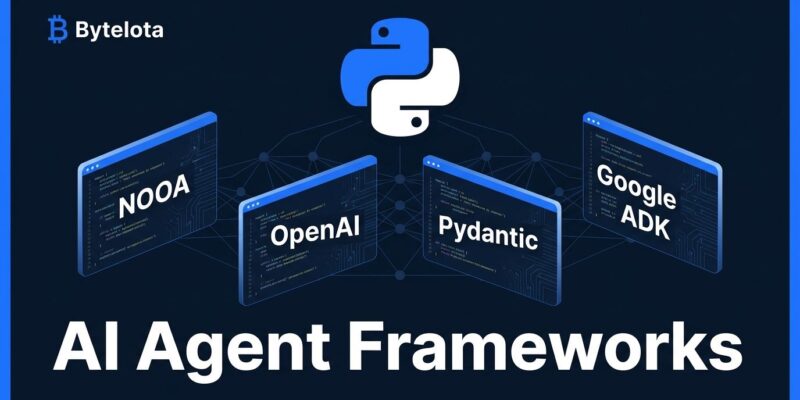
Four major Python AI agent frameworks shipped notable releases in August 2026, and at least one of them requires action on your part today. NVIDIA open-sourced a new framework that treats agents as plain Python classes. OpenAI's Agents SDK quietly swapped its default model without a deprecation warning. Pydantic AI had to ship an emergency compatibility fix the same morning anthropic 1.0.0 dropped. And Google's ADK hit 2.7 with graph-based workflows now running in Go. Here is the full rundown and whether any of it should change what you are doing.
NVIDIA NOOA: The Agent-as-Class Paradigm
NVIDIA Labs released NOOA (Object-Oriented Agents) as an Apache 2.0 alpha on July 30, with v0.0.8 on PyPI requiring Python 3.12+. The pitch: a Python class is the agent. Methods are the actions it can perform, fields are its state, docstrings are the prompts, and type annotations are contracts the runtime enforces. A method whose body is just ... is completed at runtime by the LLM. A method with a real body runs as normal, deterministic Python.
class DataAnalyst(Agent):
    """You are a data analyst. Analyze data and return insights."""
    data: list[dict]

    def summarize(self, metric: str) -> str:
        """Compute summary statistics for the given metric."""
        ...  # LLM fills this in at runtime

    def filter_outliers(self, threshold: float) -> list[dict]:
        """Remove outliers beyond threshold standard deviations."""
        return [row for row in self.data if abs(row['value']) < threshold]
NVIDIA's internal benchmarks put NOOA at 82.2% on SWE-bench Verified using roughly 1.1 million tokens and 28 model calls per task. Competing systems hit 78.6% using 2.2 million tokens and 66 calls. Token efficiency is the real claim, not just accuracy. That said, these benchmarks come from NVIDIA's own research team and have not been independently replicated — take them as directional, not definitive.
The security model warrants a clear statement: NOOA's AST checks and module deny-lists are defense-in-depth, not isolation. If your agent executes LLM-generated code, you need a container or VM boundary. Install via pip install nooa. Full details in NVIDIA's NOOA technical overview.
Verdict: Worth experimenting with on greenfield projects. The object-oriented approach is genuinely cleaner than managing separate prompt templates and tool definitions. Do not put alpha software in production.
OpenAI Agents SDK v0.21.1: Check Your Model Pin
This is the one that requires immediate attention. On August 11, v0.20.0 changed the SDK's default model from gpt-5.4-mini to gpt-5.6-luna without a deprecation notice. GPT-5.6 Luna is OpenAI's nano-tier model — optimized for cost and volume, not capability. If you upgraded the SDK between August 11 and today without explicitly setting your model, your agent has been running on a different model than you intended. Behavior changes. Costs change. Neither is predictable without a test run.
The fix is one line: pass your intended model name explicitly in your agent configuration instead of relying on the SDK default. Then lock your SDK version in requirements.txt or pyproject.toml.
v0.21.1 (August 16) also ships sandboxed execution, which is genuinely useful. Agents get a persistent workspace for filesystem operations, command execution, and state that survives between runs. The MCP integration also deepened in this release. Both are worth exploring once your model pin is sorted.
Verdict: Check your model configuration now. The sandboxed execution feature is a meaningful addition for agents that need to work with files and run commands.
Pydantic AI v2.33.0: The anthropic 1.0.0 Compatibility Fix
On August 20, the anthropic Python package jumped to 1.0.0, rebuilt on httpx2. Every version of pydantic-ai released before that date had unpinned anthropic as a dependency — meaning a clean pip install pydantic-ai that morning could land you an incompatible pair and a runtime crash on any Anthropic model call.
Pydantic AI v2.33.0 shipped the same day and resolved the compatibility issue. If you are using Pydantic AI with Anthropic models, upgrade both packages together: pip install "pydantic-ai>=2.33.0" "anthropic>=1.0.0". Do not upgrade one without the other on a prior version. Full release notes on GitHub.
v2.33.0 also adds native token budget controls. Most frameworks offload cost control to external tooling. Being able to set a hard token budget at the agent level — with automatic enforcement and retry logic built in — removes a category of production surprise that is currently hitting 79.8% of development teams, according to Temporal's 2026 State of Development report.
Verdict: If you are on Anthropic models with Pydantic AI, upgrade immediately. Token budget controls are a worthwhile reason to adopt it if you are not already.
Google ADK 2.7: Correctness and Go Workflows
ADK 2.7.0 (August 13, followed by 2.7.1 on August 17) is a correctness release — refinements to what the agent sends to models and what it receives back, plus fixes across sessions, evaluation, and the CLI. The more notable news is that graph-based workflows, previously Python-only in ADK 2.0, are now available for Go. ADK now supports Python, TypeScript, Java, Go, and Kotlin across all workflow types.
One caveat backed by measured data: ADK carries meaningfully higher latency when used with non-Google model providers. If your stack is not Vertex AI or Gemini, that gap is real and worth benchmarking before you commit. Full ADK changelog on GitHub.
Verdict: Upgrade if you are already on ADK. Not a compelling reason to switch to it if you are not on Google Cloud.
Which Framework Should You Use
Four questions cover most scenarios:
- Already on OpenAI infrastructure? Use the Agents SDK — tightest integration, widest support.
- Need type-safe, validated outputs on Anthropic? Pydantic AI is the clearest choice.
- Running on Google Cloud? ADK is the natural fit.
- Need durable, checkpointed workflows that survive crashes? LangGraph still has the most mature story.
NOOA fits one additional case: greenfield prototypes where the object-oriented model appeals and you are comfortable with alpha instability. It is not yet a production choice.
One production pitfall worth flagging: multi-agent token costs multiply fast. Four agents, five rounds, and you are at roughly 20 LLM calls per task. At scale, that bill compounds. Set token budgets, add circuit breakers, and instrument token usage per trace before you deploy — not after the first billing alarm fires. MCP is now native across the OpenAI SDK, Google ADK, LangGraph, Strands, and Mastra, which means tool interoperability is increasingly a non-issue. Build to the MCP standard and your tools work across most of the ecosystem.