
 By ByteBot
Most production AI agent failures have nothing to do with the model. The model is fine. The database isn’t. Shared state gets corrupted between parallel experiments. Schema changes from one agent break another’s expectations mid-run. Staging drifts from production before the sprint ends. pgEdge launched Starfleet on September 28 to fix the infrastructure side: a managed Postgres platform where each agent gets its own isolated database branch, a built-in MCP server, and a direct path to multi-region production — all on standard community Postgres, with no proprietary storage layer.
Each Agent Gets Its Own Branch
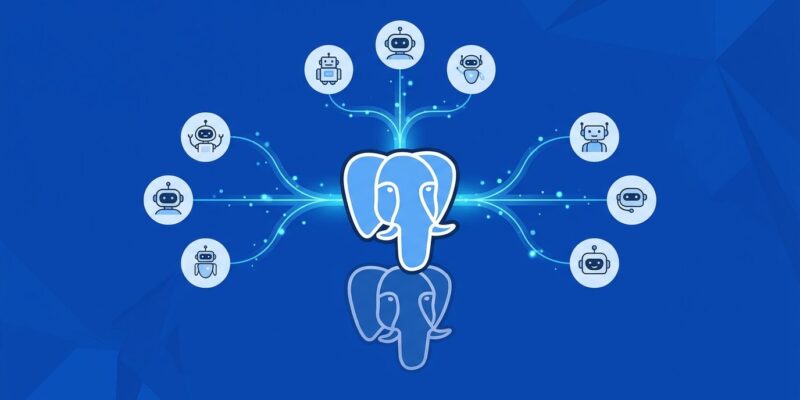
The headlining feature is per-agent database branching. Starfleet creates copy-on-write snapshots of your Postgres database, and each branch gets its own connection string, a dedicated MCP server address, and a scoped bearer token. Branches inherit the parent’s IP allowlist but are otherwise fully isolated — changes in one branch never touch another’s data.
The design choice worth noting: branches in Starfleet never merge back into the source. That is intentional. If an agent experiment succeeds, a developer promotes those schema changes through Alembic or Flyway — the same tools they’d use after any code review. Neon’s branching is designed for preview environments that merge back on pull request close. Starfleet’s is designed for experiments that either graduate through a migration or die.
The branches run on standard community Postgres, not on a fork or proprietary storage engine. That matters as vendor lock-in concerns grow: tooling that works with community Postgres today works with Starfleet, and vice versa.
Three AI APIs Built In
Alongside branching, Starfleet ships the pgEdge Agentic AI Toolkit — an open-source set of three APIs that are free regardless of whether you use the managed platform:
- MCP Server: A full Model Context Protocol server that works with Claude Code, Cursor, Replit, and Lovable. It includes pgEdge SafeSession, which enforces access controls — an agent configured with read-only credentials cannot write, even if an injection attack tries. Each branch gets its own MCP address and bearer token, so agents can’t talk to the wrong environment.
- RAG API: A retrieval-augmented generation endpoint backed by pgvector. If your agent needs to retrieve context from content stored in Postgres, this works out of the box without a separate vector database.
- PostgREST API: Direct REST access to the database from browser-side clients, the pattern agentic code generators like Lovable already expect.
pgEdge has been public about the conviction behind this: MCP, not REST APIs, is the right protocol for AI agents talking to databases. The pre-built, secured MCP server removes the friction that currently pushes teams toward building their own database adapters.
Simple to Start, Scales to Multi-Region
The scale path is linear by design. A new database starts as a single Postgres instance. When compute needs grow, you move to a larger tier without migrating data or changing application code. When the application needs multi-region availability, Starfleet adds nodes using Spock — pgEdge’s open-source logical replication extension. Every node in a Spock cluster accepts reads and writes, with automated conflict resolution. Adding a node is zero-downtime: it joins the cluster, synchronizes, and goes live without dropping a writable endpoint.
For enterprise deployments with data-residency requirements, Starfleet runs on the customer’s own cloud or on-premises infrastructure, including air-gapped environments — a capability that rules out most Postgres-as-a-service alternatives.
Who Should Use It
If you’re building standard CI/CD preview environments, Neon’s branching is faster to set up with a more mature free tier. If you need auth, storage, and realtime subscriptions alongside the database, Supabase remains the answer. Starfleet is for teams already running Postgres that are now deploying production AI agents: they need per-agent isolation, a secured MCP server, and a path to multi-region writes on the same platform without switching vendors.
The Agentic AI Toolkit is available now on GitHub and works with any Postgres instance. The managed Starfleet platform starts at $25 per database per month after a 14-day free trial — no credit card required.


