
 By ByteBot
Oracle announced AI Agent Studio for Industry Applications today, and there is a detail worth reading before the rest of the press release: if your team is based in the U.S., you will not get access for at least 12 months. Everything else about the announcement is real and technically interesting — a no-code/low-code/pro-code environment for building agents on top of Oracle’s industry stack, with MCP support, multi-LLM flexibility, and multi-agent orchestration included. But the 12-month U.S. lag is the thing you should clock first.
What Oracle Actually Built
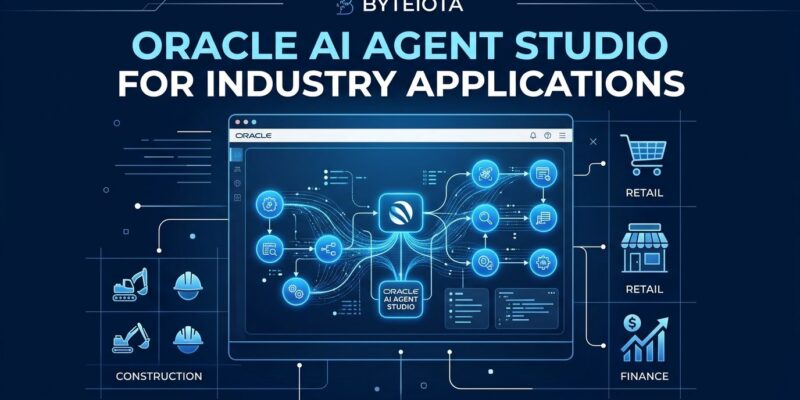
Oracle AI Agent Studio for Industry Applications extends the Fusion Cloud Agent Studio (launched March 2025) to standalone industry verticals: engineering and construction, retail, financial services, utilities, telecom, hospitality, food and beverage, and government. The studio lets customers and partners build custom agents through three paths: no-code (natural language), low-code (visual workflow editor), and pro-code (full programmatic access).
The platform includes prebuilt agents, templates, and workflows for each vertical. A construction firm can deploy an agent that surfaces schedule milestone risks, correlates field issues, and proposes mitigation steps — using live project data from Oracle’s industry applications, not a generic knowledge base. Retail customers get agents that work with product images and catalog data. Finance teams get affordability and payments agents they can extend with their own business rules.
MCP Support Is Baked In, Not Bolted On
Oracle’s implementation of the Model Context Protocol in Agent Studio is one of the more significant technical details in today’s announcement. Agents connect to approved Oracle Industry Application tools through MCP servers, and those connections can be reused across multiple agent use cases without writing custom REST wrappers or plugin logic. Oracle Autonomous DB ships a managed MCP server for direct SQL access in agentic workflows.
MCP inclusion here signals something broader: it is becoming the baseline expectation for enterprise agent tools in 2026, not a differentiator. Microsoft Copilot Studio, ServiceNow, and now Oracle are all shipping it. If your agent platform does not support MCP, that is worth noting on your vendor checklist.
Five LLMs, One Catch
The studio supports OpenAI, Anthropic’s Claude, Google’s Gemini, Meta’s Llama, and xAI’s Grok — and you can mix models within the same workflow, routing different steps to different models based on cost or capability. That flexibility is genuinely useful for complex enterprise workflows where you might want a cheap model for classification and a stronger one for synthesis.
The constraint: all models must be available through OCI Enterprise AI. There is no bring-your-own-model path. Oracle controls the approved list, and adding a new model requires it to be onboarded to OCI. If your team has a fine-tuned model or needs a provider not on Oracle’s list, this will not work.
What Fusion Cloud Customers Actually Pay
The studio, its template library, and orchestration tooling come with your Fusion Cloud subscription at no additional charge. Agent execution is metered: each action draws from a monthly grant of roughly 20,000 AI units per production environment. Once you exceed the grant, charges apply — $2.50 per AI Agent Employee per month at scale, or $50 per AI Agent Authorized User per month for custom agents. A full breakdown of what is free and what is metered is worth reading before you commit.
For teams already running Oracle Fusion Cloud, the entry cost is low. For teams evaluating Oracle specifically for AI agents, factor the metered execution costs into your total cost of ownership before signing.
Who Has U.S. Access Today
Microsoft Copilot Studio, Salesforce Agentforce, and ServiceNow AI Passport are all available in the U.S. today. Oracle’s industry agent studio is not — international markets go first, with U.S. access “planned within the next 12 months.” There is no more specific timeline. If your organization needs an enterprise agent platform for 2026 deployments, this is not an option you can act on today.
What Oracle is offering U.S. teams right now is a reason to watch the space. The MCP integration, multi-LLM routing, and deep Fusion Cloud data access — live ERP, HCM, and SCM transactions feeding agent context, not just a knowledge base query — give Oracle a real technical story. Whether that story is worth waiting 12 months to test depends on how tied your stack already is to Oracle applications.
Bottom Line
Oracle AI Agent Studio for Industry Applications is a technically credible platform that hits the right checkboxes for 2026: MCP support, multi-model flexibility, no-code to pro-code build paths, and deep integration with industry application data. The 80,000-plus certified partners already building on the Fusion version mean there is real ecosystem momentum behind it.
For enterprise developers outside the U.S. running Oracle Fusion Cloud: this is worth evaluating now. For U.S.-based teams: mark your calendars for Q4 2027, review the official announcement, and in the meantime look at what Microsoft, Salesforce, and ServiceNow already have deployed.


