 By
By In January 2026, Anthropic invalidated the OAuth tokens that OpenCode and other third-party tools used to access Claude models. It called the move a security safeguard. Developers called it a lock-in play. OpenCode kept shipping anyway — and by September 2026 it sits at 195,000 GitHub stars with 16 million monthly users. If you haven’t looked at it recently, here’s what changed and whether it belongs in your workflow.
What OpenCode Actually Is
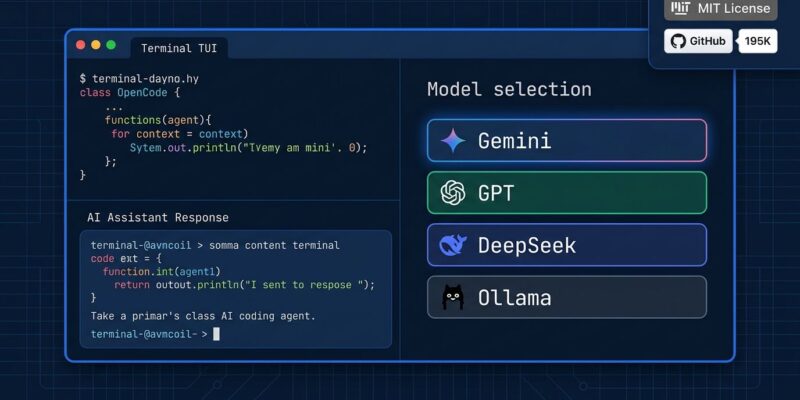
OpenCode is a terminal-native coding agent built by SST (Anomaly Innovations), MIT-licensed and written in Go. The core premise: one tool, any model. Connect it to 75+ AI providers — Anthropic via direct API key, Google Gemini, OpenAI GPT-5, DeepSeek, Mistral, or a local Llama instance via Ollama — and switch between them without changing your workflow.
Under the hood, OpenCode runs as a persistent background server. Sessions are stored in a local SQLite database, which means when your SSH connection drops or your terminal crashes mid-refactor, the agent keeps running. Reconnect and pick up where you left off — a detail that sounds minor until it saves a 40-minute session.
The Token Overhead Problem
Here is a number worth knowing: Claude Code injects approximately 33,000 tokens of scaffolding before your prompt reaches the model. OpenCode uses about 7,000. On a same-model benchmark using Opus 4.7, that gap translated directly to cost: $2.93 per task for OpenCode versus $5.65 for Claude Code — nearly 2x for identical output.
Claude Code’s prompt caching partially offsets this for repetitive tasks, so the gap narrows in practice. But for net-new work — which is most of software development — the overhead compounds. Teams running hundreds of agent sessions per day are paying a quiet tax they likely haven’t quantified.
Getting Started
Install is a single command:
curl -fsSL https://opencode.ai/install | bashAfter that, run opencode auth add to connect a model provider, drop an AGENTS.md file at your git root for project-level agent instructions, and you’re running. One hard requirement: use a modern terminal — Ghostty, WezTerm, Kitty, iTerm2, or Windows Terminal. Older terminal emulators will not render the TUI correctly.
OpenCode ships with two agents. Build has full access: read files, write files, run shell commands. Plan is read-only, useful when you want the agent analyzing without touching anything. MCP server support is built in; wire up servers with opencode mcp add and list them with opencode mcp list.
OpenCode vs Claude Code: The Real Tradeoffs
This is not a one-is-obviously-better situation.
| Factor | OpenCode | Claude Code |
|---|---|---|
| License | MIT (open source) | Proprietary |
| Models | 75+ providers | Anthropic only |
| Monthly cost | Token cost only | $20/mo + tokens |
| Session persistence | Yes (SQLite) | No |
| Token scaffolding | ~7,000 tokens | ~33,000 tokens |
| RAM usage | 1 GB+ | Lower |
| Release stability | Fast, sometimes breaks | Stable |
Claude Code is faster on the same model — a Builder.io A/B test found OpenCode ran roughly 2x slower, though it generated 29% more test coverage in the process. Claude Code also carries sharper UX polish: Agent View, /goal, Routines. Those matter in managed workflows where the interface is part of the value.
The criticism of OpenCode from the Hacker News community is also valid: 1 GB or more of RAM for a TUI application is hard to defend, and a release cadence driven by 950+ contributors means features break between versions more than they should. Open-source velocity comes with open-source instability.
When OpenCode Makes Sense
- Regulated environments where code cannot leave your infrastructure: route to a local Ollama model and nothing touches external servers.
- Cost arbitrage: DeepSeek V4 Flash runs at $0.15/M tokens. Use it for boilerplate and refactoring; reserve expensive models for reasoning-heavy tasks.
- Long-running agents over flaky connections: the SQLite-backed server model keeps sessions alive through disconnects.
- Vendor risk concerns: Anthropic’s January 2026 block showed that infrastructure-level rules can change without warning. That’s a governance risk worth pricing into your toolchain decisions.
Stick with Claude Code if you want the most polished Anthropic experience, your team is invested in the managed subscription, or speed and predictability matter more than model flexibility.
The Broader Point
195,000 GitHub stars are a vote. Developers are choosing a model of AI tooling that is portable, provider-neutral, and not dependent on a single vendor’s business decisions. The Anthropic block was supposed to slow that down. It didn’t — OpenCode hit #1 on Hacker News in March 2026 with 1,099 points and kept growing.
Whether you switch today, run both tools, or stay on Claude Code, the question is worth answering deliberately: what happens to your workflow when your AI tool vendor changes the rules?