 By
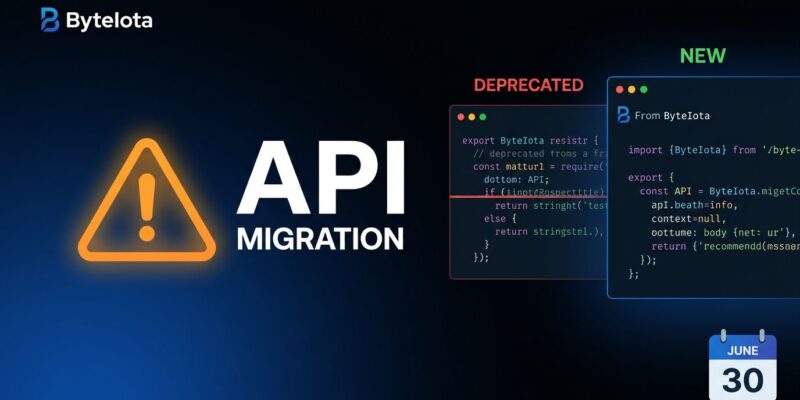
By OpenAI has set June 30, 2026 as the hard cutoff for GPT-5.2 and GPT-5.3-Codex API access. After that date, new requests to those models return errors. If your production app, CI pipeline, or Copilot integration still references these model names, you have less than four weeks to migrate — and this is messier than swapping a string.
What Is Being Shut Down
Three models are going away: GPT-5.2, GPT-5.2-Codex, and GPT-5.3-Codex. New API requests to these models are blocked on June 30. Full endpoint removal follows December 31, 2026.
If you are on GitHub Copilot, the deadline has already passed for you. OpenAI and GitHub dropped GPT-5.2 across all Copilot experiences — chat, inline edits, agent mode, code completions — on June 1. Copilot Enterprise admins who have not manually enabled replacement models in their organization settings may have users stuck on deprecated models right now.
The legacy /codex/completions endpoint is also gone, removed in February 2026 with the broader transition away from the Chat Completions API.
This Is an API Architecture Change, Not Just a Model Rename
Here is what most migration guides gloss over: OpenAI is not just retiring model names. They are migrating the entire API contract from /v1/chat/completions to the new Responses API at /v1/responses. The response shape, the message format, and how you handle multi-turn context all change.
Compare a simple request before and after.
Before (Chat Completions):
response = client.chat.completions.create(
    model="gpt-5.3-codex",
    messages=[
        {"role": "system", "content": "You are a coding assistant."},
        {"role": "user", "content": "Write a Python function to reverse a string."}
    ]
)
text = response.choices[0].message.content
After (Responses API):
response = client.responses.create(
    model="gpt-5.5",
    instructions="You are a coding assistant.",
    input="Write a Python function to reverse a string."
)
text = response.output_text
The messages array becomes input plus an optional instructions field. The choices[0].message.content accessor becomes output_text. Multi-turn state now requires opting in with store: true rather than maintaining conversation history manually.
OpenAI has published an automated migration tool — the completions-responses-migration-pack on GitHub — that uses the Codex CLI to scan your codebase, find legacy endpoint usage, and apply the edits. It handles import updates, request shapes, and response parsing. It does not handle model name strategy or cost planning.
GPT-5.5 Costs Roughly Three Times More
This is the part OpenAI’s migration guides do not put at the top: GPT-5.5 is not cost-neutral. GPT-5.3-Codex priced at .75 input and 4.00 output per million tokens. GPT-5.5 runs .00 input and 0.00 output — roughly 2.9x more on input and 2.1x more on output.
OpenAI argues GPT-5.5 uses fewer tokens to produce the same result. In agentic tasks that is measurably true. For straightforward code generation workloads, the efficiency gains are smaller and your cost delta will depend on your specific usage patterns.
- GPT-5.5 standard — the recommended replacement, best for general and agentic use cases
- GPT-5.4 — cheaper, still fully supported, good middle ground for coding-focused workloads
- GPT-5.5 Batch/Flex — cuts pricing to $2.50/$15 per million tokens for workloads that tolerate delay
If GPT-5.3-Codex was central to a high-volume pipeline, price out GPT-5.4 before committing to 5.5. Check the current OpenAI API pricing page for the latest numbers.
Migration Checklist
Five things to do before June 30:
- Grep for deprecated model strings. Search your codebase for
gpt-5.2,gpt-5.3-codex, andgpt-5.2-codex. Include config files, environment variables, and any hardcoded defaults. - Run the migration pack. Clone openai/completions-responses-migration-pack and run it against your repo. It automates endpoint and response-shape updates.
- Update model names manually where automated tools miss them — SDK wrappers, model selection logic, fallback chains.
- Calculate your cost delta. Estimate your monthly token usage and multiply by the price difference. Decide whether GPT-5.5 or GPT-5.4 is the right target.
- Test response parsing. The Responses API returns data in a different shape. Even after automated migration, run integration tests to catch any parsing code that was not updated.
If you manage a GitHub Copilot Enterprise organization, go into your admin settings and confirm that GPT-5.5 or a supported model is enabled. Do not wait for user-reported issues — some users may already be hitting errors.
Do Not Wait Until June 29
These deadlines land on teams as a surprise more often than they should. The OpenAI deprecations page lists all current retirement dates and is updated as additional models are scheduled. Bookmark it and check it quarterly.
The migration itself is not complicated. The Responses API is cleaner than Chat Completions. The pain is proportional to how much of your stack assumed GPT-5.3-Codex was permanent — and how long you wait to find that out.