
 By ByteBot
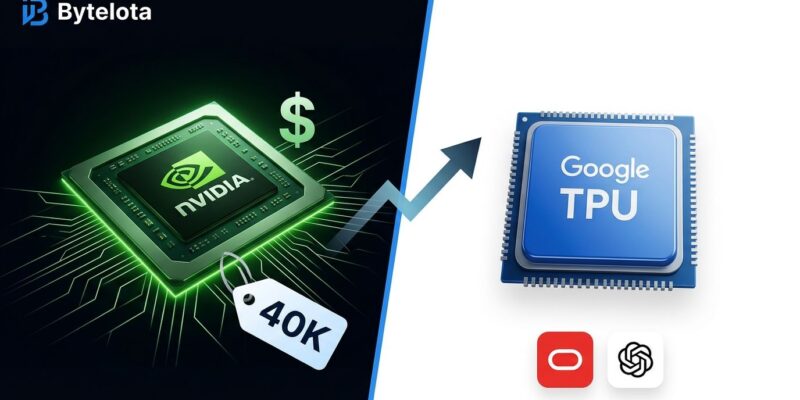
On October 27, 2026, at Oracle AI World in Las Vegas, two announcements landed the same day: OpenAI—the world’s largest consumer of AI compute—is buying Google’s Tensor Processing Units, and Oracle will become the first hyperscale cloud outside Google to host TPUs, starting in 2027. One week earlier, Google and Meta had open-sourced TorchTPU, a native PyTorch backend that removes the biggest developer barrier to adoption. The timing is not a coincidence. Nvidia’s exclusive grip on AI compute is cracking.
OpenAI Bets on TPUs—And Oracle Follows
The Information reported October 27 that OpenAI plans to purchase Google TPUs outright, graduating from the rental arrangement it has maintained on Google Cloud since mid-2025. OpenAI has not confirmed the deal publicly, but a supporting signal appeared simultaneously: an open job listing for an engineer to lead TPU optimization for both training and inference. When a company posts that role, the hardware is coming.
At the same event, Oracle announced it will offer Google’s TPU 8t (training) and TPU 8i (inference) chips on Oracle Cloud Infrastructure from 2027—the first time TPUs will be available outside Google’s own cloud. Oracle’s accelerator menu now spans five chip vendors: Nvidia, AMD, Intel, AWS Trainium, and Google TPUs. That is not a sign of a healthy monopoly for any one vendor.
To be clear about OpenAI’s position: this is diversification, not a Nvidia exit. OpenAI’s infrastructure plan runs to $1.09 trillion across seven vendors through 2035, including a $100B arrangement with Nvidia for Vera Rubin systems. However, when the world’s most GPU-hungry company starts hedging to TPUs, the economics must be compelling enough to justify the operational complexity.
TorchTPU Removes the Rewrite Tax
The historical barrier to TPU adoption was simple: you had to abandon PyTorch and rewrite everything in JAX to use them effectively. Google’s TorchTPU, released as open source on October 20, eliminates that barrier. It is a native PyTorch backend for TPUs—the only required change for most workloads is one line:
# GPU (before)
model = model.to("cuda")

# TPU (after)
model = model.to("tpu")
TorchTPU integrates with vLLM, SGLang, TorchTitan, Ray, and Hugging Face out of the box. It supports TPU v5e, v5p, v6e, and the latest v7 Ironwood generation. JAX still wins by 15–30% on raw TPU performance—XLA is the native compilation target—but TorchTPU eliminates the migration cost that kept most teams on CUDA regardless of price.
Related: Google TorchTPU: PyTorch on TPUs, XLA Gets Archived
The Cost Numbers That Are Forcing the Conversation
Google’s TPU v6e (Trillium) delivers 4x better performance per dollar compared to the Nvidia H100 for large-language-model training workloads. It runs at 300W versus the H100’s 700W and the H200’s 1000W—a meaningful operational cost difference at scale. Meanwhile, Nvidia notified customers in August 2026 of 15%+ price increases on Vera Rubin and Grace Blackwell systems. The H100 still commands $27K–$40K on the spot market.
The math for teams training large models at scale increasingly points away from Nvidia. The CUDA ecosystem remains the dominant reason to stay—tooling, debugging, profiling, and a decade of optimized code. However, TorchTPU directly attacks the tooling moat. When switching costs approach zero and the cost-performance gap is 4x, the only remaining argument for Nvidia is inertia.
Related: Intel Crashes 28%: AI Chips Are Eating Your Dev Hardware
Key Takeaways
- OpenAI is buying Google TPUs (reported Oct 27, not yet confirmed by OpenAI), and Oracle will host them on OCI from 2027—two concrete signals that AI compute is diversifying away from Nvidia exclusivity
- TorchTPU (released Oct 20) gives PyTorch developers native TPU access with a one-line code change, eliminating the JAX migration barrier that kept most teams on CUDA
- TPU v6e offers 4x better performance per dollar than H100 for LLM training, while Nvidia is raising prices 15%+ on next-gen systems—the economics are moving against Nvidia at scale
- This is not Nvidia’s end—the CUDA ecosystem and small-batch inference latency advantage remain real. It is, however, the beginning of AI compute commoditization


