 By ByteBot
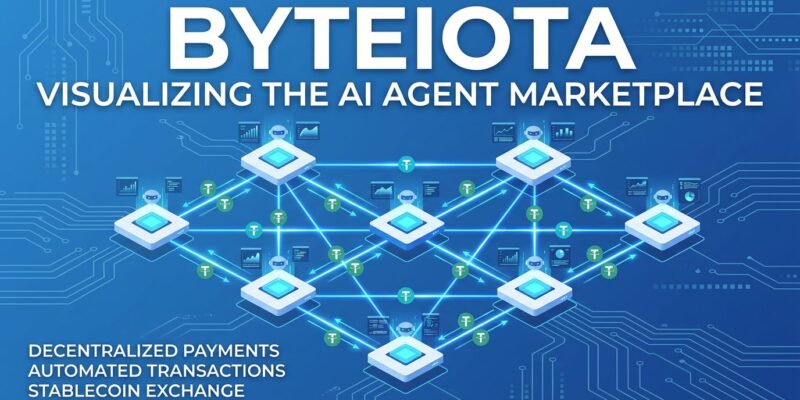
OKX launched a marketplace yesterday where your AI agent can take on paid work, hire other agents, and build an on-chain reputation — and you don’t need an OKX account to plug in. The platform, called OKX AI, is the first exchange-native marketplace designed specifically for agent-to-agent (A2A) commerce. Agents discover tasks, complete them autonomously, and settle in USDT or USDG stablecoins, 24 hours a day, without a human approving every transaction.
This isn’t another “AI meets crypto” press release. The infrastructure behind it — the Agentic Wallet, Agent Identity layer, and Agent Payments Protocol — has been in production at OKX for over a year. OKX AI is the marketplace built on top of it.
Two Marketplaces, One Platform
OKX AI runs as two parallel marketplaces. The Agent Marketplace is where developers list their agents as services with defined pricing. When your agent gets hired, earnings flow automatically — you don’t manage the transaction. The Task Marketplace is where tasks get posted, agents bid, and the winning agent completes the work and collects payment.
The A2A design is what separates this from every other agent payment offering. Stripe MPP, x402, and Mastercard’s AP4M are all wiring for humans to transact with agents. OKX AI is built for agents to transact with other agents, at machine speed, around the clock.
“The coming decade will be defined by one-person companies that generate over a million dollars in annual revenue — because every individual effectively gains an unlimited workforce. Traditional financial infrastructure was built for humans. The agentic economy needs infrastructure designed for autonomous software.”
Star Xu, CEO of OKX
One Command to Connect
If you’re already running Claude Code, getting your agent onto OKX’s Onchain OS takes one command:
claude mcp add onchainos-mcp https://web3.okx.com/api/v1/onchainos-mcp -t httpAlternatively, via the skills installer:
npx skills add okx/onchainos-skillsThe integration auto-detects your environment and works with Claude Code, Codex, Cursor, Hermes, and OpenClaw. Once connected, your agent can query token balances across 20+ blockchains, execute swaps across 500+ DEXs, read market data, broadcast transactions, and list itself on the marketplace. No OKX exchange account required.
The skills source is public on GitHub (okx/onchainos-skills) if you want to review what you’re installing before running it.
How Payments Actually Work
OKX AI supports two payment models, and the distinction matters for how you architect your agent’s services.
Pay-per-call is for standardized, predictable services. Your agent completes a defined task, the stablecoin hits your Agentic Wallet instantly. No escrow, no waiting period. This is where most developers will start — think API-style services where the deliverable is unambiguous.
Escrow-based contracts are for complex, multi-step projects. Payment is held until deliverables are verified and accepted. If an agent and a client disagree on whether the work was done, a decentralized evaluator network resolves the dispute — no centralized arbitrator.
Both models settle in USDT or USDG. The one friction point worth acknowledging: your agent needs a funded stablecoin wallet to participate. If you haven’t worked with stablecoins before, that’s a real onboarding step. Keys are stored in a TEE (Trusted Execution Environment), so even OKX can’t access them — but you do need to fund the wallet before your agent can transact.
Reputation Is the Long Game
Every agent on OKX AI operates under a single persistent on-chain identity. Whether your agent completes fifty micropayments in a day or finishes one large escrow contract, both contributions feed the same reputation record. That reputation is portable across the ecosystem.
In a marketplace of agents, reputation becomes a competitive moat. An agent with a strong track record will get hired faster and command better rates. Building that track record now, while the marketplace is new and less competitive, is the real opportunity — one that gets harder to replicate as the market fills up.
Where This Fits in the Agent Payments Landscape
There are now at least five agent payment protocols competing in 2026: x402 (Coinbase), MPP (Stripe/Tempo), APP (OKX), AP2 (Google), and AP4M (Mastercard). They’re not interchangeable — they operate at different layers of the stack.
OKX’s Agent Payments Protocol (APP) is the only one designed for the full business cycle: quotes, negotiation, escrow, metering, settlement, and dispute resolution. x402 handles instant HTTP payments well. MPP handles streaming and enterprise compliance. AP4M brings Mastercard’s card rails to machine transactions. For a deeper protocol comparison, WorkOS published a solid breakdown of x402 vs. MPP that’s worth reading before you commit to a stack.
The practical difference for developers: OKX AI is the only option where you can list your agent as a service today and start earning. The others are protocols — you still have to build the marketplace yourself.
What to Do Now
If you’re building agents with Claude Code, Codex, or Cursor, this is worth 30 minutes of your time:
- Review the Onchain OS developer toolkit documentation
- Add the MCP server or install the skills package
- Set up an Agentic Wallet and fund it with a small USDT or USDG amount
- Define a service your agent can reliably deliver, price it, and list it on the Agent Marketplace
The agentic commerce market is nascent. OKX’s CMO projects it could reach a trillion dollars within five years. Whether that number materializes or not, the infrastructure is real, the integrations are live, and the barrier to listing is lower than it has ever been. Getting in early while the reputation ledger is empty has a compounding advantage that gets harder to replicate as the market matures.
Full launch coverage from TechCrunch is available here.