
 By
LlamaIndex shipped OCRia-1 on October 22 — a 4-billion-parameter vision-language model that beats every document parsing system tested on its flagship benchmark, including models eight times its size. It is already live in LlamaParse at no price change, and it costs a third of what Gemini 4 charges per page while running 75 times faster. If you are building a RAG pipeline or document AI agent and you are routing PDFs through a frontier LLM, you should probably read this.
The Benchmark Numbers
On ParseBench — a public benchmark of enterprise documents pulled from insurance, finance, and government sources — OCRia-1 scores 87.4. That is the highest recorded score for any parsing model under 35 billion parameters, and 12.1 points ahead of Chandra-OCR-2, the previous leader at 74.8. Mistral OCR 4.1 sits at 67.5.
The chart extraction category is particularly lopsided: OCRia-1 scores 85.1 while the next competitor scores 66.1. That 19-point gap is not a rounding error. Charts are difficult to parse because the model must identify series labels, axis scales, and value mappings from a visual element — and most models lose that structure entirely.
On olmOCR-bench, OCRia-1 scores 92.9 specifically on tables. It also leads PulseBench-Tab’s 1,820 multilingual tables at 84.1, and it tops both long-table categories on fr-bench-pdf2md. These are not LlamaIndex’s own benchmarks.
What It Actually Does
Document parsing sounds unglamorous until your RAG pipeline starts hallucinating because it lost a table row. Most failures in production document AI trace back to the same place: bad parsing leads to mangled chunks, which produce weak embeddings, which cause irrelevant retrieval, which produces wrong answers. The hard part is not free text — it is structured content buried inside PDFs: complex tables with merged cells, charts with embedded data, mathematical notation, and multi-column layouts.
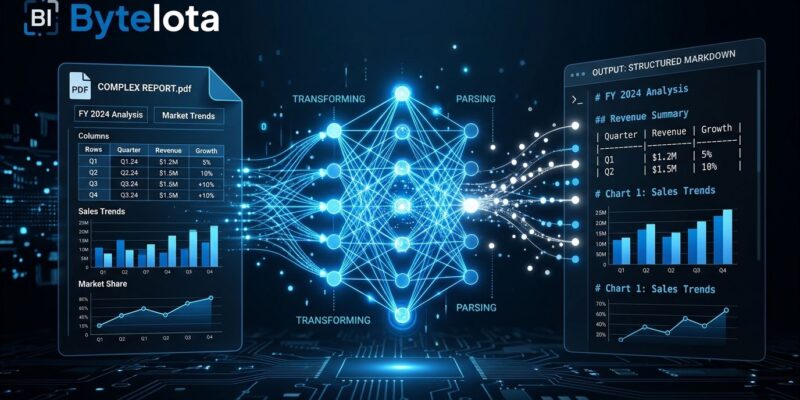
OCRia-1 handles these by converting document pages to structured Markdown:
- Tables → HTML with nested headers, merged cells, and irregular grids preserved
- Charts → HTML tables of values mapped to correct series and labels
- Formulas → LaTeX
- Diagrams and flowcharts → Mermaid blocks
- Inline formatting → Preserved in Markdown and HTML, including superscripts, strikethroughs, and checkboxes
Cost and Speed
OCRia-1 costs approximately $13 per 1,000 pages through LlamaParse. Gemini 4 runs around $39 for the same workload. Claude Opus 5.5 is approximately $52. The median page latency is 0.2 seconds — roughly 75 times faster than frontier general-purpose models on document parsing tasks. That speed comes from custom CUDA kernels and fused vLLM operations; the model decodes at approximately 4,700 tokens per second on a single B200 GPU, about nine times faster than the base Qwen3.5-4B model on stock vLLM.
| Model | ParseBench | Cost / 1K pages | Median latency |
|---|---|---|---|
| OCRia-1 | 87.4 | ~$13 | 0.2s |
| Chandra-OCR-2 | 74.8 | — | 0.7s |
| Mistral OCR 4.1 | 67.5 | — | — |
| Gemini 4 | — | ~$39 | ~10s |
| Claude Opus 5.5 | — | ~$52 | — |
How to Use It
If you are already using LlamaParse, you are already using OCRia-1 — it now powers all three tiers with no configuration changes required. For standalone access without a LlamaCloud account, OCRia-1 is available on OpenDocRouter as llamaindex/ocria-1, with $5 in free credit for new accounts.
from llama_parse import LlamaCloud

client = LlamaCloud(api_key="your-key")
file = client.files.create(file=open("report.pdf", "rb"))
result = client.parsing.parse(
    file_id=file.id,
    tier="agentic",
    output_format="markdown"
)
print(result.content)
How It Was Built
OCRia-1 starts from Qwen3.5-4B and was trained in two stages. Supervised fine-tuning (SFT) teaches the target output format — how to write a merged-cell table as HTML, how to represent a chart as a data table. Reinforcement learning with verifiable rewards (RLVR) then handles the errors SFT leaves behind: it scores individual table cells, chart value mappings, and formatting marks, and penalizes degenerate outputs like repetition or dropped content. The training set includes 100,979 pages, with synthetic pages generated for dense tables and complex structures where exact ground truth is hard to source from real documents.
The Broader Point
OCRia-1 is part of a pattern worth paying attention to. In 2026, specialized small models have consistently beaten frontier generalists at specific tasks: Recursive’s Flint on coding, Block’s Dessa on voice, and now LlamaIndex on document parsing. The lesson for developers building production AI systems is the same each time: routing everything through GPT-6 or Claude Opus because they are capable is not a strategy — it is a billing problem.
The technical report is public and detailed if you want to dig into the benchmark methodology and training setup. The official announcement has everything needed to get started today.


