 By ByteBot
NVIDIA released Nemotron-Labs-TwoTower on July 1, and the headline number is hard to ignore: 2.42 times faster inference throughput at 98.7% of the baseline model’s benchmark quality. What makes it interesting for developers isn’t just the speed — it’s how NVIDIA got there. The base model was never retouched. A second neural network tower, trained on 2.1 trillion tokens rather than the backbone’s 25 trillion, does all the work.
If you run inference-heavy workloads — agent loops, high-QPS APIs, batch pipelines pushing structured JSON — this is worth understanding now. If you’re waiting for one-click vLLM support, you’ll need to wait a few more months.
Two Towers, One Trick
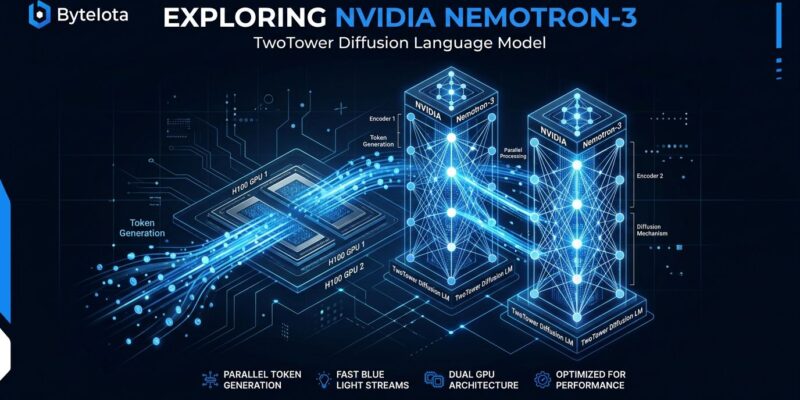
The architecture is a two-tower setup. The first tower is the existing Nemotron-3-Nano-30B-A3B model on Hugging Face, left completely frozen — 52 layers of interleaved Mamba-2, self-attention, and MoE. It processes your prompt causally, left-to-right, same as any autoregressive model. The second tower is a trainable copy of the same architecture, but its job is different: it takes a block of masked tokens and refines them in parallel using mask diffusion, rather than generating one token at a time. The two towers communicate via cross-attention, so the denoiser benefits from everything the context tower already computed.
The result is block-level parallelism. Instead of emitting tokens sequentially, Nemotron TwoTower generates chunks simultaneously. The autoregressive bottleneck isn’t eliminated — it’s compressed to operate at block granularity rather than token granularity. The full technical paper on arXiv covers the denoising schedule and block sizing in detail.
The Quality Gap Is Real — But Narrow Where It Matters
The 98.7% quality retention figure is aggregate across benchmarks. Dig into the breakdown and the picture is more nuanced: code and math tasks see modest degradation, while general knowledge and commonsense tasks remain near-par or better. That pattern reflects a structural reality of diffusion decoding — tasks requiring tight long-range logical dependencies are harder to parallelize without quality loss.
For most production agent workloads, though, this gap rarely bites. Agents classifying intent, extracting structured data from documents, routing decisions, or summarizing content don’t require the same reasoning depth as hard math problems. If your agent is spending 80% of its compute on tasks that fall into the “near-par” category, the 2.42x throughput becomes a legitimate cost reduction — not a marketing number.
Who Benefits, Who Doesn’t
The use cases that fit best: tool-heavy agent loops making many short model calls, high-volume structured JSON generation, and batch inference pipelines where your bill is dominated by tokens_out multiplied by calls_per_task. At 10,000 agent calls per day, 2.42x throughput translates to roughly half the GPU allocation needed for the same load.
The use cases that don’t fit: production coding assistants (where code quality degradation matters), complex multi-step math reasoning, and any team on a single-GPU setup. vLLM users also need to wait — as of July 2026, vLLM supports the NemotronH AR backbone, not the two-tower diffusion path. Native two-tower support is not yet available.
Hardware Reality: Two H100s Required
Full two-tower diffusion mode requires two GPUs at roughly 59 GB each in BF16 — that means two A100 or H100 80GB cards. The model ships with a place_towers_on_devices utility that distributes the towers across devices:
from transformers import AutoTokenizer, AutoModelForCausalLM

tokenizer = AutoTokenizer.from_pretrained(
    "nvidia/Nemotron-Labs-TwoTower-30B-A3B-Base-BF16",
    trust_remote_code=True
)
model = AutoModelForCausalLM.from_pretrained(
    "nvidia/Nemotron-Labs-TwoTower-30B-A3B-Base-BF16",
    trust_remote_code=True
)
model.place_towers_on_devices("cuda:0", "cuda:1")
If you only have one GPU, the AR fallback mode is available — but you get standard autoregressive performance with no speed benefit. Worth knowing before you plan a deployment around the 2.42x number.
Diffusion LLMs Are No Longer a Research Bet
Nemotron TwoTower lands in a space that’s moving fast. Inception Labs’ Mercury 2 hit 1,009 tokens per second on Blackwell in February with native tool use and JSON schema output — now available on Azure AI Foundry. NVIDIA’s own Nemotron-Labs-Diffusion (May 2026) brought a tri-mode architecture — autoregressive, diffusion, and self-speculation — in 3B, 8B, and 14B sizes. What was academic in 2024 is production infrastructure in mid-2026.
Nemotron TwoTower’s significance isn’t just the speed number. It’s the first commercially-licensed, open-weight diffusion LLM at this scale — available to inspect, fine-tune, and deploy without proprietary constraints. If your team has been watching diffusion language models from a distance, the availability of open weights under a commercial license changes the evaluation calculus.
Verdict
If you have dual H100s and run high-volume inference on workloads that don’t require deep reasoning — try Nemotron TwoTower now. The throughput gains are real, the license is clean, and the weights are on Hugging Face. If you’re on a single GPU, building a coding assistant, or waiting for vLLM support, bookmark it and revisit in Q4 2026. The tooling will catch up.