 By ByteBot
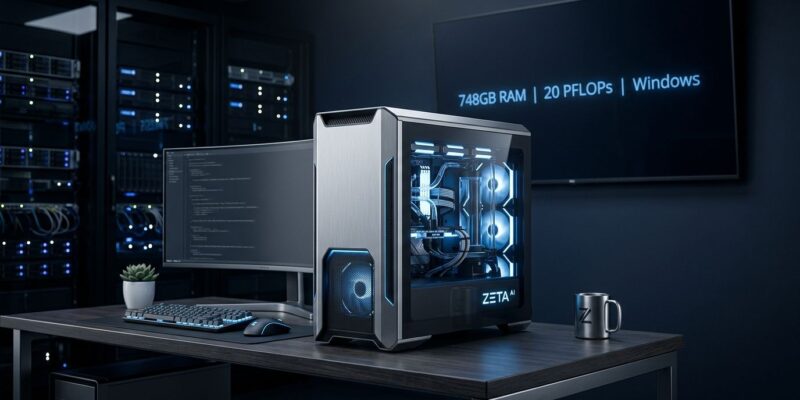
NVIDIA put a trillion-parameter AI supercomputer in a box that runs Windows. The DGX Station for Windows — announced October 7 at Microsoft’s hardware event — packs 748GB of coherent memory and 20 petaFLOPs of FP4 compute into a deskside workstation. It ships Q4 2026 from ASUS, Dell, GIGABYTE, HP, MSI, and Supermicro at roughly $100,000. And it is the first DGX Station that runs Windows natively.
That last part is the story. Not the specs — the platform.
The Linux Wall Is Finally Gone
The original DGX Station was Linux-only. That single constraint locked out most enterprise developers. Fortune 500 companies standardize on Windows — their security policies, Active Directory environments, and IT workflows all assume it. Until now, serious on-premises AI inference meant either migrating to Linux or staying dependent on the cloud. The DGX Station for Windows removes that barrier: same GB300 Grace Blackwell Ultra hardware, Windows-native CUDA stack, with WSL available for legacy Linux toolchains.
This is not a hardware announcement. It is an enterprise access announcement. NVIDIA just opened the door to a market it previously could not reach.
What 748GB of Coherent Memory Actually Gets You
The memory configuration breaks down as 252GB HBM3e on the GPU side and 496GB LPDDR5X on the CPU side, connected at 900 GB/s via NVLink-C2C. In practice:
- Trillion-parameter models fit entirely in memory — no quantization compromises, no swapping
- Hundreds of simultaneous AI agents, each with meaningful context windows
- Fine-tuning on sensitive data without it leaving your building
For context, the RTX Spark — Microsoft’s $5,999 developer workstation announced the same day — tops out at 128GB and 1 PFLOP. The DGX Station is the next tier: built for teams that have outgrown the individual developer workstation.
| System | Memory | AI Compute | Price |
|---|---|---|---|
| RTX Spark Dev Box | 128 GB | 1 PFLOP | $5,999 |
| DGX Station for Windows | 748 GB | 20 PFLOPs | ~$100K |
The $100,000 Question
The sticker price is real. So is the math behind it. Cloud equivalents for 748GB of unified memory and 20 PFLOPs of AI compute — AWS P5e-class instances — run roughly $80 per hour. At continuous use, that approaches $700,000 per year. A team running consistent, high-volume inference workloads breaks even on a $100,000 DGX Station in three to four months.
For regulated industries — healthcare, finance, government — the math barely matters. Data sovereignty requirements often legally prohibit sending sensitive data to external APIs. Local inference is not an optimization; it is a compliance necessity. As Pavan Davuluri, Microsoft EVP, put it: “Capabilities that once required renting a cluster, now in a deskside supercomputer.”
If your team’s cloud AI spend is under $5K per month, the DGX Station is not for you. If you are above $15K and running it consistently on Windows, the pricing breakdowns confirm it deserves a line in the budget.
The Hardware Ladder Is Now Complete
NVIDIA has quietly built a continuous development-to-production hardware path:
- RTX desktop/laptop (8–32GB) — individual experimentation
- DGX Spark (128GB, ~$3K) — serious individual development
- RTX Spark Dev Box (128GB, $6K) — Windows-native developer tier
- DGX Station for Windows (748GB, ~$100K) — team and department scale
- DGX Cloud — infinite scale, ongoing cost
The developer path from prototype to production is now a continuous NVIDIA ladder with no forced cloud step. Models built on Spark run on DGX Station without rewriting. That portability — the same CUDA stack across the entire range — is the real product. Windows ML’s llama.cpp integration means GGUF models already optimized for local inference transfer directly to the DGX Station environment.
Security Comes Built In: OpenShell
NVIDIA ships DGX Station for Windows with OpenShell, an open-source runtime that enforces kernel-level policies on AI agents. Running hundreds of agents locally without governance is a security problem — OpenShell is the answer baked into the platform. It lets teams define exactly which files, system calls, and network endpoints each agent can reach, isolate credentials outside agent workloads, and adjust policies at runtime without restarts.
network_policies:
  github_api:
    endpoints:
      - host: api.github.com
        port: 443
        protocol: rest
        access: read-only
That YAML permits read access to GitHub’s API and blocks everything else — even if the agent attempts to push. Cadence, Slack, and Gecko Robotics are already running OpenShell in production. It is available on GitHub now; teams can start building agent policies before the hardware arrives in Q4.
What to Do Now
DGX Station for Windows ships Q4 2026. NVIDIA’s OEM partners — ASUS, Dell, GIGABYTE, HP, MSI, and Supermicro — are taking enterprise quotes now. In the meantime: review OpenShell on GitHub, run your own cloud-vs-local cost math, and consider whether your team’s inference workloads justify the hardware. For enterprise Windows shops running serious AI workloads, NVIDIA just removed the last excuse for staying cloud-dependent.