 By ByteBot
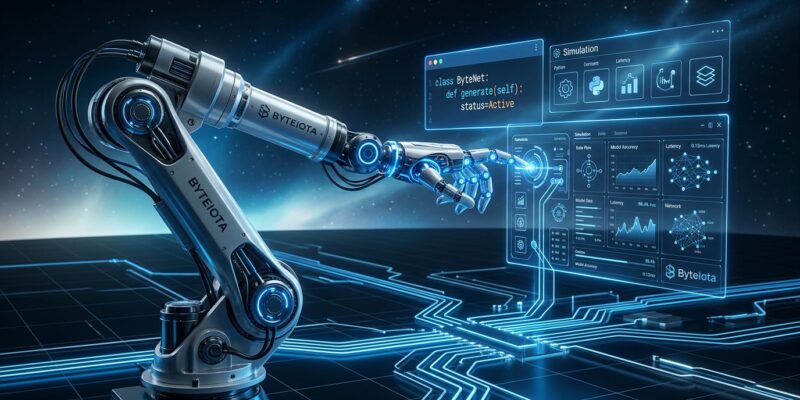
NVIDIA just open-sourced a collection of physical AI skills that let any coding agent — Claude, Copilot, Cursor, whatever you use — drive the full robot development pipeline from synthetic data generation to edge deployment. It shipped June 1. It is on GitHub right now. And no, you do not need a robotics background to start.
What “Skills” Means in This Context
These are not libraries you import or APIs you call manually. They are agent-executable workflow primitives. You install one with a single command:
npx skills add nvidia/skills --skill physical-ai-neural-reconstructionFrom that point, your coding agent knows how to run the workflow. When it encounters a relevant task — reconstruct a scene, generate training data, evaluate a policy — it calls the skill automatically. No repo clone. No YAML config. No “getting started” guide that takes a full afternoon to survive.
The skills are available via github.com/nvidia/skills and skills.sh, and the CLI supports targeting specific agents with the --agent flag. This is NVIDIA applying the npm mental model to robotics infrastructure.
Four Domains, Four Complete Pipelines
The NVIDIA Agent Toolkit covers four physical AI domains, each with skills spanning the full development loop:
Robotics (Isaac)
Isaac Sim skills let your agent launch simulation sessions, author scenes, control simulation, capture data, and validate environments. Isaac Lab skills handle reinforcement learning setup, training, evaluation, and custom environment creation. Isaac mobility skills cover the full navigation pipeline: scene search, USD conversion, environment registration, residual RL, and policy evaluation. Training runs in simulation; deployment targets Jetson-based edge hardware.
Autonomous Vehicles (Alpamayo)
AV skills reconstruct fleet-captured data into simulation environments, generate photorealistic driving scenarios at scale, and run closed-loop reinforcement learning to push training coverage beyond what real-world driving data can provide. The underlying model is Alpamayo 2 Super — an open 32-billion-parameter Vision-Language-Action model built for level 4 development.
Vision AI (Metropolis)
Metropolis skills generate synthetic visual scenarios including anomalies, support pseudo-labeling for semi-supervised workflows, and build video AI agents that can search, summarize, and analyze live or recorded video streams. Directly applicable to industrial inspection and surveillance AI — no NVIDIA datacenter required.
Industrial Digital Twins (Omniverse)
Omniverse skills convert CAD data into simulation-ready USD assets and optimize large-scale digital twin scenes. SK hynix is already running this for semiconductor fab digital twins. Foxconn is using it for factory robotics. This is production-validated infrastructure, not a research prototype.
Cosmos 3 Is the Engine Behind All of It
Also announced June 1: NVIDIA Cosmos 3, the world foundation model powering the skills. It is the first fully open omnimodel for physical AI — handling text, image, video, ambient sound, and action prediction in a single unified forward pass, built on a Mixture-of-Transformers (MoT) architecture.
What this means practically: when your agent calls a skill to generate robot training data, Cosmos 3 does physically grounded world reasoning — not just pattern-matching on video frames. It can generate rare scenarios (robot collisions, unusual road conditions, factory anomalies) that are expensive or dangerous to capture in the real world. Available as NVIDIA NIM microservices for production deployment.
Try It Right Now Without Any Setup
NVIDIA is offering three data generation skills as one-click Brev Launchables — preconfigured GPU environments that bundle everything you need:
- Neural Reconstruction — reconstruct physical scenes into digital twins
- Video Data Augmentation — augment vision model training data at scale
- Defect Image Generation — generate synthetic defect images for inspection AI
No local GPU. No configuration. You can be generating synthetic robot training data within minutes via NVIDIA Brev.
This Is Already in Production
The cynical read of any NVIDIA open-source release is: “interesting demo, unproven in practice.” That read does not hold here. Universal Robots, NEURA Robotics, Agile Robots, Foxconn, TSMC, SK hynix, and Siemens are all running on this stack. The NVIDIA Physical AI Dataset has surpassed 15 million downloads on Hugging Face. NVIDIA Isaac GR00T X Embodiment Sim is one of the most-downloaded robotics datasets in existence.
NVIDIA is not open-sourcing an experiment. They are open-sourcing the interface to infrastructure that enterprises are already paying to run. The skills just make it accessible to any developer with an AI coding agent and an afternoon to spare.
What to Do Now
If you build anything that touches vision AI, robotics, or physical automation:
- Browse the skill catalog at github.com/nvidia/skills
- Run a Brev Launchable to try neural reconstruction or defect generation without any setup
- Read the full NVIDIA announcement for the complete skill catalog and partner integrations
The agentic era is eating physical AI next. This is how it starts.