 By ByteBot
Meta dropped Muse Spark Open on October 15th — an 816-billion-parameter open-weight model that, on paper, competes with the closed frontier. Running it locally costs roughly $20,000 in Apple hardware and requires two Mac Studios physically cabled together. That is not a limitation. That is the most interesting engineering story of the release.
What Muse Spark Open Is
Muse Spark Open is a Mixture-of-Experts model from Meta Superintelligence Labs. Total parameters: 816B. Active parameters per token: 42B. The model has 62 transformer layers, 256 experts per layer, and activates eight experts per token through top-8 routing. It supports a 1 million token context window and handles text, image, video, and audio input natively. Meta built it explicitly for agentic and coding workflows — reading large codebases, multi-step engineering tasks, tool use — not as a general-purpose chat model.
The weights are on HuggingFace under the Muse Model License. Seven inference providers went live simultaneously at launch: Together AI, Fireworks, Nebius, Groq, Modal, Baseten, and OpenRouter.
The Memory Paradox Every Developer Needs to Understand
MoE architecture has a brutal deployment property: compute scales with active parameters, but memory scales with total parameters. Muse Spark Open computes each token using roughly 42B parameters — fast. But all 816B parameters must sit in memory simultaneously, or the model cannot function. You cannot page experts in and out fast enough to matter.
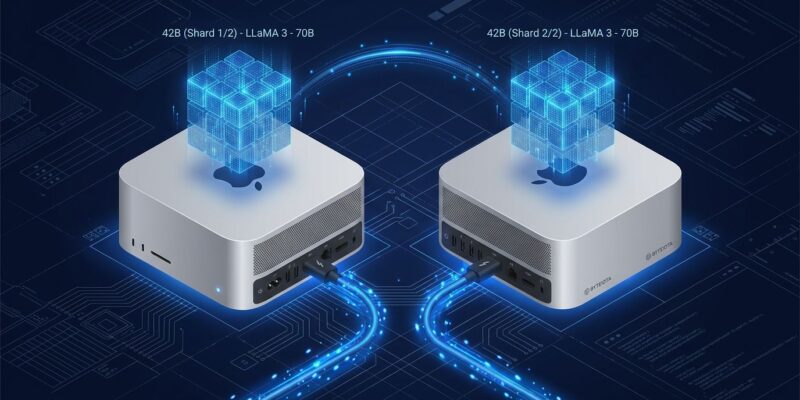
A 4-bit quantized version of Muse Spark Open occupies around 493GB before any runtime overhead. A single M5 Ultra Mac Studio with 512GB of unified memory cannot hold it — you need roughly 19GB of headroom for activations and KV cache. Two 512GB Mac Studios, however, give you 1TB of total memory. That is exactly what this setup is designed for.
Apple and Meta’s Quiet Engineering Partnership
The interesting part of this story is not the model. It is what Apple built to make this possible.
macOS 26.2 shipped a low-latency RDMA (Remote Direct Memory Access) driver over Thunderbolt 5. Apple’s MLX framework (v0.30.1 and later) added a new communication layer called JACCL that uses this driver to do tensor parallelism across physically separate machines. In practice: each Mac Studio holds half the model weights, each runs half the matrix math per forward pass, and they synchronize constantly over two Thunderbolt 5 cables. The data transfer latency is low enough that the two machines behave as a single unified system.
Apple published the MLX distributed inference research alongside the Muse Spark Open launch. This was not an accident. Apple is positioning M-series Mac Studios as enterprise AI inference hardware — not for training, not for the cloud, but for sovereign, on-premises inference that runs on consumer desktops. It is a platform play, and Muse Spark Open is its first flagship demonstration.
The Performance Reality
Two M5 Ultra Mac Studios running the 4-bit model hit 24.99 tokens per second at an 8,192-token context. Four Mac Studios in a cluster hit 36.7 tokens per second with NVFP4 quantization. These are usable speeds for private inference and development workflows. They are not competitive with cloud APIs at scale.
For context: cloud providers (Together AI, Fireworks, Nebius) all price Muse Spark Open identically at $1.25 per million input tokens and $4.25 per million output tokens. To justify $20,000 in hardware over cloud costs, a team would need to push roughly 5.4 billion tokens per month at full utilization. Most teams will use the API. They should.
The License: Permissive, With Strings
The Muse Model License permits free use, copying, fine-tuning, distillation, and building commercial products. Two catches worth knowing: First, if you build a Model-as-a-Service business earning more than $20 million annually, you must notify Meta and negotiate a separate agreement before serving Muse Spark Open. Second, any product that uses the model must display “Built with Muse Spark Open” in the UI or documentation.
These terms are more permissive than most enterprise software licenses. They are not Apache 2.0. The distinction matters if you are building a hosted AI product — know the threshold before you hit it.
Who Should Actually Run This Locally
The honest answer is a short list: research labs that need air-gapped inference, enterprise teams in healthcare, finance, or legal that cannot send data to third-party APIs, and organizations that want to fine-tune a frontier-class open-weight model on proprietary data without routing it through Meta’s servers. For everyone else, the cloud API is the right choice — faster, cheaper at typical usage volumes, and operational immediately.
The broader signal here is not that you should buy two Mac Studios. It is that Apple has built distributed inference infrastructure out of consumer-grade hardware, and it works. The memory requirements will only shrink as quantization improves and M-series memory capacity increases. The pattern Apple established with MLX and RDMA over Thunderbolt 5 will outlast Muse Spark Open itself.
For a full comparison of self-hosting costs vs. cloud API economics, the OpenRouter model page lists all current providers and pricing in one place.